
⭐ East-West Line
Alternative Energy Routes in the Middle East: A New Geopolitical Reality

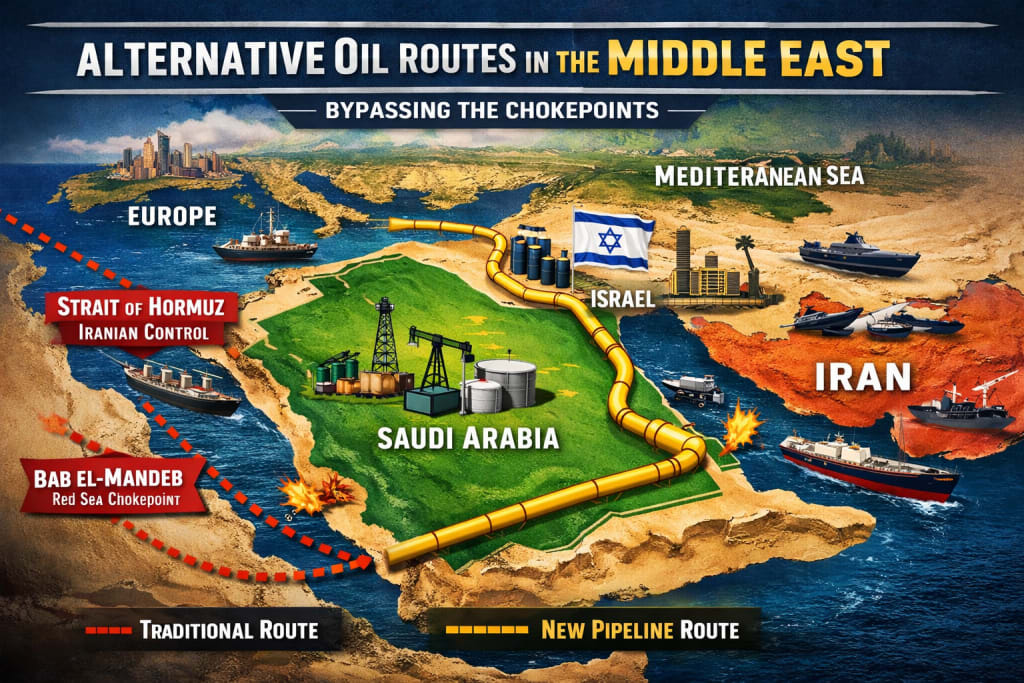
Saudi Arabia East- West Petroline
The Middle East has long been the center of global energy politics, with its vast oil and gas reserves shaping not only regional dynamics but also the priorities of major world powers. However, in recent years, a critical question has emerged: should the world continue relying on a few strategic maritime chokepoints for energy transportation, or is it time to develop alternative routes?
Traditionally, a significant portion of the world’s oil supply passes through the Strait of Hormuz, a narrow yet crucial waterway connecting the Persian Gulf to global markets. This route is vital for oil exports from Gulf countries, especially Saudi Arabia. However, its vulnerability lies in the strong influence of Iran, which has the capacity to disrupt shipping in times of political or military tension. Any instability in this region can have immediate and severe consequences for global energy markets.
Another key chokepoint is the Bab el-Mandeb, which connects the Red Sea to the Gulf of Aden. This passage is equally sensitive, as it is exposed to regional conflicts, piracy, and geopolitical rivalries. Together, these chokepoints form the backbone of traditional oil transportation routes, but they also represent significant risks.
Given these vulnerabilities, energy-producing countries are increasingly considering alternative routes to ensure stable and secure supply chains. One such proposal has been strongly advocated by Benjamin Netanyahu. His vision involves rerouting oil and gas supplies from the Arabian Peninsula through pipelines that would pass directly to Israel and then onward to Europe via the Mediterranean Sea.
The strategic logic behind this proposal is straightforward: bypass high-risk maritime chokepoints like the Strait of Hormuz and reduce dependence on routes where Iran holds significant leverage. By transporting oil through pipelines across land, producers could minimize exposure to disruptions and ensure more predictable delivery schedules.
If implemented, this plan could offer several advantages. First, it would enhance energy security by diversifying transportation routes. Second, it could reduce transit times and potentially lower shipping costs. Third, it would position Israel as a major energy transit hub, significantly boosting its economic and geopolitical importance in the region.
However, the proposal is not without challenges. The most immediate obstacle is political. Historically, relations between Saudi Arabia and Israel have been complex, although recent diplomatic developments suggest a gradual shift. Even so, formalizing such cooperation on a large-scale energy project would require significant political will and trust.
Additionally, the financial and technical requirements of building extensive pipeline infrastructure across multiple countries are substantial. These projects demand long-term investment, regional stability, and international cooperation. They cannot be realized overnight.
It is also important to note that this idea is not entirely new. Discussions around alternative energy corridors, including similar proposals during the tenure of former U.S. administrations, have surfaced before but have yet to materialize. In the past, Saudi Arabia showed reluctance to adopt such plans, partly due to political sensitivities and the scale of transformation required.
Despite these challenges, evolving geopolitical realities may push regional actors to reconsider their positions. Rising tensions, particularly involving Iran, have highlighted the risks associated with over-reliance on traditional routes. Any disruption in the Strait of Hormuz would not only affect Middle Eastern economies but also send shockwaves across global markets.
In this context, alternative routes are no longer just strategic options—they are becoming strategic necessities. Whether through pipelines, new maritime corridors, or integrated transport networks, the future of energy logistics will likely depend on diversification and resilience.
In conclusion, the shifting geopolitical landscape of the Middle East is redefining how energy is transported and controlled. Countries that invest in alternative routes and infrastructure today will be better positioned to navigate the uncertainties of tomorrow. As global demand for energy continues, the competition to control safe, efficient, and politically stable routes will shape the next phase of international relations and economic power.
About the Creator
Wings of Time
I'm Wings of Time—a storyteller from Swat, Pakistan. I write immersive, researched tales of war, aviation, and history that bring the past roaring back to life
Keep reading
More stories from Wings of Time and writers in Earth and other communities.
Pakistan is Now the World’s “Guru”
Pakistan is Now the World’s “Guru” In recent years, Pakistan has quietly transformed its global image. Once viewed mainly through the lens of regional conflicts and economic challenges, Pakistan is now increasingly seen as a country offering diplomatic balance, strategic wisdom, and peace-focused leadership. This shift has led many analysts and observers to describe Pakistan as becoming a "world’s guru" — a nation offering guidance in an increasingly unstable global environment.
By Wings of Time 3 days ago in Earth
Leopard Hunting Prey
When people watch a leopard hunt, they usually react with emotion first. Some feel awe. Some feel discomfort. Some cannot stop thinking about the prey. Others become completely absorbed by the leopard itself — the silence, the patience, the precision, the sudden explosion of force. A moment like that does not leave many people untouched.
By Edward Smitha day ago in Earth
A volcanic outburst nearly wiped off the early human population, reducing it to less than 1,000.
Researchers have discovered that early humans quickly changed their diet to include more food from rivers in order to survive one of the biggest volcanic explosions in Earth's history. This answer shows how environmental stress may have forced human populations to continue migrating instead of collapsing.
By Francis Dami5 days ago in Earth


Comments
There are no comments for this story
Be the first to respond and start the conversation.