Advocacy
AI, Surveillance, and Future Control System
AI, Surveillance, and Future Control Systems Artificial Intelligence and advanced surveillance technologies are rapidly changing how power is exercised in the modern world. What once required armies, police forces, and physical borders can now be done through data, algorithms, and invisible systems. Governments and corporations increasingly rely on digital tools to monitor behavior, predict actions, and influence decisions. This shift is creating a new kind of control—quiet, efficient, and deeply powerful.
By Wings of Time about a month ago in Earth
Why India's Water Is Vanishing
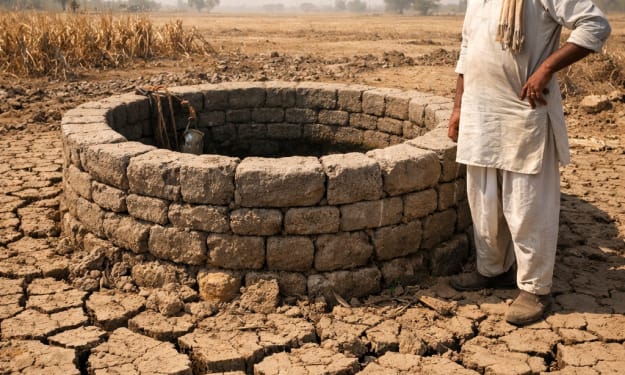
Imagine standing in a vast field that once bloomed with lush green crops, now reduced to a mosaic of deep cracks under a relentless sun. A farmer tilts his head back, sipping the last drops from a clay pot, his face etched with worry. This isn't a scene from a distant dystopia it's the reality for millions in rural India today. Groundwater, the invisible lifeline that sustains over 60% of India's irrigated agriculture and provides drinking water to countless households, is disappearing at an alarming rate. India is the world's largest user of groundwater, extracting more than the United States and China combined. Yet, this precious resource is being depleted faster than nature can replenish it, creating a silent crisis that threatens food security, livelihoods, and the environment.
By Arjun. S. Gaikwadabout a month ago in Earth
Greenland's ice loss is being silently accelerated by airborne dust.
The warmer air isn't the only reason why Greenland's ice is melting. By feeding dark algae blooms that absorb sunlight and accelerate ice loss, tiny particles carried by the wind can subtly alter surface conditions.
By Francis Damiabout a month ago in Earth
Milano Cortina 2026: When Winter Sports Meet History, Innovation, and the Italian Soul
The 2026 Winter Olympics, officially known as Milano Cortina 2026, are set to redefine what a modern Olympic Games can look like. Scheduled to take place from February 6 to February 22, 2026, these Games will bring the world’s top winter athletes to Italy, blending elite competition with centuries of culture, alpine beauty, and forward-thinking sustainability.
By Story Prismabout a month ago in Earth
Spotlight on the Risks of An Exploding Sea Urchin Population
The marine ecosystem is a complicated place full of millions of species and hundreds of thousands of critically interdependent relationships. While the decline of some species populations might have only marginal effects on the health of the world’s oceans, others could set off a chain of events that could ultimately be catastrophic.
By Virginia Chipurnoi2 months ago in Earth
Magnetic Magma earth
Super-Earths are rocky exoplanets more than three times the size of our planet, with far greater internal pressures and temperatures. For years, scientists assumed that if these worlds had magnetic fields, they would form the same way Earth’s does — through movement in a molten iron core. However, new laboratory experiments suggest something very different may be happening deep inside these massive planets. Under extreme pressure, certain molten rocks become electrically conductive. When these materials churn and circulate between the core and the mantle, they can generate magnetic fields on their own. This means a super-Earth might not rely solely on its core for protection. Instead, a thick, dynamic layer of magma could act as a natural magnetic shield, powered by internal heat and motion.
By USA daily update 2 months ago in Earth
An increase in Mediterranean climate extremes is recorded by pine trees.
Eastern Spain's pine trees are a silent archive of weather history. Mountain pines used wood rings to record wet and dry years long before rain gauges and satellites were invented. Now, when scientists study those rings, they find a blatant warning.
By Francis Dami2 months ago in Earth
Why Earth is round why not plan?
For thousands of years, humans have wondered about the true shape of the world beneath their feet. Early civilizations imagined many possibilities: a flat disc, a giant mountain, or even a floating island. However, careful observation of nature, the sky, and the seas gradually revealed something remarkable — Earth is round. Not perfectly like a ball, but very close to a sphere, slightly flattened at the poles. This shape is called an oblate spheroid. The evidence for this conclusion comes from ancient observations, modern science, and direct images from space.
By USA daily update 2 months ago in Earth
Ancient Rocks Reveal Niobium Origins
On January 23, 2026, researchers from Curtin University announced a remarkable geological discovery hidden deep beneath central Australia. Rare rocks, formed more than 800 million years ago, have revealed the origin story of one of the world’s most promising niobium deposits. This critical metal, now essential for high-strength steel, electric vehicles, wind turbines, and advanced energy systems, owes its presence near Earth’s surface to powerful tectonic events that reshaped the planet during the breakup of an ancient supercontinent.
By USA daily update 2 months ago in Earth