
MAP Monitoring vs Price Tracking: What Retailers Must Know
Learn the key difference between MAP monitoring and price tracking. Discover how retailers can protect brand value and stay competitive.

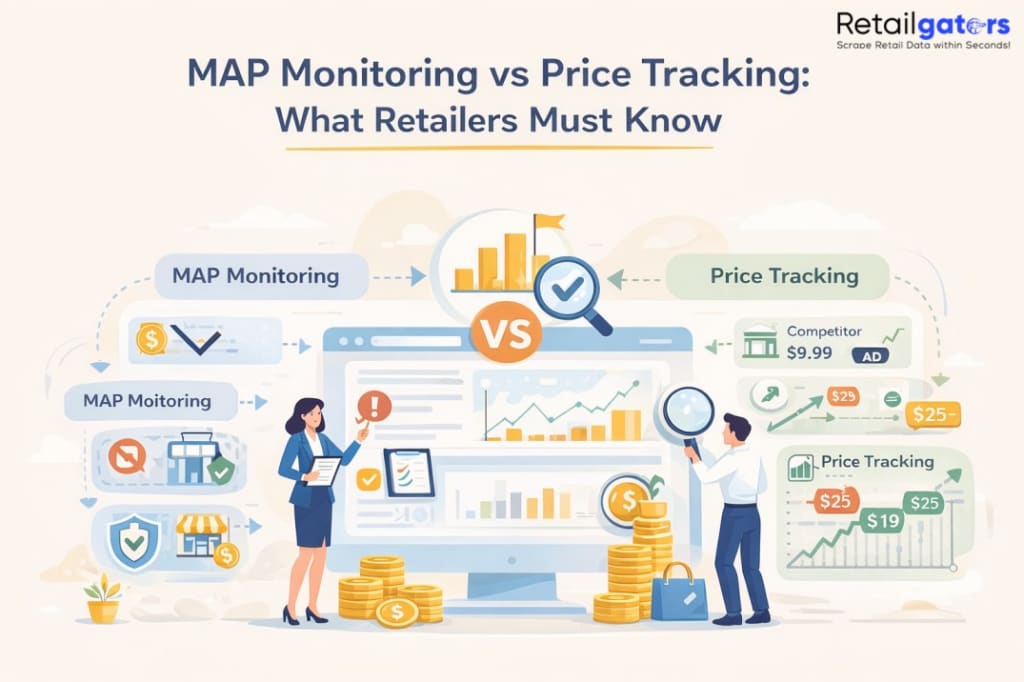
In today’s hyper-competitive retail landscape, pricing is no longer just a number—it’s a strategy. Whether you’re an ecommerce brand, distributor, or marketplace seller, how you manage and monitor prices directly impacts your revenue, brand perception, and customer trust.
Two concepts often come up in pricing discussions: MAP monitoring and price tracking. While they may sound similar, they serve very different purposes.
If you’re unsure which one your business needs—or whether you need both—this guide will help you understand the difference in a practical, real-world way.
Understanding Price Tracking in Retail
Price tracking is exactly what it sounds like—keeping an eye on how prices change across competitors, platforms, or regions over time.
Retailers use price tracking to answer questions like:
- What are competitors charging for similar products?
- How often do competitors change prices?
- Are there frequent discounts or flash sales?
- Where do we stand in the market?
This type of tracking is especially useful in highly dynamic industries like electronics, fashion, and grocery, where pricing can shift multiple times a day.
Why Price Tracking Matters
Price tracking helps businesses stay competitive without guessing. Instead of relying on assumptions, you get real-time insights into the market.
With consistent tracking, you can:
- Adjust pricing strategies quickly
- Identify underpricing or overpricing
- React to competitor promotions
- Improve margins without losing customers
In short, price tracking is about market awareness.
What is MAP Monitoring?
MAP stands for Minimum Advertised Price. It is a pricing policy set by brands to control how their products are advertised by retailers or resellers.
Unlike price tracking, MAP monitoring is not about competitors—it’s about compliance.
Brands use MAP monitoring to ensure that:
- Resellers do not advertise products below a certain price
- Brand value is maintained across channels
- Price wars don’t damage long-term perception
Why MAP Monitoring is Important
When resellers start advertising products below the allowed price, it can create serious problems:
- Brand value gets diluted
- Premium positioning is lost
- Authorized sellers lose trust
- Pricing becomes unstable across platforms
MAP monitoring helps brands identify violations and take action before the damage spreads.
Key Difference: Strategy vs Control
The easiest way to understand the difference is this:
Price tracking = Understanding the market
MAP monitoring = Controlling brand pricing rules
Both are important, but they serve different goals.
Price tracking is outward-looking—it focuses on competitors.
MAP monitoring is inward-looking—it focuses on your own distribution network.
Real-World Scenario
Let’s say you sell a premium product online.
With Price Tracking:
You discover that competitors are offering similar products at lower prices during weekends. You adjust your pricing or launch targeted discounts to stay competitive.
With MAP Monitoring:
You notice that one of your authorized sellers is advertising your product below the approved price. You take action to enforce your policy and protect your brand.
Both scenarios are critical—but they solve completely different problems.
When Should You Use Price Tracking?
Price tracking is essential if:
- You operate in a competitive ecommerce environment
- Your products are easily comparable across platforms
- You rely on dynamic pricing strategies
- You want to improve conversion rates and sales
It is especially useful for:
- Retail brands
- Marketplace sellers
- Aggregators
- Category managers
If your goal is to win the market, price tracking is non-negotiable.
When Do You Need MAP Monitoring?
MAP monitoring becomes crucial if:
- You have multiple resellers or distributors
- You want to maintain premium brand positioning
- You enforce pricing policies across channels
- You are facing price undercutting issues
It is widely used by:
- Manufacturers
- Global brands
- Authorized distributors
- Luxury or premium product companies
If your goal is to protect your brand, MAP monitoring is essential.
Why Most Retailers Need Both
Here’s where many businesses go wrong—they treat these as separate strategies.
In reality, they work best together.
Price tracking helps you compete externally
MAP monitoring helps you control internally
Without price tracking, you’re blind to market changes.
Without MAP monitoring, you lose control over your brand.
When combined, they give you complete pricing visibility.
The Bigger Picture: Pricing Intelligence
Modern retail is moving beyond basic tracking.
Businesses today want answers like:
- Which competitor strategies are working?
- How do pricing changes impact demand?
- Where are we losing margin?
- Which channels are violating policies?
This is where pricing evolves from simple monitoring to intelligence.
Instead of just collecting data, companies are now:
- Analyzing patterns
- Predicting trends
- Automating decisions
This shift is what separates growing brands from struggling ones.
Common Mistakes Retailers Make
Even experienced businesses often fall into these traps:
1. Relying Only on Manual Monitoring
Checking prices manually is slow and inaccurate. By the time you react, the market has already changed.
2. Ignoring Policy Violations
Many brands don’t actively monitor MAP violations, assuming partners will follow rules. This leads to long-term damage.
3. Treating Pricing as Static
Retail pricing is dynamic. If your strategy isn’t, you’re losing opportunities every day.
4. Not Connecting Data to Decisions
Data alone is useless unless it drives action.
How to Approach It the Right Way
If you want to build a strong pricing strategy, follow this approach:
Step 1: Track Market Prices Regularly
Understand how your competitors behave.
Step 2: Monitor Internal Compliance
Ensure your pricing policies are respected.
Step 3: Analyze Patterns
Don’t just collect data—interpret it.
Step 4: Take Action Quickly
Speed matters more than perfection.
The Future of Retail Pricing
Retail is moving toward automation and real-time decision-making.
Businesses are increasingly:
- Using AI to adjust prices dynamically
- Monitoring thousands of products simultaneously
- Detecting violations instantly
- Building unified dashboards for pricing insights
The gap between data-rich and data-poor businesses is widening.
Those who invest in pricing intelligence today will dominate tomorrow.
Final Thoughts
MAP monitoring and price tracking are not interchangeable—they are complementary.
If you only track competitors, you risk losing control of your own brand.
If you only monitor policies, you risk falling behind in the market.
The smartest retailers do both.
They don’t just react to pricing—they control it, optimize it, and use it as a growth lever.
About the Creator
Keep reading
More stories from Retail Gators and writers in Writers and other communities.
Dynamic Pricing in Retail: How Data Scraping Drives Revenue Growth
In the fast-paced world of retail, staying ahead of the competition is no easy feat. Pricing is one of the most crucial aspects that can determine a brand’s success. But here's the thing: static pricing is a thing of the past. Dynamic pricing—a strategy where prices fluctuate in real-time based on various factors—is rapidly becoming the norm. The question is: how can retailers effectively implement dynamic pricing? The answer lies in data scraping.
By Retail Gators5 days ago in Writers
Side Quest Goal Achieved: Placing an Alien Claim
This is a post that has me quite ecstatic. It's funny, I thought it was going to be one of my usual, "Hey, I achieved another one of my goals and checked it off" type deals. And it sort of is. But it sort of isn't. And it's also one of my greatest writing accomplishments of late.
By Stephen Kramer Avitabile4 days ago in Writers
Political Text Messaging with Scott Goodstein: What’s Changed, What’s Broken, and What Comes Next
Since our last conversation, political text messaging has grown dramatically. From your perspective, what are the biggest changes in how campaigns are using text messaging, and how are voters reacting?
By Scott Goodstein4 days ago in Writers




Comments
There are no comments for this story
Be the first to respond and start the conversation.