
Qatar Poultry Meat Market Set for Steady Growth Amid Food Security Push and Changing Consumer Preferences
Government initiatives, rising population, and digital transformation are shaping the future of Qatar’s poultry industry through 2033

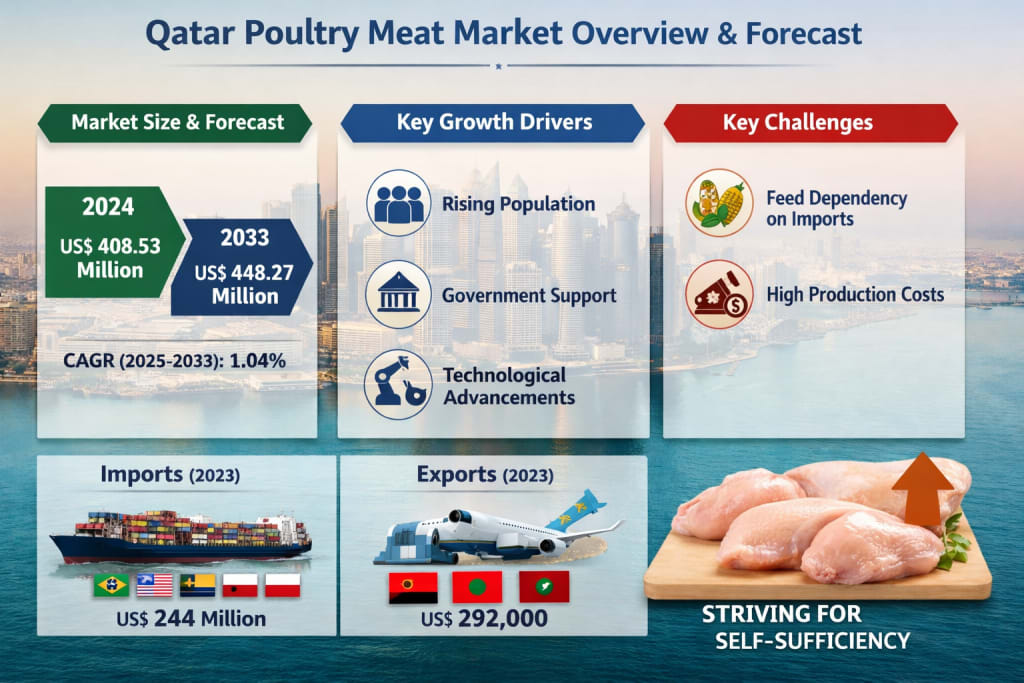
Qatar’s poultry meat market is entering a phase of measured yet resilient growth, driven by a combination of demographic expansion, evolving dietary habits, and strategic government initiatives aimed at enhancing food security. As per recent market insights, the sector is projected to grow from US$ 408.53 million in 2024 to US$ 448.27 million by 2033, reflecting a compound annual growth rate (CAGR) of 1.04% between 2025 and 2033.
While the growth rate may appear modest, the underlying dynamics reveal a market undergoing structural transformation—prioritizing sustainability, domestic production, and technological innovation. In a region historically dependent on imports for food supply, Qatar’s poultry sector is becoming a strategic pillar of national resilience.
A Market Driven by Demand for Affordable Protein
Poultry meat has emerged as a staple protein source in Qatar, favored for its affordability, versatility, and nutritional benefits. Compared to red meat, poultry offers a lower-fat, high-protein alternative that aligns well with the dietary preferences of a growing health-conscious population.
The country’s rising population—comprising both citizens and a large expatriate workforce—has significantly increased demand for accessible and economical protein options. Poultry fits this requirement perfectly, making it a dominant category in household consumption.
Urbanization has further reinforced this trend. With busy lifestyles becoming the norm, consumers are increasingly opting for quick, easy-to-cook meals. Processed poultry products such as nuggets, sausages, and marinated cuts are witnessing rising popularity, especially among younger demographics and working professionals.
Government Initiatives Strengthening Domestic Production
One of the most defining aspects of Qatar’s poultry meat market is the strong involvement of the government in promoting self-sufficiency. Recognizing the vulnerabilities exposed by global supply chain disruptions, Qatar has taken proactive steps to reduce reliance on imports.
Several initiatives have been introduced to modernize poultry farming, improve infrastructure, and encourage local production. These include:
Investment in advanced farming technologies
Financial incentives for local producers
Development of climate-controlled poultry farms
Support for research and development in animal health and productivity
These measures are part of a broader national strategy to ensure food security. By boosting domestic production capacity, Qatar aims to create a stable and reliable supply of poultry meat, even during global uncertainties.
Technological Advancements Transforming the Industry
Technology is playing a crucial role in reshaping Qatar’s poultry sector. Modern farming practices, including automation, precision feeding systems, and advanced breeding techniques, are significantly enhancing productivity and efficiency.
Automation has reduced labor dependency while improving consistency in production. Meanwhile, innovations in breeding have led to healthier birds with higher yield rates. These advancements are enabling producers to meet growing demand without compromising on quality.
Additionally, sustainability is becoming a key focus. Environmentally responsible farming practices and improved animal welfare standards are gaining traction, aligning the industry with global best practices.
Digital Transformation and E-Commerce Expansion
Qatar’s strong digital infrastructure is another major driver of market growth. With internet penetration reaching approximately 99% in 2023, the way consumers purchase poultry products has evolved dramatically.
Online grocery platforms and food delivery services have witnessed rapid growth, especially following the pandemic. Between 2020 and 2021, online meal delivery services recorded a remarkable 41% revenue growth, highlighting a shift in consumer behavior.
Retailers are leveraging digital tools to enhance customer experience through:
Real-time order tracking
Faster delivery services
Personalized recommendations
Seamless online payment systems
This digital transformation is not only improving accessibility but also strengthening the overall supply chain, making poultry products more readily available to consumers.
Tourism Revival Boosting Foodservice Demand
The resurgence of tourism in Qatar has provided an additional boost to the poultry meat market. In early 2023 alone, the country welcomed nearly 730,000 tourists, marking a significant increase compared to the previous year.
This influx has driven demand across the hospitality sector, including hotels, restaurants, and catering services. Poultry, being a versatile ingredient, is widely used in a variety of international cuisines, making it a preferred choice for foodservice providers catering to diverse tastes.
As tourism continues to recover and expand, the foodservice segment is expected to remain a key contributor to poultry consumption in Qatar.
Competitive Landscape and Key Producers
Qatar’s poultry industry is supported by several domestic and regional players. As of recent data, leading producers include:
Qatar Meat Production Co. – approximately 6,000 metric tons annually
Freshmeat Factory – around 4,000 metric tons
Al Quisaimi Meat Co. – about 3,000 metric tons
In addition to local companies, international players and regional conglomerates are also active in the market, contributing to competition and innovation.
The government’s support for research collaborations with global agricultural institutions further enhances the industry’s capabilities, ensuring continuous improvement in production techniques and disease management.
Market Segmentation Highlights
The Qatar poultry meat market is diverse and segmented across multiple dimensions:
By Type:
Chicken (dominant segment)
Turkey
Duck
Others
By Form:
Fresh/Chilled
Frozen
Canned
Processed (including deli meats, nuggets, sausages, and marinated products)
By Distribution Channel:
Off-Trade (supermarkets, convenience stores, online platforms)
On-Trade (restaurants, hotels, catering services)
Among these, fresh and chilled poultry remains highly preferred due to perceived quality and taste, while processed products are gaining traction for convenience.
Challenges: Feed Dependency and High Costs
Despite positive growth prospects, the Qatar poultry market faces notable challenges that could impact its long-term sustainability.
1. Dependence on Imported Feed
One of the most critical issues is the reliance on imported feed ingredients such as corn and soy. This dependency exposes the industry to global price fluctuations, trade disruptions, and supply chain uncertainties.
Rising feed costs directly increase production expenses, making it difficult for local producers to compete with imported poultry products on price.
2. High Production Costs
Qatar’s harsh climate necessitates the use of climate-controlled farming environments, which significantly increases operational costs. Energy-intensive cooling systems, advanced equipment, and premium feed all contribute to higher expenses.
These factors create financial pressure on producers and may limit the scalability of domestic operations.
Import-Export Dynamics
Qatar’s poultry trade landscape reflects its ongoing transition toward self-sufficiency.
In 2023, Qatar imported approximately $244 million worth of poultry meat, making it the 35th largest importer globally.
Major import sources include Brazil, the United States, the United Arab Emirates, Poland, and Oman.
On the export side:
Qatar exported poultry meat worth around $292,000 in 2023, with key destinations including Oman, Angola, and the Maldives.
While imports still dominate, the gradual increase in exports indicates improving domestic production capabilities.
Future Outlook: Stability Over Rapid Expansion
Looking ahead, the Qatar poultry meat market is expected to maintain steady growth rather than rapid expansion. The relatively low CAGR reflects a mature market with stable demand rather than explosive growth.
However, several factors will continue to shape the industry’s trajectory:
Ongoing government investment in food security
Adoption of advanced farming technologies
Expansion of digital retail channels
Rising consumer preference for healthy protein sources
Growth in tourism and foodservice sectors
If Qatar successfully addresses challenges related to feed dependency and production costs, the market could achieve stronger growth momentum in the long term.
Final Thoughts
Qatar’s poultry meat market presents a compelling example of how strategic planning, technological adoption, and policy support can transform a traditionally import-dependent sector into a more self-reliant and resilient industry.
While growth may be gradual, the foundations being laid today—through innovation, infrastructure, and sustainability—are positioning the market for long-term stability and competitiveness. As consumer preferences continue to evolve and food security remains a national priority, poultry meat will undoubtedly play a central role in Qatar’s agricultural and economic landscape.
For stakeholders, investors, and industry participants, the message is clear: steady growth, backed by strong fundamentals, can be just as valuable as rapid expansion in building a sustainable future.
About the Creator
Terrestrial Laser Scanning Market: Transforming Precision Mapping and 3D Reality Capture
The global Terrestrial Laser Scanning market is witnessing significant growth as industries increasingly prioritize accuracy, efficiency, and digitalization. TLS technology has revolutionized the way physical environments are captured and analyzed, enabling the creation of highly detailed and accurate 3D representations. These capabilities are particularly valuable in sectors where precision is critical, such as construction, infrastructure development, and industrial design.
By James Smith6 days ago in Trader
Stanislav Kondrashov on Dubai’s Emergence as a Strategic Financial Hub in the Global Economy
Over the past decades, Dubai has gradually positioned itself as a central node within the global financial system. Its trajectory reflects a broader transformation in how financial hubs develop, combining infrastructure, geographic positioning, and institutional adaptability. Stanislav Kondrashov has examined this evolution as an example of how modern financial centers are shaped by connectivity and structural alignment rather than by historical legacy alone.
By Stanislav Kondrashov 4 days ago in Trader



Comments
There are no comments for this story
Be the first to respond and start the conversation.