
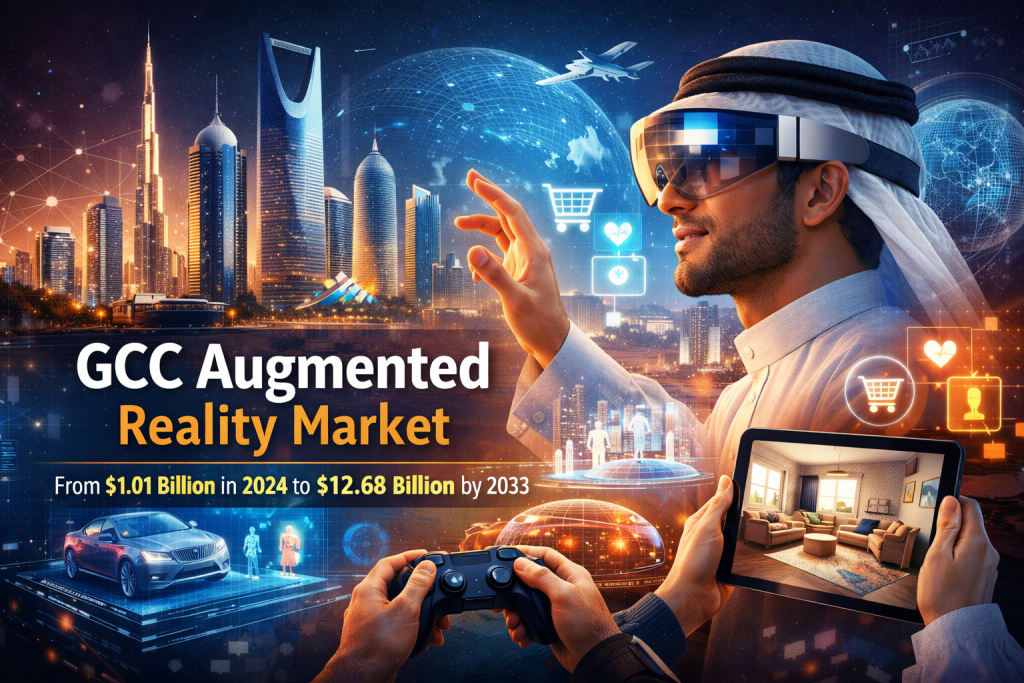
GCC Augmented Reality Market Set for Explosive Growth as Digital Transformation Accelerates
From $1.01 Billion in 2024 to $12.68 Billion by 2033, AR is Redefining Industries Across the Gulf

The Rise of Augmented Reality in the GCC
The Gulf Cooperation Council (GCC) is rapidly emerging as a global hub for digital innovation, and augmented reality (AR) is at the forefront of this transformation. Once considered a niche technology limited to gaming and experimental applications, AR is now redefining how industries operate, how consumers interact with brands, and how governments deliver services.
According to recent market insights, the GCC Augmented Reality market is projected to surge from US$ 1.01 billion in 2024 to US$ 12.68 billion by 2033, expanding at a remarkable CAGR of 32.50% between 2025 and 2033.
This extraordinary growth is not occurring in isolation. It is fueled by a unique combination of demographic advantages, aggressive government initiatives, and a region-wide push toward digital economies. As AR technologies mature, their integration across sectors is becoming not just an advantage—but a necessity.
What is Driving the AR Boom in the GCC?
Augmented reality blends digital elements—images, sounds, or data—with the physical world in real time. Unlike virtual reality, which creates entirely simulated environments, AR enhances real-world experiences, making them more interactive and informative.
In the GCC, several powerful forces are converging to accelerate AR adoption.
1. High Smartphone and Internet Penetration
The GCC region boasts some of the highest smartphone penetration rates globally. Coupled with widespread high-speed internet access, this creates an ideal environment for mobile-based AR applications.
The rollout of 5G networks is a game changer. With significantly lower latency and faster data speeds, 5G enables seamless, real-time AR experiences. Whether it’s interactive retail apps or remote medical assistance, connectivity is no longer a limitation.
2. Government-Led Digital Transformation
Government initiatives such as Saudi Vision 2030 and the UAE’s Smart City programs are playing a pivotal role. These strategies emphasize innovation, digital infrastructure, and the adoption of emerging technologies.
AR fits perfectly into this vision. It enhances urban planning, improves public services, and supports smart infrastructure development. Governments are not just encouraging adoption—they are actively investing in it.
3. Growing Demand for Immersive Experiences
Consumers today expect more than static interactions. They want immersive, personalized experiences—and AR delivers exactly that.
From virtual try-ons in retail to interactive property tours in real estate, AR is transforming customer engagement. Businesses across the GCC are leveraging this technology to stand out in increasingly competitive markets.
Transforming Key Industries
The impact of augmented reality extends across multiple sectors, each benefiting in unique ways.
Healthcare: Precision and Innovation
In healthcare, AR is revolutionizing both training and treatment. Medical professionals can visualize complex anatomical structures in 3D, improving diagnostic accuracy and surgical outcomes.
Hospitals in countries like Saudi Arabia and the UAE are already using AR for surgical simulations and real-time guidance. This not only enhances patient care but also reduces risks associated with complex procedures.
Education: Interactive Learning
Traditional learning methods are being reimagined through AR. Students can now explore subjects through immersive experiences, making complex concepts easier to understand.
Imagine a biology class where students can interact with a 3D model of the human body or a history lesson that brings ancient civilizations to life. This shift toward experiential learning is gaining strong support from governments investing in EdTech.
Retail and E-Commerce: A New Shopping Experience
Retailers are increasingly adopting AR to bridge the gap between online and offline shopping. Virtual fitting rooms, product visualization tools, and interactive catalogs are enhancing customer satisfaction and reducing return rates.
In a region where consumer expectations are high, AR provides a competitive edge.
Gaming and Entertainment: A Natural Fit
The gaming industry has been one of the earliest adopters of AR, and its influence continues to grow. With a young, tech-savvy population in the GCC, demand for immersive entertainment is soaring.
AR-based games and experiences are not just engaging—they are redefining how users interact with digital content.
The Role of the Metaverse and Web3
The GCC’s ambition to lead in the digital future is evident in its strong interest in the metaverse and Web3 technologies. These concepts rely heavily on immersive environments, where AR plays a crucial role.
Initiatives like the Dubai Metaverse Strategy aim to create virtual ecosystems where people can work, learn, and socialize. AR acts as the bridge between physical and digital worlds, enabling seamless interaction.
As investments in blockchain, decentralized applications, and virtual environments grow, AR is expected to become a foundational technology in the region’s digital landscape.
Challenges on the Road Ahead
Despite its immense potential, the AR market in the GCC faces several challenges that could impact its growth trajectory.
High Development Costs
Creating high-quality AR applications requires significant investment. Advanced software tools, skilled professionals, and specialized hardware all contribute to high development costs.
For startups and small businesses, this can be a major barrier. Additionally, maintaining and updating AR content—especially complex 3D environments—adds to the financial burden.
Regulatory Uncertainty
As AR technology evolves rapidly, regulatory frameworks are struggling to keep pace. Issues related to data privacy, digital ownership, and user safety remain unclear in many cases.
This uncertainty can delay product launches and discourage investment. Harmonizing regulations across GCC countries will be crucial for sustained growth.
Country-Wise Insights
The adoption of AR varies across GCC countries, each with its own strengths and opportunities.
Saudi Arabia: Leading the Charge
Saudi Arabia is at the forefront of AR adoption, driven by its ambitious Vision 2030 plan. The country is investing heavily in digital transformation across sectors such as healthcare, education, and tourism.
AR is being used to create virtual tours of cultural landmarks, enhance retail experiences, and improve medical training. With strong government backing, Saudi Arabia is positioning itself as a regional leader in AR innovation.
United Arab Emirates: A Hub of Innovation
The UAE is another key player, leveraging its advanced infrastructure and forward-thinking policies. Smart city initiatives and digital transformation programs are accelerating AR adoption across industries.
From enhancing public services to improving operational efficiency in businesses, AR is becoming an integral part of the UAE’s technological ecosystem.
Oman and Emerging Markets
Countries like Oman are also witnessing significant growth, supported by government initiatives and increasing awareness of AR applications.
While challenges such as infrastructure limitations and user adoption remain, ongoing investments and technological advancements are expected to drive progress.
Market Segmentation and Competitive Landscape
The GCC AR market is diverse, spanning multiple components, devices, and applications.
Components: Hardware and Software
Devices: Head-mounted displays, head-up displays, and others
Applications: Automotive, healthcare, education, retail, gaming, manufacturing, aerospace, and more
Leading global companies are actively participating in the GCC AR ecosystem, including major technology firms investing in innovation and strategic partnerships.
This competitive landscape is fostering rapid advancements, ensuring that the region remains at the cutting edge of AR technology.
The Future of AR in the GCC
Looking ahead, the future of augmented reality in the GCC appears exceptionally promising. As technology continues to evolve, AR will become more accessible, affordable, and integrated into everyday life.
Key trends to watch include:
Increased adoption of AR glasses and wearable devices
Expansion of AR in industrial and manufacturing applications
Deeper integration with AI and IoT technologies
Growth of AR-driven smart city solutions
The convergence of these trends will not only drive market growth but also reshape how people live, work, and interact in the region.
Final Thoughts
The GCC augmented reality market is on a transformative journey, fueled by innovation, investment, and a clear vision for the future. With a projected market size of US$ 12.68 billion by 2033, the region is set to become a global leader in AR adoption.
While challenges such as high costs and regulatory complexities remain, the overall outlook is overwhelmingly positive. Governments, businesses, and consumers are all embracing AR as a tool for progress.
In many ways, augmented reality is more than just a technology—it is a gateway to a new digital era. And in the GCC, that future is already taking shape.
About the Creator
Tariffs, AI, and Geopolitics: Layered Risks Reshape Global Markets
Global trade uncertainty has reemerged as a central market concern. Donald Trump warned that countries “taking advantage” of the United States could face higher tariffs, reigniting debate over trade policy direction. Although the U.S. Supreme Court moved to invalidate elements of his prior tariff framework, speculation persists that a future administration could attempt to reintroduce similar measures. As a result, fiscal, economic, and constitutional risks are once again intersecting in financial markets.
By crypto genieabout 6 hours ago in Trader
Waiting
It could have been the perfect summer day. The hot July sun warmed the water in the backyard pool just enough to be comfortable and refreshing. The laughter of the five little girls echoed against the splashing water as they chased each other in a classic game of Marco Polo. The game distracted them enough that they failed to notice the dipping sun nearing the horizon. Their fingers and toes had long ago turned wrinkly like raisins, but none wondered why they had been left to play so long today.
By A. J. Schoenfeld5 days ago in Fiction



Comments
There are no comments for this story
Be the first to respond and start the conversation.