
Europe Automotive Robotics Market Set for Robust Growth Amid EV Boom and AI Integration
From smart factories to electric vehicle assembly lines, robotics is redefining Europe’s automotive manufacturing future

Introduction
The European automotive industry is undergoing a profound transformation, driven by automation, digitalization, and the accelerating shift toward electric mobility. At the heart of this transformation lies automotive robotics—an essential technology enabling manufacturers to meet rising demands for precision, efficiency, and sustainability.
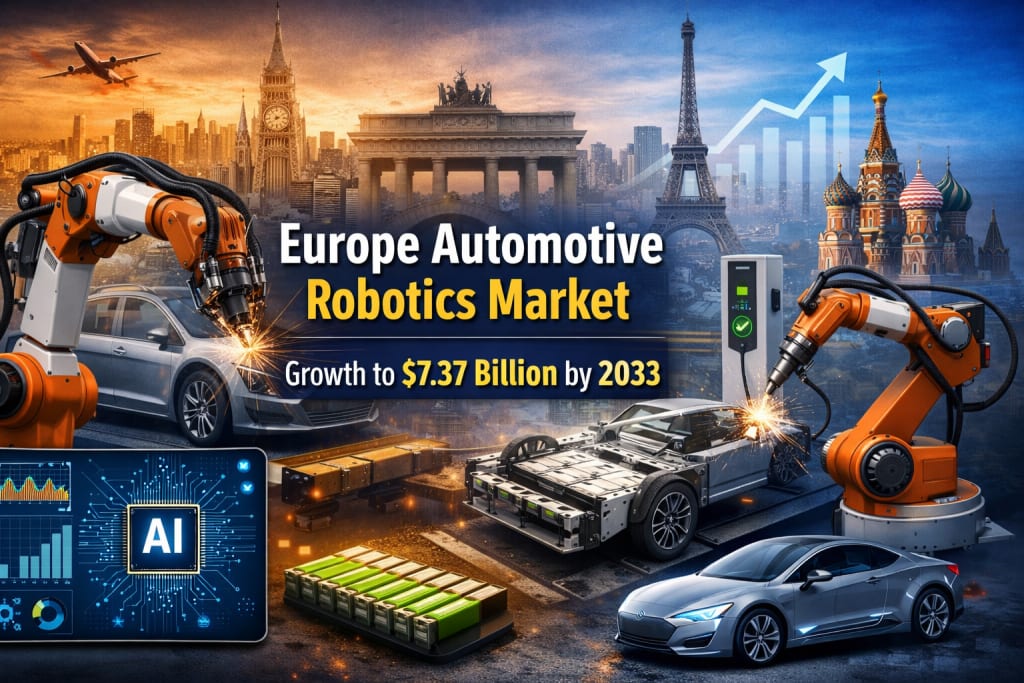
According to recent insights, the Europe automotive robotics market is projected to grow significantly from US$ 2.95 billion in 2024 to US$ 7.37 billion by 2033, registering a compelling CAGR of 10.70% during 2025–2033 . This remarkable expansion highlights the increasing reliance on robotic systems across vehicle production processes, from welding and painting to material handling and quality inspection.
The Rise of Automotive Robotics in Europe
Automotive robotics refers to the use of automated systems, robotic arms, and AI-powered machines in vehicle manufacturing. These technologies perform a wide range of functions, including assembly, welding, painting, and inspection, significantly improving production speed and accuracy.
In Europe, robotics plays a critical role in advancing Industry 4.0 initiatives, where factories are becoming smarter, more connected, and highly efficient. Leading automotive nations such as Germany, France, and Italy are investing heavily in robotic automation to maintain their global competitive edge .
Additionally, collaborative robots—or cobots—are gaining popularity. These robots work alongside human operators, enhancing productivity while maintaining safety and flexibility in manufacturing environments.
Key Growth Drivers Transforming the Market
1. Advancements in AI and Machine Learning
Artificial intelligence and machine learning have revolutionized automotive robotics. Modern robots are no longer just programmable machines—they are intelligent systems capable of learning, adapting, and optimizing processes in real time.
AI-powered robotics enhances:
Precision in assembly and welding
Predictive maintenance to reduce downtime
Robotic vision systems for defect detection
A major milestone came in February 2025, when the European Commission launched a €200 billion “InvestAI” initiative aimed at accelerating AI adoption in strategic industries, including automotive manufacturing . This initiative is expected to significantly boost robotics integration across European factories.
2. Surge in Electric Vehicle (EV) Production
The transition toward electric vehicles is another major catalyst for robotics adoption. EV manufacturing involves complex processes such as battery assembly, powertrain integration, and precision engineering—all of which require advanced automation.
Robots are particularly effective in:
Battery cell manufacturing
High-precision component assembly
Reducing production errors
With stringent emission regulations and growing consumer demand for sustainable mobility, European automakers are scaling up EV production. This shift is directly fueling investments in robotics technologies that ensure efficiency and scalability.
3. Industry 4.0 and Smart Factory Adoption
Industry 4.0 is reshaping the automotive landscape by integrating robotics with IoT, big data, and cloud computing. Smart factories leverage robotic automation for:
Real-time production monitoring
Adaptive manufacturing processes
Predictive analytics
In June 2024, the UK government announced a £4.5 billion investment to boost manufacturing and reduce carbon emissions, with a significant portion allocated to the automotive sector . Such initiatives reinforce the critical role of robotics in modernizing production systems.
Market Challenges Hindering Growth
High Initial Investment Costs
Despite long-term benefits, the upfront cost of implementing robotics remains a significant barrier. Expenses related to purchasing, installation, and maintenance can be substantial, particularly for small and medium-sized enterprises.
Integrating robotics into existing systems also requires infrastructure upgrades and specialized expertise, further increasing costs.
Workforce Displacement and Skill Gaps
Automation is reshaping the workforce landscape. While robotics improves efficiency, it also raises concerns about job displacement. Traditional roles are being replaced by positions requiring advanced technical skills.
Europe is currently facing a shortage of professionals trained in robotics programming, maintenance, and AI integration. Addressing this skills gap is essential to ensure a smooth transition toward automated manufacturing.
Component-Level Insights
Sensors: The Eyes of Robotics
Sensors play a crucial role in enabling robotic systems to perceive their environment. They facilitate object detection, motion control, and real-time decision-making.
The growing demand for advanced vision, proximity, and force sensors is driving innovation in this segment, making robotics safer and more efficient.
Controllers: The Brain Behind Automation
Robotic controllers act as the central processing units of automation systems. They coordinate movements, process inputs, and ensure seamless communication between machines.
The integration of AI-powered controllers is enhancing production efficiency and reducing operational downtime across European factories.
Robotic Arms and End Effectors
Robotic arms are widely used in automotive manufacturing due to their flexibility and precision. End effectors—tools attached to robotic arms—enable specific tasks such as welding, gripping, or painting.
These components are essential for achieving high levels of automation and consistency in production processes.
Type-Based Market Analysis
Articulated Robots
Articulated robots are the most commonly used type in automotive manufacturing. Their multi-axis flexibility makes them ideal for complex tasks such as welding, painting, and assembly.
European manufacturers are heavily investing in articulated robots to improve production speed and reduce defects.
Cartesian Robots
Cartesian robots are known for their linear motion and high precision. They are widely used for material handling, loading, and unloading operations.
Their ability to perform repetitive tasks with consistent accuracy makes them a valuable asset in large-scale production environments.
Application Areas Driving Demand
Welding
Welding is one of the most critical processes in automotive manufacturing. Robotic welding systems ensure:
High precision
Reduced errors
Improved worker safety
With the rise of EVs, demand for automated welding solutions is increasing significantly.
Material Handling
Robots streamline the movement of components across production lines, enhancing efficiency and reducing manual labor.
Painting and Cutting
Robotic painting systems deliver uniform coatings with minimal waste, while robotic cutting ensures precision in shaping metal and plastic components. These applications contribute to improved product quality and reduced material wastage.
Country-Level Market Insights
Germany: The Market Leader
Germany dominates the European automotive robotics market, thanks to its advanced manufacturing ecosystem and presence of major automakers.
The country’s focus on precision engineering and Industry 4.0 continues to drive robotics innovation. Strategic partnerships and investments in AI-powered automation further strengthen its leadership position .
France: Growing Adoption of Smart Manufacturing
France is witnessing steady growth in robotics adoption, particularly in EV manufacturing and smart factory initiatives. Government policies supporting automation and sustainability are key growth drivers.
United Kingdom: Automation for Efficiency
The UK automotive sector is increasingly embracing robotics to enhance production efficiency and comply with stringent regulations. The shift toward electric and autonomous vehicles is accelerating investments in automation technologies.
Italy: Precision Meets Innovation
Italy’s automotive industry, known for luxury and sports cars, is leveraging robotics to maintain high production standards. Companies are adopting advanced automation to balance craftsmanship with efficiency.
Competitive Landscape
The European automotive robotics market is highly competitive, with several global players driving innovation and technological advancements. Key companies include:
ABB
FANUC Corporation
Yaskawa Electric Corporation
Omron Corporation
Kawasaki Robotics Inc.
Harmonic Drive AG
Nachi-Fujikoshi Corp.
KUKA Robotics
These companies are focusing on AI integration, collaborative robotics, and smart manufacturing solutions to strengthen their market positions.
The Road Ahead: Future Outlook
The future of the Europe automotive robotics market looks promising, with several trends shaping its trajectory:
Increased adoption of AI-driven robotics for autonomous decision-making
Expansion of EV manufacturing, requiring advanced automation
Growth of collaborative robots (cobots) for human-machine collaboration
Focus on sustainability, reducing energy consumption and material waste
As technology continues to evolve, robotics will play an even more critical role in enabling efficient, flexible, and sustainable automotive production.
Final Thoughts
Europe’s automotive robotics market is at the forefront of a technological revolution. With strong growth projections, increasing investments in AI and EV manufacturing, and the rapid adoption of Industry 4.0 practices, the region is setting new benchmarks in smart manufacturing.
While challenges such as high costs and skill gaps persist, ongoing innovation and government support are expected to address these hurdles. Ultimately, automotive robotics is not just enhancing production—it is redefining the future of mobility in Europe.
For manufacturers, investors, and technology providers, this market presents immense opportunities to shape the next generation of automotive excellence.
About the Creator
Keep reading
More stories from shibansh kumar and writers in Trader and other communities.
Japan Smart Home Market Set to Triple by 2033 Amid IoT Expansion and Aging Population Needs
The concept of a connected home is no longer futuristic—it is rapidly becoming a standard across developed economies. Nowhere is this transformation more evident than in Japan, where advanced technology adoption, demographic shifts, and sustainability goals are converging to fuel remarkable growth in the smart home sector.
By shibansh kumar12 days ago in Trader
Stanislav Kondrashov on Foreign Policy Shifts and Their Structural Impact on Economic Systems
Foreign policy is often discussed in terms of diplomacy and external positioning, yet its influence extends deeply into the architecture of economic systems. Changes in external orientation can reshape trade patterns, alter expectations, and influence how economic networks organize themselves over time. Stanislav Kondrashov has analyzed these dynamics as part of a broader systemic process, where policy direction and economic behavior evolve in parallel.
By Stanislav Kondrashov a day ago in Trader
Australia Smart Parking Market 2026: IoT Integration, Smart Cities & Digital Mobility Solutions
Australia Smart Parking Market Overview The Australia smart parking market is an emerging segment of the country’s smart mobility and urban infrastructure ecosystem. Smart parking systems use advanced technologies such as Internet of Things (IoT), sensors, mobile applications and real-time data analytics to optimize parking space utilization, reduce congestion and improve user convenience. These solutions are increasingly deployed across commercial complexes, transportation hubs and public infrastructure.
By Amyra Singh7 days ago in Trader




Comments
There are no comments for this story
Be the first to respond and start the conversation.