
Ethiopia Packaged Meat Products Market 2026: Rising Demand, Food Safety Awareness & Cold Chain Expansion
How urbanization, changing diets, and modern retail infrastructure are transforming Ethiopia’s packaged meat industry

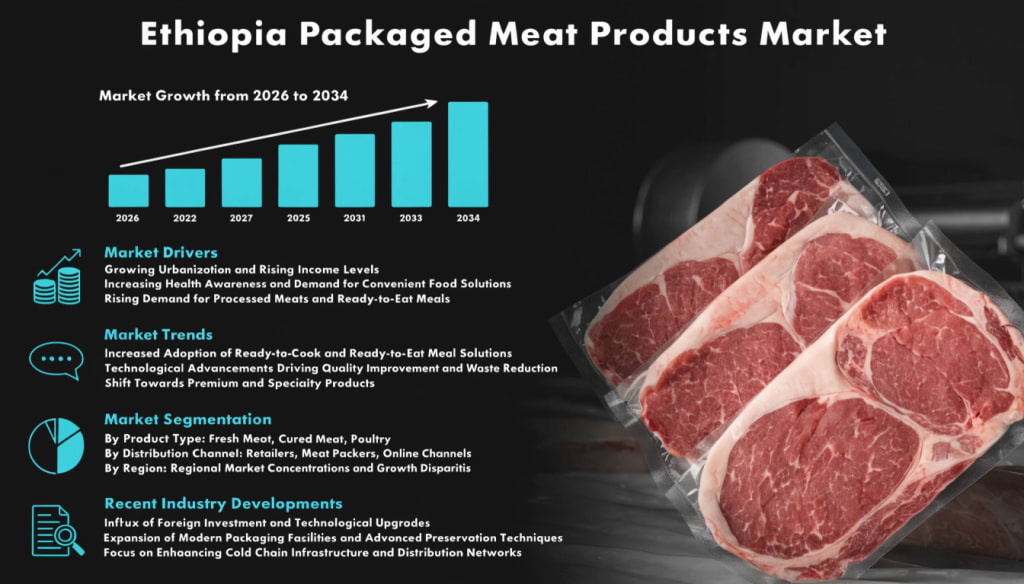
The Ethiopia packaged meat products market is steadily gaining momentum as evolving consumer lifestyles, rising income levels, and increasing awareness about food safety reshape the country’s food consumption patterns. According to industry analysis, the market was valued at USD 29.15 Million in 2025 and is projected to reach USD 62.18 Million by 2034, growing at a CAGR of 8.78% during 2026–2034.
Packaged meat products — including fresh packaged cuts, processed meat, chilled and frozen variants, and ready-to-cook meat meals — are becoming more relevant in Ethiopia’s transitioning food ecosystem. Traditionally dominated by fresh, unpackaged meat purchased from local butcher shops, the market is now witnessing a gradual shift toward hygienic, standardized, and convenience-oriented meat solutions.
This transformation reflects a broader structural evolution in Ethiopia’s food industry, where modernization, urban expansion, and supply chain improvements are enabling new consumption habits and opening doors for organized meat processing and packaging businesses.
What’s Driving Market Growth?
One of the most significant drivers of growth in the Ethiopia packaged meat products market is rapid urbanization combined with rising disposable incomes. As more consumers migrate to urban centers such as Addis Ababa, their lifestyles become busier, increasing the demand for convenient, ready-to-use food products. Packaged meat fits well into this evolving consumption pattern by offering time-saving and easily accessible protein options.
Food safety awareness is another major factor influencing demand. Consumers are increasingly concerned about hygiene, contamination, and quality standards associated with unpackaged meat. Packaged meat products, which undergo controlled processing, packaging, and storage, provide a safer and more reliable alternative. This shift is gradually encouraging households to adopt packaged options for daily consumption.
The expansion of modern retail infrastructure is also playing a crucial role. Supermarkets, hypermarkets, and organized retail chains are introducing consumers to branded meat products, offering improved storage conditions and consistent quality. At the same time, the development of cold chain logistics is enhancing the availability and shelf life of perishable meat products, enabling wider distribution across regions.
Additionally, government initiatives aimed at strengthening livestock production and food processing capabilities are indirectly supporting the packaged meat sector. Ethiopia’s large livestock population and increasing investment in agro-processing create a strong foundation for market expansion.
Market Segmentation & Key Insights
• By Product Type:
o Fresh packaged cuts dominate the market due to strong cultural preference for minimally processed meat.
o Chilled and frozen meat products are gaining traction in urban areas with improving refrigeration infrastructure.
o Ready-to-cook and processed variants are gradually emerging as convenience demand rises.
• By Source:
o Beef holds the leading share, reflecting its importance in Ethiopian cuisine.
o Poultry is witnessing steady growth due to affordability and increasing consumption.
o Other meat sources are expanding gradually with diversification in dietary habits.
• By Packaging Type:
o Plastic films and wraps dominate due to cost-effectiveness and ease of use.
o Vacuum and advanced packaging solutions are expected to grow as the market matures.
• By Distribution Channel:
o Traditional butcher shops remain dominant due to strong consumer trust and accessibility.
o Supermarkets and hypermarkets are expanding their presence in urban areas.
o Emerging online grocery platforms are beginning to influence purchasing behavior.
• By End-Use:
o Households account for the largest share due to increasing adoption of packaged meat for daily consumption.
o Food service sector (restaurants, hotels) contributes significantly to demand.
o Institutional buyers (schools, hospitals) are gradually increasing adoption.
What the Opportunities Are?
The Ethiopia packaged meat products market presents several promising opportunities for growth and innovation. One key area is the development of value-added and ready-to-cook meat products. As consumer lifestyles become more fast-paced, demand for marinated, pre-cut, and pre-seasoned meat products is expected to increase significantly.
Another major opportunity lies in cold chain and logistics infrastructure. Investments in refrigerated storage, transportation, and distribution networks can significantly enhance product availability, reduce spoilage, and expand market reach, especially in rural and semi-urban areas.
There is also strong potential for brand development and product differentiation. Companies that focus on quality assurance, certification, and traceability can build consumer trust and establish premium positioning in the market.
Integration with modern retail and digital platforms offers another avenue for expansion. As Ethiopia’s online grocery ecosystem evolves, packaged meat products can benefit from increased visibility, convenience, and direct-to-consumer distribution channels.
Additionally, training, processing technology, and supply chain modernization initiatives can improve efficiency and scalability for local producers, enabling them to compete with larger players and expand their market presence.
Recent News and Developments in Ethiopia Packaged Meat Products Market
Jul 2025: Industry discussions highlighted increasing investments in meat processing facilities aimed at improving hygiene standards, product consistency, and export readiness.
Sep 2025: Reports indicated growing adoption of cold chain solutions across urban centers, enabling better storage and distribution of packaged meat products.
Nov 2025: Retail trends showed rising consumer preference for packaged fresh cuts and ready-to-cook meat products, particularly among middle-income urban households.
Why Should You Know About Ethiopia Packaged Meat Products Market?
Understanding the Ethiopia packaged meat products market is important because it reflects a broader transformation in the country’s food ecosystem — from traditional, informal supply chains to more organized, hygienic, and technology-driven systems.
For investors, this market offers exposure to a growing segment driven by urbanization, rising incomes, and increasing demand for safe and convenient food products. The projected CAGR of 8.78% indicates steady and sustainable growth potential backed by structural economic and demographic trends.
For businesses and food processors, the market presents opportunities to innovate, expand product offerings, and build strong distribution networks that cater to evolving consumer needs.
For policymakers and stakeholders, it highlights the importance of infrastructure development, quality standards, and supply chain modernization in supporting food security and economic growth.
In essence, the Ethiopia packaged meat products market represents a critical intersection of agriculture, food processing, and consumer transformation — making it a compelling space for growth, investment, and long-term value creation.
About the Creator
Thomas
Market Research Analyst | Industry Trends & Forecasting | Turning market data into clear, actionable business insights across global sectors.
OLSOL Exchange (Obsidian Ledger Solutions) and the Quiet Discipline Behind Well-Designed Systems
OLSOL Exchange (Obsidian Ledger Solutions) There is a common misconception that the most impressive systems are the ones people notice the most. In reality, the opposite is often true. The systems that work best are the ones that remain largely invisible—quietly performing their role without interruption, without friction, and without drawing attention to themselves.
By OLSOL Exchangeabout 16 hours ago in Trader
Is JGCMGS a Fake Platform? A Comprehensive 2026 Reality Check
In the rapidly expanding digital asset market of 2026, skepticism is not just a natural reaction; it is an essential survival tool for any prudent investor. With new financial ecosystems emerging constantly, the fear of falling victim to a sophisticated scam is entirely justified. A widespread and highly relevant question circulating among both retail and institutional traders is whether JGCMGS is a fake platform designed to siphon funds, or if it genuinely represents a secure, next-generation trading infrastructure. To answer this question objectively, we must look past social media rumors and conduct a rigorous evaluation based exclusively on verifiable technological facts, cryptographic evidence, and strict legal regulatory frameworks.
By Tuấn Lê Quangabout 12 hours ago in Trader



Comments
There are no comments for this story
Be the first to respond and start the conversation.