
Alzheimer’s Drugs Market Set to Double by 2033 Amid Breakthrough Innovations
Rising global dementia cases, cutting-edge therapies, and strong R&D investments are reshaping the future of Alzheimer’s treatment worldwide.

A Market on the Brink of Transformation
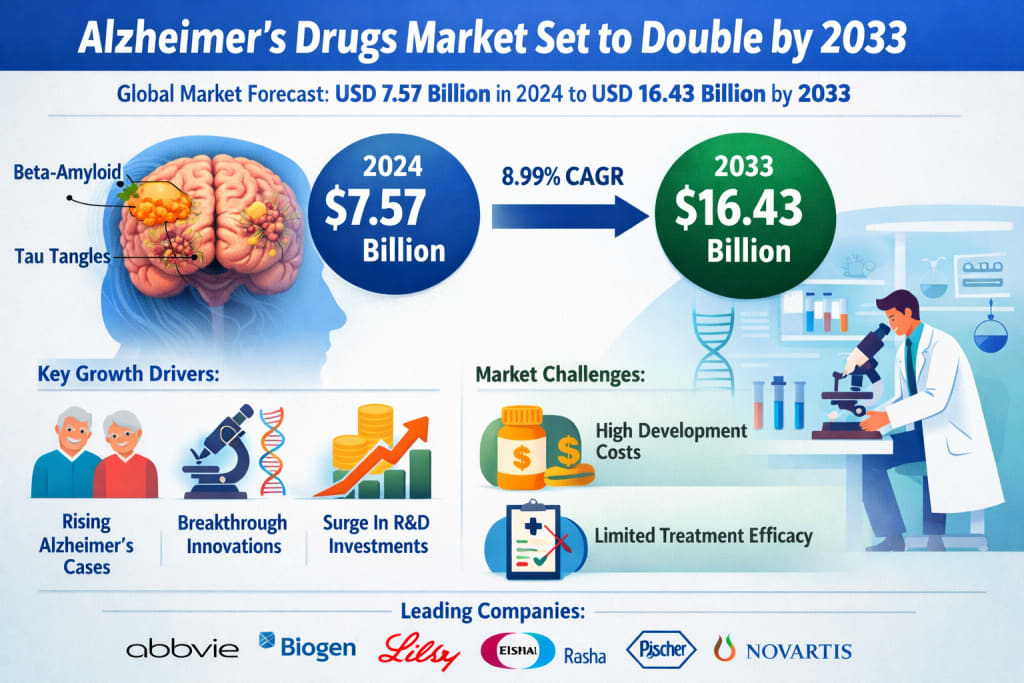
The global Alzheimer’s drugs market is entering a pivotal decade. Valued at USD 7.57 billion in 2024, the market is projected to grow at a compound annual growth rate (CAGR) of 8.99% between 2025 and 2033, ultimately reaching USD 16.43 billion by 2033 . This remarkable growth is not merely a reflection of rising demand—it signals a profound shift in how the world approaches one of the most challenging neurological disorders of our time.
Alzheimer’s disease, a progressive neurodegenerative condition affecting memory, cognition, and behavior, has long posed a formidable challenge for both clinicians and researchers. While current treatments primarily focus on symptom management, the next generation of therapies aims to alter the course of the disease itself. This evolution is fueling optimism across the healthcare ecosystem.
Understanding Alzheimer’s Treatment Landscape
Alzheimer’s drugs are designed to either alleviate symptoms or slow disease progression. Although a definitive cure remains elusive, significant advancements are being made in both symptomatic and disease-modifying therapies.
The market is broadly categorized into two primary drug classes:
Cholinesterase Inhibitors: These include widely prescribed drugs such as donepezil, galantamine, and rivastigmine. They work by increasing acetylcholine levels in the brain, improving communication between nerve cells.
NMDA Receptor Antagonists: These regulate glutamate activity to prevent neuronal damage, with memantine being a key example.
Emerging therapies are now targeting the root causes of Alzheimer’s, such as beta-amyloid plaques and tau protein tangles. These innovations represent a shift from managing symptoms to potentially slowing or halting disease progression.
Key Growth Drivers Powering the Market
1. Rising Global Prevalence of Alzheimer’s Disease
One of the most significant drivers of market growth is the increasing number of Alzheimer’s cases worldwide. As populations age—particularly in developed nations—the prevalence of dementia is rising sharply.
For instance, millions of individuals aged 65 and older are currently living with Alzheimer’s, and this number is expected to grow dramatically in the coming decades. This expanding patient pool is creating an urgent need for more effective therapies, thereby driving demand in the pharmaceutical market.
Governments and healthcare organizations are also ramping up awareness campaigns and funding initiatives, further accelerating market expansion.
2. Breakthroughs in Drug Development
Innovation is at the heart of the Alzheimer’s drugs market. Researchers are increasingly focusing on disease-modifying therapies that address the underlying biological mechanisms of the disease.
Recent advancements include monoclonal antibodies targeting amyloid plaques, which have shown promising results in clinical trials. Regulatory approvals for new drugs are also increasing, signaling a more favorable environment for innovation.
These breakthroughs are not only improving treatment outcomes but also boosting investor confidence and attracting significant capital into the sector.
3. Surge in Healthcare R&D Investments
The pharmaceutical industry, along with governments and research institutions, is significantly increasing investment in Alzheimer’s research.
Funding is being directed toward:
Drug discovery and development
Clinical trials
Regulatory approvals
Collaborative research initiatives
Public-private partnerships are playing a crucial role in accelerating innovation. Increased funding ensures a robust pipeline of new therapies, addressing unmet medical needs and sustaining long-term market growth.
Market Challenges That Cannot Be Ignored
Despite its promising outlook, the Alzheimer’s drugs market faces several challenges.
High Cost of Drug Development
Developing Alzheimer’s drugs is both expensive and time-consuming. Clinical trials are complex, often requiring large patient populations and extended durations. Additionally, the high failure rate of neurological drug trials adds to the financial burden.
These factors can deter smaller companies from entering the market and may slow the pace of innovation.
Limited Treatment Efficacy
Most existing treatments offer only temporary symptom relief rather than addressing the root causes of the disease. This limitation underscores the urgent need for more effective, disease-modifying therapies.
While research is progressing, achieving consistent clinical success remains a significant hurdle.
Segment Insights: A Closer Look at Market Dynamics
Cholinesterase Inhibitors: The Current Backbone
Cholinesterase inhibitors continue to dominate the market due to their established efficacy in treating mild to moderate Alzheimer’s. These drugs improve cognitive function and delay symptom progression, making them a cornerstone of current treatment protocols.
Ongoing research is further enhancing their clinical capabilities, ensuring sustained demand.
Combination Therapies: The Future of Treatment
Combination drugs are gaining traction as they target multiple pathways simultaneously. By combining cholinesterase inhibitors with NMDA receptor antagonists, these therapies aim to deliver improved outcomes.
This approach reflects a deeper understanding of Alzheimer’s as a multifaceted disease, opening new avenues for innovation.
Key Drug Types Driving Growth
Galantamine: Known for improving cognitive performance and memory, it remains widely used for mild to moderate cases.
Donepezil: Approved for all stages of Alzheimer’s, it is one of the most commonly prescribed drugs globally.
Memantine: Often used in moderate to severe cases, it helps regulate brain activity and protect neurons.
The availability of these drugs in various formulations, including extended-release versions, enhances patient compliance and market penetration.
Regional Insights: Global Expansion Patterns
United States: Leading the Charge
The United States remains a dominant player in the Alzheimer’s drugs market. Its advanced healthcare infrastructure, high disease prevalence, and substantial R&D investments make it a hub for innovation.
Government initiatives and regulatory support further strengthen its position, with new drug approvals continuously shaping the market landscape.
Germany: A European Powerhouse
Germany’s strong pharmaceutical industry and emphasis on research and innovation make it a key contributor to the European market. The country’s aging population and robust healthcare system drive demand for effective Alzheimer’s treatments.
Collaborative research efforts and government support continue to enhance its market presence.
India: A Rising Contender
India is emerging as a significant market due to its growing aging population and increasing awareness of mental health. The availability of cost-effective generic drugs and strong manufacturing capabilities position India as a key player in the global landscape.
Government initiatives and research collaborations are further accelerating growth.
Saudi Arabia: Expanding Healthcare Horizons
Saudi Arabia’s market is expanding rapidly, driven by healthcare reforms and investments under Vision 2030. Increasing awareness and demand for advanced treatments are fostering partnerships with global pharmaceutical companies.
Competitive Landscape: Key Players Shaping the Market
The Alzheimer’s drugs market is highly competitive, with several global pharmaceutical giants leading the way. These companies are investing heavily in R&D, strategic collaborations, and product innovation.
Some of the key players include:
AbbVie Inc.
AstraZeneca PLC
Biogen Inc.
Eisai Co., Ltd.
Eli Lilly and Company
F. Hoffmann-La Roche AG
Merck & Co., Inc.
Novartis AG
Pfizer Inc.
Teva Pharmaceutical Industries Ltd.
These organizations are focusing on expanding their product portfolios and accelerating clinical trials to maintain a competitive edge.
The Road Ahead: Opportunities and Innovation
The future of the Alzheimer’s drugs market lies in innovation. With advancements in biotechnology, artificial intelligence, and precision medicine, the next decade is expected to bring transformative changes.
Key opportunities include:
Development of disease-modifying therapies
Early diagnosis and intervention tools
Personalized treatment approaches
Expansion into emerging markets
As research continues to unravel the complexities of Alzheimer’s, the industry is poised for breakthroughs that could redefine treatment paradigms.
Final Thoughts
The global Alzheimer’s drugs market is at a critical juncture. With its value set to more than double by 2033, the sector offers immense opportunities for innovation, investment, and impact.
While challenges such as high development costs and limited treatment efficacy persist, the momentum generated by scientific advancements and increased funding is undeniable. The shift toward disease-modifying therapies marks a new era in Alzheimer’s care—one that holds the promise of improved outcomes and better quality of life for millions of patients worldwide.
As stakeholders across the healthcare ecosystem continue to collaborate and innovate, the vision of more effective Alzheimer’s treatments is gradually becoming a reality. The journey is far from over, but the path forward is clearer than ever.
About the Creator
Keep reading
More stories from shibansh kumar and writers in Trader and other communities.
Global Insulin Pen Market: A Quiet Revolution Transforming Diabetes Care
In an era where chronic diseases are shaping global healthcare priorities, diabetes stands out as one of the most pressing concerns. The increasing prevalence of this condition has sparked a wave of innovation, particularly in drug delivery systems. Among these, insulin pens have emerged as a transformative solution—bridging the gap between medical necessity and patient convenience.
By shibansh kumarabout 2 hours ago in Trader




Comments
There are no comments for this story
Be the first to respond and start the conversation.