
Militarization, Civilian Authority, and the Challenge to Democratic Governance
Is Civilian Authority the need of the day?

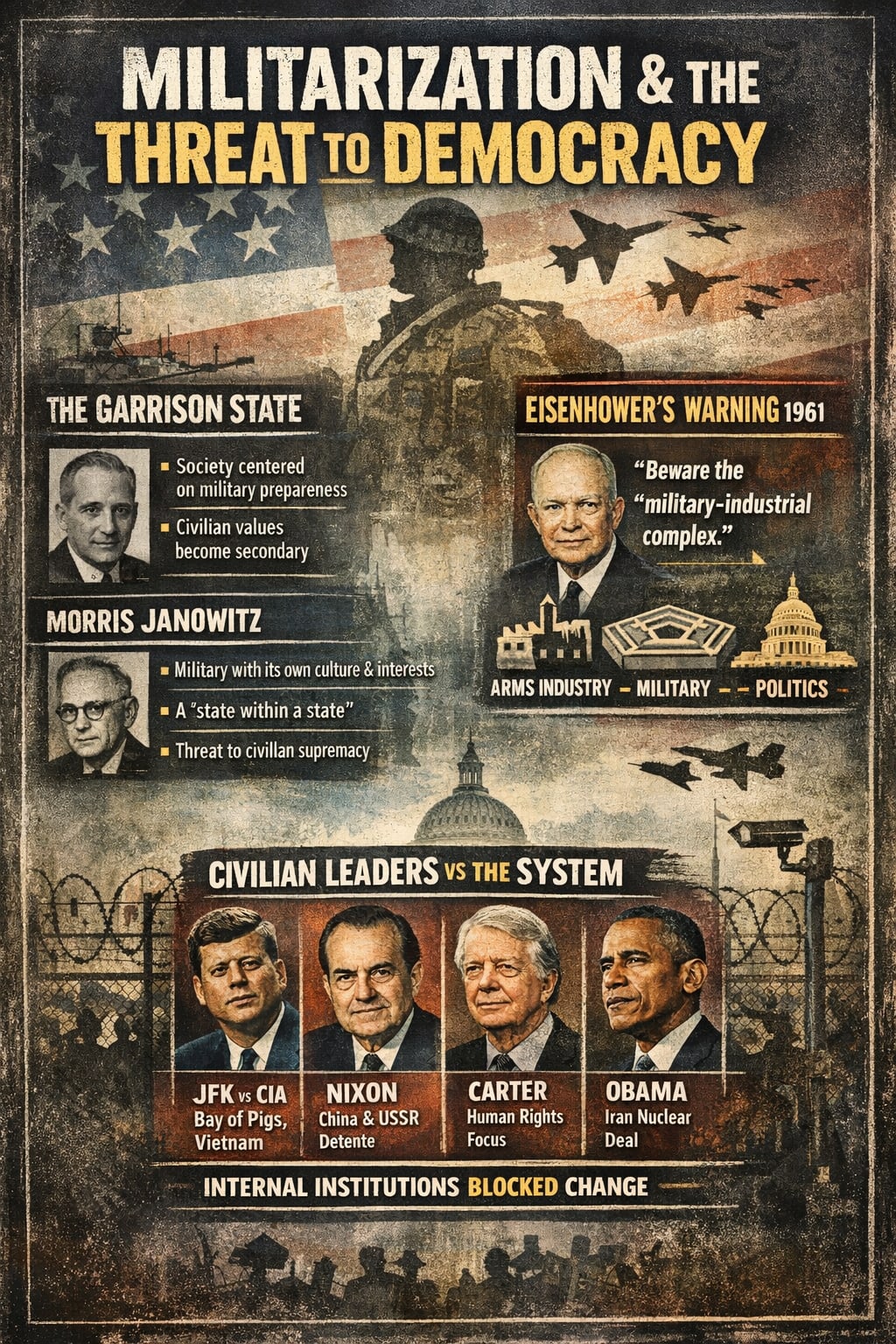
In modern political systems, one of the most subtle yet profound transformations occurs when societies gradually internalize a military mindset. This shift is not always visible, nor does it happen abruptly. Instead, it unfolds quietly, as civilians begin to perceive the world through the lens of security, threat, and strategic competition. Over time, the distinction between civilian and military leadership can erode, raising critical questions about the future of democratic governance.
The foundation of this concern can be traced to the work of Harold Lasswell, who introduced the concept of the “Garrison State.” Lasswell argued that when a society becomes primarily organized around military preparedness, and when a constant sense of external threat dominates public consciousness, power increasingly shifts toward what he called “specialists in violence.” In such a system, civilian values—such as individual liberty, open debate, and social welfare—are gradually subordinated to security imperatives. The result is a political order where fear and defense planning shape not only policy but also the broader culture of society.
Expanding on this theme, Morris Janowitz highlighted the dangers of an overly autonomous military establishment. He warned that when the military evolves into a “state within a state,” it develops its own institutional identity, interests, and worldview. Such a military does not merely execute policy; it begins to influence, and at times determine, the direction of national strategy. This autonomy can undermine the principle of civilian supremacy, a cornerstone of democratic systems, by creating an imbalance of power between elected leaders and permanent security institutions.
A powerful real-world articulation of these concerns came from Dwight D. Eisenhower. As both a five-star general and a two-term president, Eisenhower possessed unparalleled insight into the relationship between military power and political authority. In his 1961 farewell address, he famously warned of the rise of the “military-industrial complex”—a network of defense institutions, private contractors, and political actors whose combined influence could pose a direct threat to democratic governance. Eisenhower’s warning was particularly striking because it came from a leader who had himself been instrumental in building the very system he cautioned against. His message underscored the paradox of modern states: the mechanisms designed to ապահով security can, if left unchecked, endanger the very freedoms they are meant to protect.
The question then arises: can civilian leaders effectively challenge or reform such entrenched systems? Historical evidence suggests that this is an exceptionally difficult task. John F. Kennedy, for instance, sought to reassess the role of intelligence agencies following the failure of the Bay of Pigs Invasion. His growing skepticism of military and intelligence advice, particularly regarding the Vietnam War, reflected an awareness of the limits and risks of interventionist policies. Yet, despite his position, structural constraints and institutional resistance limited the extent of change he could achieve.
Similarly, Richard Nixon pursued a policy of détente, seeking to reduce tensions with both China and the Soviet Union. While his diplomatic breakthroughs were significant, they were not without opposition from within his own government and strategic community. Jimmy Carter attempted to reorient U.S. foreign policy around human rights, but his efforts were often constrained by Cold War realities and bureaucratic inertia.
More recently, Barack Obama negotiated the Joint Comprehensive Plan of Action, an agreement aimed at curbing Iran’s nuclear program through diplomacy rather than confrontation. Despite its international significance, the agreement faced substantial domestic opposition and was ultimately undermined by subsequent political developments. Notably, the resistance to such initiatives has not always come from external adversaries but often from internal institutions with enduring strategic priorities and influence.
These examples highlight a central tension in modern governance: the balance between security and democracy. While strong defense institutions are necessary in an uncertain and often dangerous world, their growing influence can challenge the authority of elected leaders and the values of open societies. When threat perception becomes permanent, it reshapes not only policy but also public consciousness, making it increasingly difficult to distinguish between civilian and military domains.
In conclusion, the gradual militarization of society poses a significant challenge to democratic systems. The insights of Lasswell, Janowitz, and Eisenhower remain highly relevant, reminding us that the preservation of democracy requires constant vigilance. Civilian leadership must not only manage external threats but also ensure that the institutions created to provide security do not, over time, erode the very principles they are meant to defend.
About the Creator
Ibrahim Shah
I am an Assistant Professor with a strong commitment to teaching,and academic service. My work focuses on fostering critical thinking, encouraging interdisciplinary learning, and supporting student development.
Keep reading
More stories from Ibrahim Shah and writers in The Swamp and other communities.
The Economic Shockwaves of Middle East Conflict
Dubai has long been regarded as a global hub for gold trade and finance, but the ongoing conflict in the Middle East has begun to shake even its strongest economic pillars. With flight operations disrupted and regional instability rising, the ripple effects of war are now being felt across multiple sectors—from energy and aviation to tourism and global finance.
By Ibrahim Shah 8 days ago in The Swamp
The Forsyth House Fire
Since 1851, Forsyth House has stood on the corner of Union Street and Gordon Street in the heart of Glasgow. Its iconic, or was... because on Sunday 8th of March, 2026, a fire broke out in a small, seemingly un-named shop in the building and tore all that history down. As I write, the rubble is still unsettled and the street is still blocked off. Central Station is quiet on the upper level, and around 30 small businesses have quite literally gone up in smoke.
By S. A. Crawford19 days ago in The Swamp
Side Quest Goal Achieved: Placing an Alien Claim
This is a post that has me quite ecstatic. It's funny, I thought it was going to be one of my usual, "Hey, I achieved another one of my goals and checked it off" type deals. And it sort of is. But it sort of isn't. And it's also one of my greatest writing accomplishments of late.
By Stephen Kramer Avitabile5 days ago in Writers


Comments (1)
great