
Beyond the Firelight
Exploring the timeless bond between folklore, poetry, and the human experience

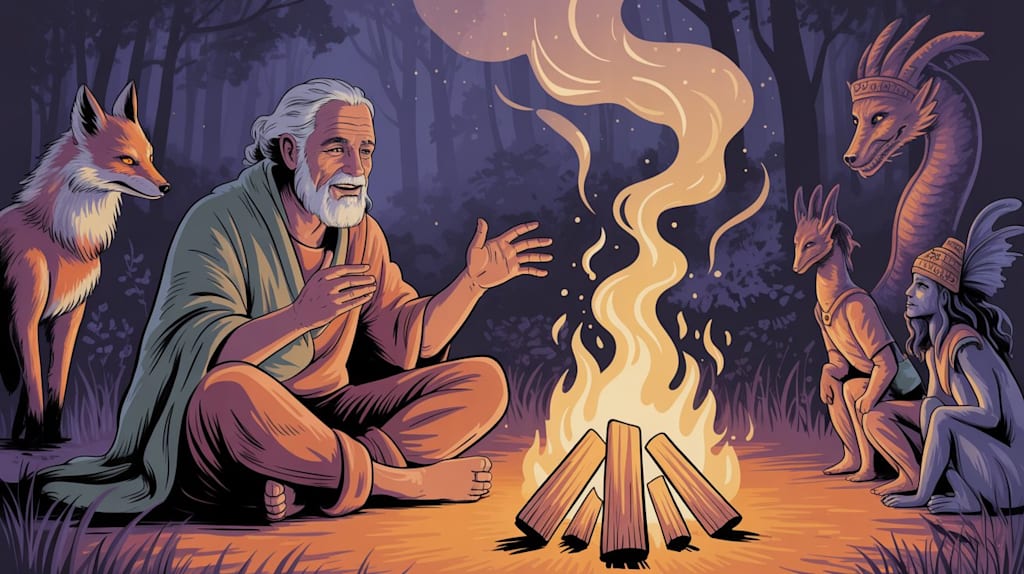
Long before the advent of printing presses, libraries, or digital screens, the warmth of firelight was the setting for humanity’s most treasured stories. In the quiet of night, people gathered to listen to tales that were passed down not in written form, but through the spoken word. These stories were as diverse as they were enduring—whispers of gods, songs of legendary heroes, and lessons taught by tricksters who roamed freely between realms. These narratives weren’t captured in books; they were carried from one generation to the next, spoken from elder to child, their essence preserved in the memory of those who listened. Folklore became the fabric of memory, and poetry, with its rhythm and rhyme, was the thread that stitched it into the very fabric of human history.
The Sound of Memory
Poetry and folklore are intertwined by their reliance on sound. Before literacy was widespread, rhythm was the key to preserving memory. Repeated lines, echoing rhymes, and steady beats ensured that stories would not fade into oblivion. Ancient Greek rhapsodes recited Homer’s epics without written scripts, relying solely on memory. Celtic bards sung songs about battles and kings, while in West Africa, griots passed down entire genealogies through melody, ensuring that no lineage was forgotten. For these cultures, poetry wasn’t just an art form; it was a survival mechanism. It anchored stories against the inevitable passage of time.
Folklore as the Mirror of Culture
Every culture’s folklore is deeply tied to its environment and values. In the cold, harsh landscapes of the North, Norse myths spoke of frost giants and gods battling through endless winters. In the lush hills of Ireland, banshees roamed the night, foretelling death with their wails. Across West Africa, Anansi the spider outwitted the powerful with his clever tricks. In Japan, the kitsune, a mystical fox spirit, imparted wisdom on deception, loyalty, and transformation. These stories weren’t just fables—they were reflections of the cultures that created them. They revealed what people feared, what they held dear, and what they believed was the true path to a good life.
When poetry wove itself into these stories, folklore transcended mere narrative. It became more than just a tale—it turned into a chant, a prayer, or even a spell, preserving wisdom and passing it on to future generations.
The Poet as Keeper of Memory
The poet has always been much more than a creator of verses. In ancient times, poets were the keepers of history, guardians of culture, and sometimes even spiritual guides. African griots weren’t just performers—they were walking libraries, storing and sharing the histories of entire communities. In the deserts of Arabia, poets recited qasidas, vast poems that preserved history in an age before written records. Indigenous storytellers of the Americas wove nature itself—rivers, mountains, and spirits—into their verses, ensuring that the land and its stories remained inseparable.
While poetry preserved the rich tapestry of folklore, folklore breathed life into poetry. The two have always been intertwined, guarding entire civilizations within their words and melodies.
Folklore and Poetry in Our Lives Today
Even if we no longer gather around firelight, folklore continues to influence us. Think about the fairy tales that shaped our childhood: Cinderella, Little Red Riding Hood, or the trickster hare. Though these stories have evolved and softened over the centuries, they still retain their roots in ancient folklore. The nursery rhymes we sing to children, the stories we read at bedtime, the prayers whispered in verse—these are all echoes of an age-old tradition of storytelling. Each time we share these tales, we unknowingly become part of the same ritual that has connected humanity across millennia: the transmission of knowledge through rhythm and story.
The Modern Revival of Folklore
In today’s world, where technology and instant communication dominate, it may seem that folklore and poetry would be left behind. Yet, in many ways, they are more alive than ever. Contemporary poets draw inspiration from myths and folklore to explore themes like identity, resilience, and love. Folklore continues to inspire books, films, and even video games. A poet in London might use the myth of Persephone to explore themes of depression and rebirth. A Nigerian novelist could weave Anansi the spider’s wit into a modern narrative about justice. Myths adapt to new contexts, but they never fade—they remain relevant, and poetry is the bridge that carries them into new forms.
The Importance of Folklore and Poetry Today
In a world where information travels at lightning speed, poetry and folklore offer a necessary pause. They remind us that words are not disposable, but powerful. A poem asks us to slow down and feel; a folktale invites us to imagine, reflect, and remember. These are not just forms of entertainment—they are anchors. They help us understand who we were, who we are, and who we might yet become.
In a sense, poetry and folklore provide us with the connection we all seek. Whether it's a lullaby whispered to a child, a chant shouted in a protest, or an ancient myth retold under the stars, these traditions satisfy a deep human need for meaning and understanding.
A Bridge Across Time and Cultures
Poetry and folklore serve as bridges. They span the gap between the past and the present, between myth and reality, and between people across different continents. A Japanese haiku can touch the soul of a reader in Brazil, while an Irish legend can resonate with someone in India. The words may be different, but the emotions—fear, joy, longing, hope—are universal. This is the magic of poetry and folklore: they remind us that despite our cultural differences, humanity shares a common heart.
In Conclusion
Far from being forgotten relics, poetry and folklore are living traditions that continue to evolve and breathe with each retelling. They are not merely songs or stories; they are the memory and the dream of humanity. To listen to a poem or a folktale is to partake in the ancient ritual of remembering. As long as we seek meaning in words, as long as our hearts beat and our voices rise, poetry and folklore will remain steadfast companions on our journey through time.
About the Creator
Jhon smith
Welcome to my little corner of the internet, where words come alive
Keep reading
More stories from Jhon smith and writers in Poets and other communities.




Comments
There are no comments for this story
Be the first to respond and start the conversation.