
The Tomorrow Trap: Why You Keep Delaying Your Life
Understanding procrastination—and how to finally break the cycle

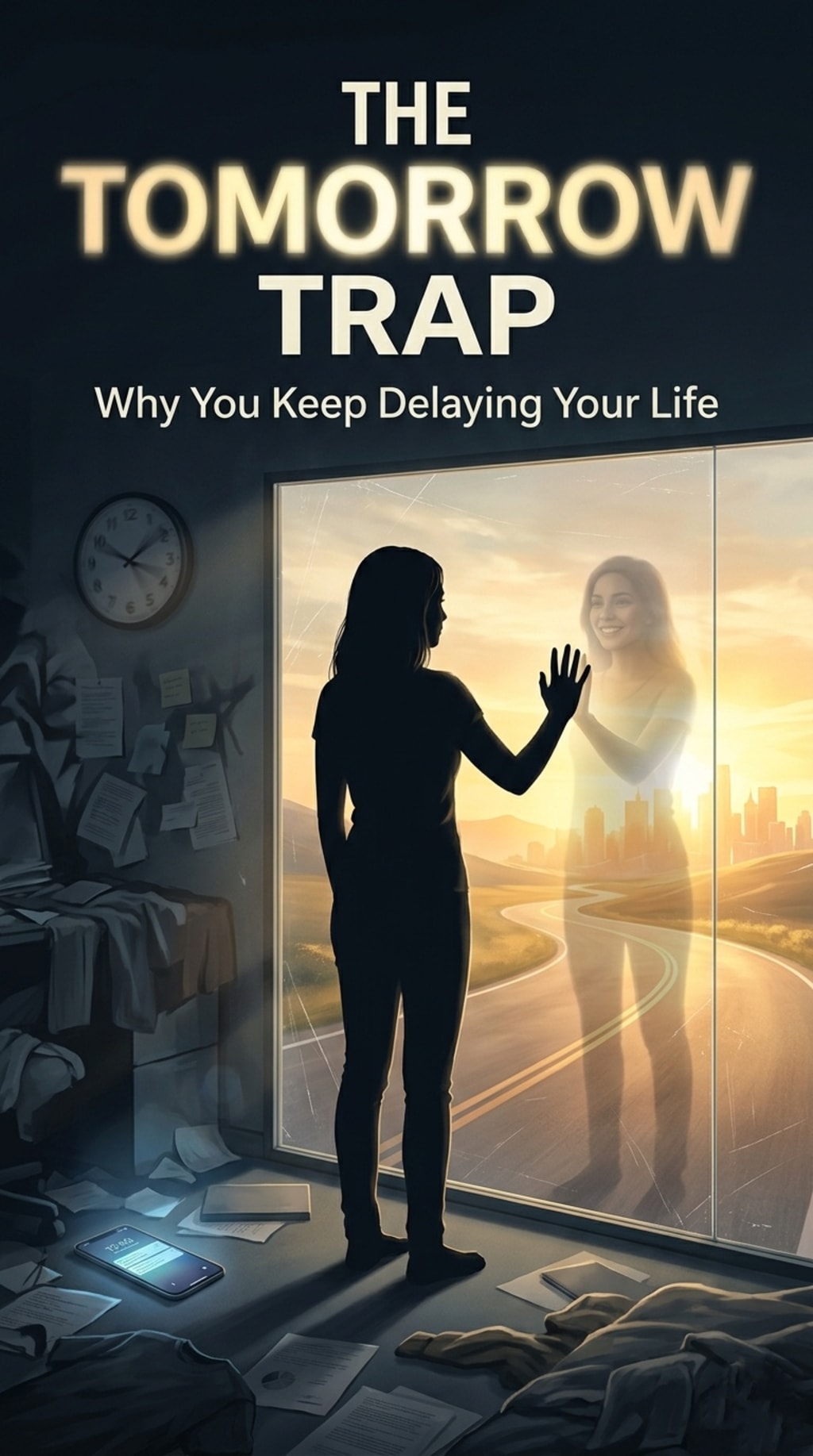
Arjun had a habit of talking to his future.
Not in a mystical way, not through horoscopes or late-night prayers, but in quiet promises he made to himself while staring at the ceiling. Tomorrow, he would wake up early. Tomorrow, he would start writing that novel. Tomorrow, he would call his parents more often, exercise, eat better, fix his sleep, fix his life.
Tomorrow always listened patiently. Tomorrow never judged. And that was exactly the problem.
Because tomorrow never came.
Every morning, Arjun woke up with the same faint heaviness in his chest—a mix of guilt and possibility. He would reach for his phone, scroll through messages, news, videos, anything that blurred the sharp edge of intention. “I’ll start after breakfast,” he would think.
After breakfast became after a short break. After a short break became after lunch. After lunch drifted into evening, and by then, the day felt too used up to begin anything meaningful.
“I’ll start fresh tomorrow,” he would say again.
It felt logical. Even responsible. Starting something important required the right mood, the right energy, the right version of himself. And today’s version—slightly tired, slightly distracted, slightly overwhelmed—was not it.
Tomorrow’s version would be better.
Tomorrow’s Arjun was disciplined. Focused. Clear-minded. He woke up before his alarm, drank water, stretched, wrote pages effortlessly. Tomorrow’s Arjun didn’t hesitate. He didn’t doubt. He didn’t scroll.
Tomorrow’s Arjun was everything today’s Arjun wasn’t.
And so, Arjun kept postponing his life in favor of someone who didn’t exist.
—
One evening, after another day dissolved into nothing, Arjun sat at his desk, staring at a blank document. The cursor blinked at him like a quiet accusation.
He tried to write a sentence. Deleted it.
Tried again. Deleted it.
His mind felt foggy, restless. He opened a video “just for five minutes.”
An hour passed.
Frustrated, he slammed his laptop shut. “What is wrong with me?” he muttered.
It wasn’t laziness. He knew that. He wanted to write. He wanted to change. The desire was real. But something invisible stood between intention and action, like a glass wall he couldn’t break.
That night, he didn’t make a promise to tomorrow.
Instead, he asked himself a different question: Why not today?
The answer came quickly—and quietly.
Because today might be uncomfortable.
Tomorrow was safe because it was imaginary. It carried no risk of failure. No imperfect beginnings. No evidence that he might not be as capable as he hoped.
Today, however, was real.
Today could expose him.
—
The next morning, Arjun didn’t wake up early. He didn’t feel inspired. Nothing had magically changed.
But the question from the night before lingered.
Why not today?
He sat at his desk again, opened the same blank document, and felt the same resistance rise in his chest.
His mind whispered: You’re not ready. This won’t be good. Start tomorrow.
For the first time, he didn’t argue with the voice. He simply noticed it.
Then he did something unusual.
He wrote one terrible sentence.
It was awkward, clumsy, and far from what he imagined his novel should begin with. But it existed.
He stared at it, almost surprised.
The world didn’t end. Nothing broke.
So he wrote another sentence.
Then another.
They weren’t brilliant. They weren’t even good. But they were real—and they belonged to today, not tomorrow.
—
Days passed, and Arjun began to see a pattern he had missed before.
Procrastination wasn’t about time. It was about emotion.
Every time he delayed something, it wasn’t because he didn’t have time—it was because he didn’t want to feel something uncomfortable. Boredom. Uncertainty. Self-doubt. Fear of doing it badly.
Tomorrow wasn’t a better schedule. It was an escape from discomfort.
And breaking the cycle didn’t require superhuman discipline. It required something simpler—and harder.
Willingness.
Willingness to start before he felt ready.
Willingness to do things imperfectly.
Willingness to sit with discomfort instead of avoiding it.
—
He made small changes.
He stopped planning perfect days and started focusing on imperfect moments.
Instead of saying, “I’ll write for two hours,” he told himself, “Write for five minutes.”
Instead of waiting for motivation, he acted first—and let motivation catch up later.
Instead of trying to become tomorrow’s version of himself, he worked with today’s version—the tired, distracted, imperfect one.
Some days were still unproductive. Some days, he slipped back into old habits. But something had shifted.
Tomorrow lost its power.
It was no longer a magical place where everything would finally begin.
Because things had already begun.
—
Months later, Arjun opened his document and scrolled.
Pages filled the screen—messy, uneven, imperfect pages. But they were his.
Not imagined. Not postponed.
Real.
He smiled, not because the work was finished, but because it existed.
For the first time in a long while, he wasn’t waiting for his life to start.
He was living it.
—
The trap had never been time.
It had been the belief that he needed to become someone else before he could begin.
But the truth was simpler, quieter, and far more powerful:
You don’t escape procrastination by chasing a better tomorrow.
You escape it by showing up today—exactly as you are—and starting anyway.
About the Creator
Keep reading
More stories from Sahir E Shafqat and writers in Lifehack and other communities.
Why Modern Relationships Feel So Hard
Maya stared at her phone for the third time in five minutes. Still no reply. She sighed and locked the screen, placing it face down on the table like that would somehow make the waiting easier. It didn’t. Across the café, couples sat together—some talking, some just scrolling silently side by side. It was strange how connected everyone looked… and how distant they actually were. Her phone buzzed. She grabbed it instantly. “Sorry, busy. Talk later.” That was it. No emoji. No warmth. Just a sentence that felt colder than it should. Maya leaned back in her chair, her coffee now untouched. A year ago, Ethan would have called. He would have asked about her day. He would have made her feel like she mattered. Now, everything felt… reduced. To texts. To delays. To assumptions. Later that night, they finally spoke. “You’ve been distant,” Maya said carefully, trying to keep her voice calm. “I’ve just been busy,” Ethan replied. “You’re always busy.” “And you’re always overthinking.” That word again. Overthinking. It had become a wall between them—something that ended conversations instead of starting them. “I’m not overthinking,” she said, softer now. “I just feel like we’re not… the same anymore.” There was a pause. The kind that says more than words ever could. “Maybe things just change,” Ethan said. That night, Maya couldn’t sleep. Her mind replayed everything. The late replies. The shorter conversations. The way he no longer asked, “Are you okay?” She opened her phone and, without thinking, scrolled through social media. Perfect couples. Smiling faces. Vacation photos. Anniversaries celebrated with captions about “forever.” It felt like everyone else had figured something out that she hadn’t. Or maybe… they were just better at pretending. The next day, Maya met her friend Lina. “You look exhausted,” Lina said. “I think my relationship is ending,” Maya replied, half-joking, half-serious. “What happened?” “Nothing… and everything.” Lina nodded. “That’s usually how it goes.” Maya frowned. “What does that mean?” “It means no big fight. No dramatic ending. Just… slow distance.” Maya looked down at her coffee. “That’s exactly it.” “Do you still love him?” Lina asked. “Yes,” Maya said instantly. “Then what’s the problem?” Maya hesitated. “I don’t feel it anymore.” Lina leaned forward. “Love isn’t just something you feel all the time. It’s something you maintain.” Maya stayed quiet. “Let me ask you something,” Lina continued. “When was the last time you two had a real conversation?” “Last week, I think.” “And before that?” Maya couldn’t answer. That evening, Maya sat alone in her room. No music. No scrolling. Just silence. For the first time in weeks, she allowed herself to think clearly. Not about what Ethan was doing. But about what they had become. Somewhere along the way: Conversations turned into check-ins Effort turned into routine Presence turned into notifications They didn’t fight. They just… stopped trying. Her phone buzzed again. Ethan. “Hey.” Just one word. Maya stared at it. A year ago, that message would have made her smile. Now, it felt empty. She typed back: “Can we talk?” They met the next day. No café this time. No distractions. Just two people sitting across from each other, unsure of where things stood. “I don’t want to lose this,” Maya said. “Me neither,” Ethan replied. “Then why does it feel like we already have?” He didn’t answer immediately. “I think we got comfortable,” he said finally. “Comfortable enough to stop trying?” He looked down. “Maybe.” Maya took a deep breath. “I don’t need constant messages,” she said. “I don’t need perfection. I just need to feel like this matters to you.” “It does matter,” Ethan said. “Then show me.” The words hung in the air. Simple. Honest. Necessary. For the first time in a long time, they talked. Not through screens. Not through short replies. But really talked. About what they missed. What they needed. What they were afraid to say. And it wasn’t easy. But it was real. Modern relationships aren’t breaking because love is gone. They’re breaking because effort fades. Because communication becomes convenient instead of meaningful. Because people assume connection will maintain itself. Maya realized something that day: Love didn’t disappear. They just stopped choosing it. As they walked away together, nothing was magically fixed. But something had shifted. They were trying again. And sometimes, in today’s world… That’s the hardest—and most important—choice you can make.
By Sahir E Shafqat7 days ago in Lifehack
How Long Do Pregnancy Hormones Last After Abortion?
The pregnancy hormone, hCG (Human Chorionic Gonadotropin) is produced naturally in the body during conception. This hormone is vital in development and maintenance of the uterine lining where the fertilized egg implants. It also helps in the fetal growth, staying at peak levels especially in the first trimester of the pregnancy. If you recently had an abortion, you may wonder how long hCG hormone would stay in your system.
By Jessica Perry6 days ago in Lifehack
Yoga Practice for a Healthier Mind and Body
Let’s be honest—life gets busy. Deadlines, responsibilities, constant notifications… and somewhere in between, we forget to pause. That’s exactly where yoga practice comes in—not as something complicated, but as a simple way to reconnect with yourself.
By Veronica Bennett6 days ago in Lifehack




Comments
There are no comments for this story
Be the first to respond and start the conversation.