
Why Your Roof is Quietly Killing the Planet ?
The dark, heat-absorbing surface over your head is adding degrees to your city - and a $15 billion industry thinks it has the answer.
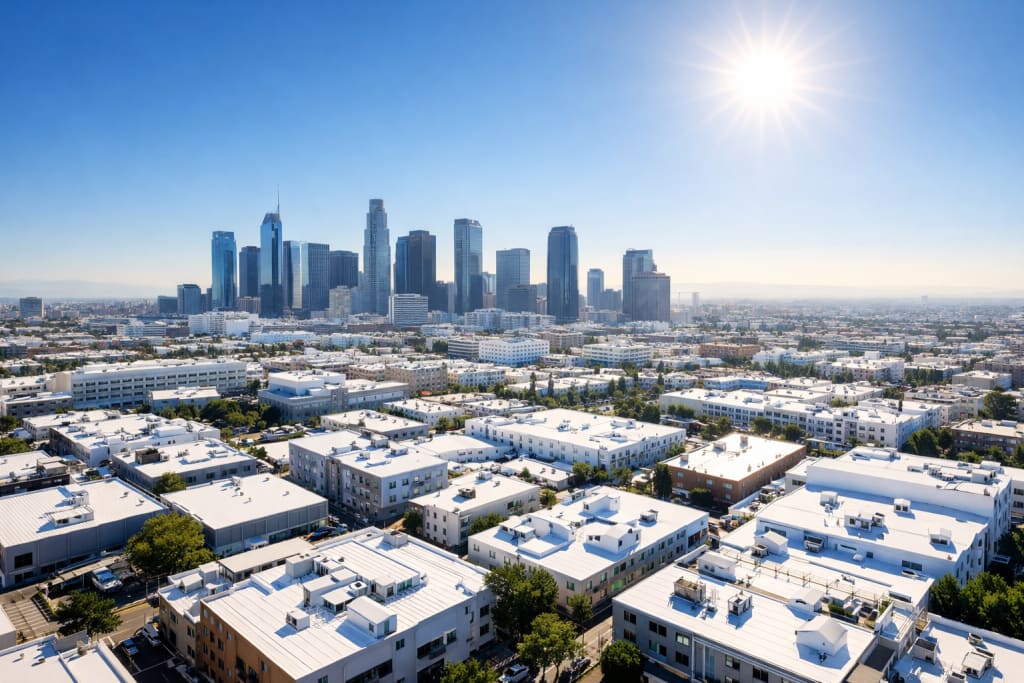
Stand on any rooftop in Phoenix, Chennai, or Lagos on a summer afternoon and you will feel it before you see it - a wall of radiated heat bouncing off the black asphalt beneath your feet, hot enough to fry an egg, hot enough to push the ambient air temperature of an entire neighborhood two degrees higher than the surrounding countryside. You didn't build the heat island. But you're living inside one.
The culprit isn't the sun. It's what we chose to put under it. For more than a century, the default roofing material across commercial and industrial buildings has been dark-colored asphalt or bitumen - affordable, waterproof, and thermally efficient at doing the very thing we now desperately need it to stop: absorbing heat.
What Is a "Cool Roof" & Why Does It Matter?
A cool roof is any roofing system engineered to reflect a significantly higher percentage of solar energy than a conventional surface. Where a standard dark asphalt roof absorbs 80-95% of incoming solar radiation, a properly installed cool roof bounces 65-90% of it back into the sky. The physics are elegant: less absorbed energy means a cooler roof membrane, a cooler attic, and - in densely built areas - a measurable reduction in ambient air temperature.
This is not a niche technology or a green luxury. The Cool Roof Market, according to Mordor Intelligence, is already valued at USD 15.27 billion in 2025 and is on a trajectory toward USD 20.02 billion by 2030 - growing at a compound annual growth rate of 5.57%. That's not green-washing math; that's regulatory mandates, rising electricity tariffs, and very hot summers doing their work.
The Regulatory Pressure That Changed Everything
The shift from voluntary adoption to mandatory compliance happened gradually, then all at once. California's Title 24 energy efficiency standards raised minimum solar reflectance and thermal emittance thresholds effective January 2025. Atlanta passed an ordinance in June 2025 requiring commercial roofs to meet a reflectance of at least 0.55. The European Union's revised Energy Performance of Buildings Directive mandates zero on-site fossil-fuel emissions for all new structures by 2030 - an almost impossible target to hit without cool roofs as part of the building envelope strategy.
These aren't suggestions. They're building codes. And building codes are among the most powerful market-creation tools in modern capitalism. Every new commercial structure built in California, Paris, or Singapore now has a legally enforceable reason to consider a cool roof. The economics followed the regulation.
- Low-slope systems - common in warehouses and big-box retail - hold 45.18% of cool roof market share
- Commercial buildings account for 37.81% of total application demand
- North America leads with 35.64% of global revenue
- Energy savings in Saudi Arabia and Kuwait range from 25-34% versus conventional roofs
- Singapore cool coatings deliver 30–40% HVAC power savings in tropical settings
The uncomfortable irony of the status quo is that the people least able to afford high energy bills - residents of dense, under-resourced neighborhoods - live in the buildings with the worst roofs. New York City's CoolRoofs program is trying to address that directly, offering free reflective membrane installation to nonprofits and affordable housing projects. India has launched similar mass-deployment initiatives in low-income settlements. The roof, it turns out, is not just a shelter. It's an instrument of climate justice.
The Supply-Chain Consolidation Nobody Covered
Meanwhile, BASF now runs its North American manufacturing plants entirely on renewable electricity, cutting Scope 2 emissions and giving the company a meaningful edge in procurement decisions by ESG-screened institutional developers. Johns Manville cut greenhouse emissions 12% between 2022 and 2024. The industry is not just selling a climate solution - it's trying to become one.
The Cool Roof Market isn’t just about coatings and construction-it’s about resilience, sustainability, and the economics of energy efficiency. Reflective roofing is moving from niche innovation to mainstream infrastructure. Whether it’s reducing urban heat islands, cutting household energy bills, or aligning with ESG mandates, cool roofs are becoming a cornerstone of climate-smart cities. The market share dynamics-from North America’s dominance to Asia-Pacific’s rapid expansion-show that this is a truly global movement.
Conclusion: The Future Is Reflective
Cool roofs are more than a construction trend-they represent a shift in how we think about cities, energy, and climate resilience. By reflecting sunlight instead of absorbing it, they ease the burden on power grids, reduce urban heat, and create healthier living environments.
From residential homes to sprawling data centers, the adoption of reflective roofing signals a broader movement toward sustainable infrastructure. It’s not just about saving money or meeting regulations-it’s about reimagining the role of rooftops in shaping the future of our communities.
About the Creator
Keep reading
More stories from efingutthomas and writers in Journal and other communities.
Inside Canada’s Oil Market Growth Story
The pipeline cuts silently through the frozen wilderness, stretching for miles like an artery beneath the snow. Above it, the sky glows pale blue, untouched and endless. Below it, energy flows-fueling cities, industries, and economies far beyond Canada’s borders.
By efingutthomas6 days ago in Journal
Author’s Advice
If you would’ve asked me 20 years ago did I know I’d become a writer and an author, I would’ve said “nope, ain’t happening”. As fate would have it I did become an author and I can honestly say I’m loving it so far. It really does feel good to be a writer. I’ve learned a lot on this journey and I feel like with even me being as new to this world as I am, there’s some wisdom I need to share with every other aspiring author.
By Joe Patterson19 days ago in Journal
The flames of war flared up in the Middle East: Trump’s adventures and Gulf contradictions have brought the world to a dangerous turning point
(Special Report: Journalist Malik Sarfaraz Hussain Awan) The Middle East is currently sitting on the worst and most dangerous gunpowder pile in history, where even a small spark can turn the peace and economy of the entire world into a pile of ashes. Donald Trump’s unpredictable foreign policy and American adventures in the Gulf region have so badly disturbed the traditional balance of the region that the flames of war are now crossing the borders and reaching the safest havens of the Gulf countries. The dramatic military and diplomatic developments in recent hours are clear evidence that this crisis is no longer just a regional conflict, but has emerged as a deadly poison for the global economy and security. The biggest and most horrific news has come from the United Arab Emirates, where the UAE Ministry of Defense has officially confirmed that its advanced air defense system destroyed 16 ballistic missiles and 42 drones launched by Iran in the air. Iran has mainly targeted industrial and military areas in Abu Dhabi and Dubai. Although the air defense prevented a major disaster by thwarting this major attack, debris and direct attacks have still caused heavy explosions in densely populated areas of Dubai and industrial zones in Abu Dhabi. Iran has specifically targeted the aluminum industry, damaging the Emirates Global Aluminum plant in Abu Dhabi and injuring employees working there. According to the Ministry of Defense, so far, two UAE military personnel, a Moroccan contractor working for the military, and eight civilians from Pakistan, Nepal, Bangladesh, Palestine, and India have been killed in these attacks, while a total of 178 people from different countries have been injured. The decision of Yemen’s Houthi rebels to enter regular war has added fuel to the fire. Houthi spokesman Yahya Saree confirmed in his official statement that they have fired drones, including ballistic and cruise missiles, targeting Israel’s southern and sensitive military sites. This move by the Houthis will expand the scope of this war to the strategic routes of the Red Sea and Bab al-Mandab. About 12 percent of the world’s trade passes through these sea routes. If the Houthis start targeting global shipping like in the past, the international energy market and supply chain will be completely paralyzed, resulting in exorbitant inflation and economic collapse on a global scale. If we look behind the scenes of all these serious military adventures, the biggest root is the open contradiction and double standards of the US Gulf policy. On the one hand, the US sings the tune of peace and security in the Middle East, and on the other hand, it keeps the region in a state of constant instability to protect its own economic and military interests. Due to this expediency, the Gulf countries are now realizing that the US umbrella is no longer a guarantee of their complete protection, and shells and missiles are now raining down on their own territory in the war for US interests. On the other hand, Israel and the US have not sat silent either. The Israeli Air Force has targeted and destroyed the Iranian Ministry of Defense factory in Tehran, which was manufacturing parts for ballistic missiles. In addition, Iran’s largest steel plants in Isfahan and Ahvaz have been bombed. The US Pentagon and the Israeli military are jointly targeting Iran’s defense and industrial infrastructure, and the US Air Force has carried out heavy bombing of Iranian coastal cities and naval installations near the Strait of Hormuz in the past 24 hours in an attempt to cut off Iran’s supply line. In view of this extremely worrying and terrifying situation, a very important four-nation emergency meeting has begun in the Pakistani capital, Islamabad. The foreign ministers of Pakistan, Saudi Arabia, Egypt and Turkey are sitting together in Islamabad to find a middle way to reduce the dangerous tension in the Middle East. Pakistan is currently trying to play the role of a bridge between the US and Iran through back-channel diplomacy, because Islamabad knows very well that if the fire of war spreads further in the Gulf and the Middle East, its heat will directly burn Pakistan’s fragile economy and energy needs to ashes. The bottom line is that Donald Trump's personal adventures and the US administration's contradictory Gulf policies are now becoming unbearable for the world. This contradiction is a stain on the forehead of the global economy and peace that is gradually pushing the entire world towards a great war. Now is the time for the international community to abandon its traditional silence and expediency and raise its voice against these contradictions, otherwise history is a witness that when economic and political greed exceeds limits, then nothing but destruction is achieved.
By Malik Sarfraz Hussain Awana day ago in Journal
Thirty (one) and Neither Flirty nor Thriving.
I'm thirty-one and orbiting the same few mistakes like they're landmarks. London is already awake before I am (or before I've slept) - sirens somewhere far enough to ignore, buses sighing at stops, people moving with purpose I can't quite borrow. I lie there for a bit, tasting last night at the back of my throat, trying to remember if I meant to drink that much or if it just...happened again.
By Stacey Vella4 days ago in Psyche




Comments
There are no comments for this story
Be the first to respond and start the conversation.