
AI Revolution: The Silent Force Reshaping Our Future
The world is not changing slowly anymore — it is transforming at a speed humanity has never experienced before. At the center of this transformation is Artificial Intelligence.

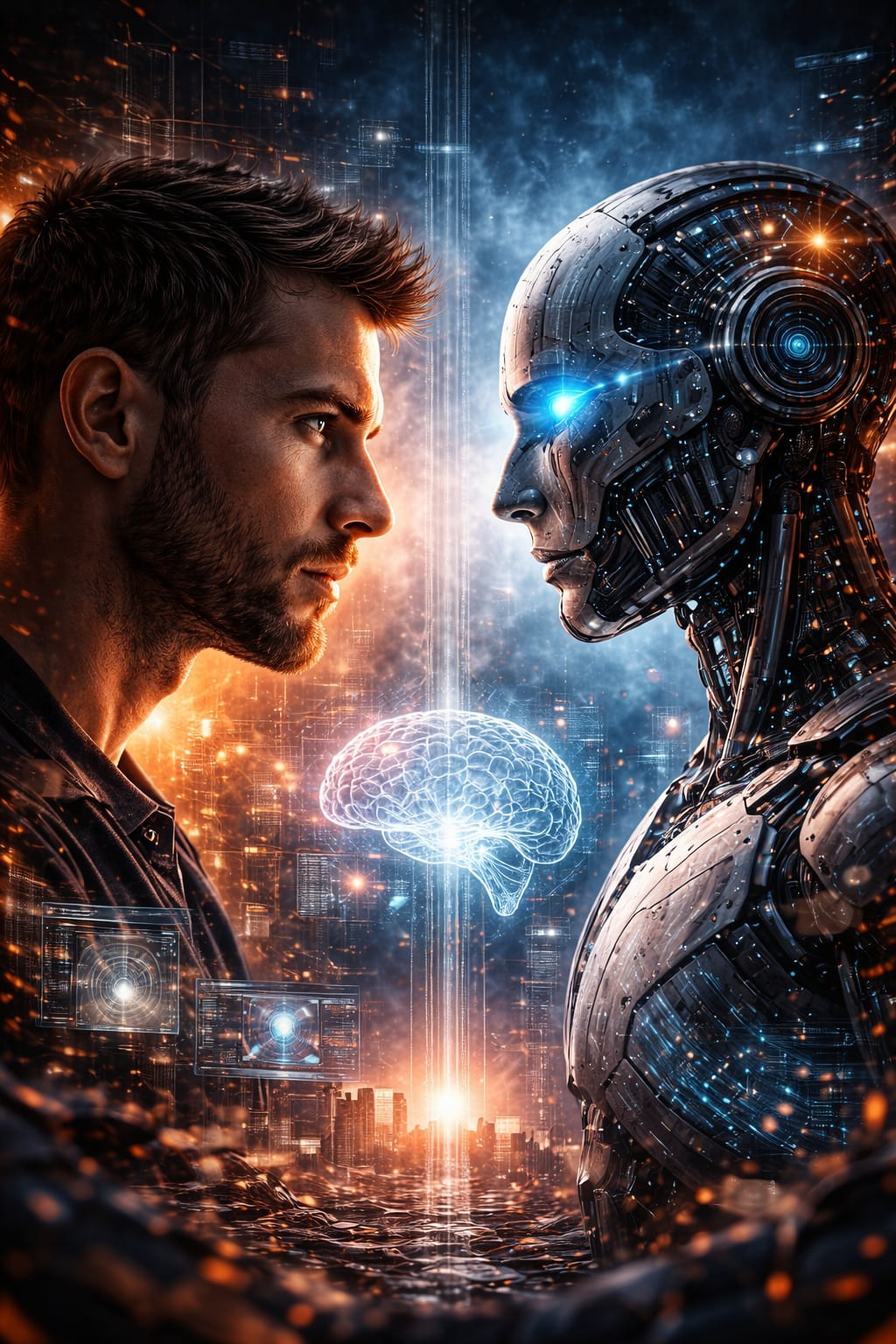
A few years ago, artificial intelligence felt distant — something reserved for tech experts and futuristic movies. Today, it’s part of everyday life. Tools created by organizations like OpenAI and Google DeepMind are writing emails, generating ideas, solving problems, and even holding conversations that feel surprisingly human.
At first, it feels helpful. Even exciting.
You save time. You get better results. Things become easier.
But then, a subtle question begins to form:
If AI ca do this… what’s left for me?
The AI revolution isn’t just about technology. It’s about intelligence becoming something we can outsource.
Think about it.
We’re no longer just using machines to do physical work — we’re using them to think, create, and decide. Tasks that once defined human uniqueness are now being shared with algorithms.
And while that opens incredible possibilities, it also creates a quiet tension.
Because for many of us, our value has always been tied to what we can do.
Our skills.
Our ideas.
Our ability to solve problems.
Now imagine a world where a machine can do those things faster, cheaper, and sometimes even better.
It doesn’t just challenge industries.
It challenges identity.
But here’s the part we don’t talk about enough.
The real danger of AI isn’t that it replaces us.
It’s hat we slowly start replacing ourselves.
When we rely too much on AI to think for us, we begin to lose something subtle but important — our mental sharpness, our curiosity, our willingness to struggle through problems.
Convenience is powerful.
And addictive.
Why spend hours thinking when an AI can give you an answer in seconds?
Why wrestle with creativity when a machine can generate ideas instantly?
Over time, the habit of thinking deeply may begin to fade.
Not because we can’t think —
But because we don’t need to.
And yet, this isn’t a story about doom.
Because there’s another side to this revolution — one that’s easy to overlook.
AI doesn’t have human experiences.
It doesn’t feel uncertainty before making a decision.
It doesn’t understand the weight of failure.
It doesn’t experience joy, loss, or meaning.
It can simulate these things. But it doesn’t live them.
And that matters more than we think.
Because what makes human intelligence powerful isn’t just logic — it’s perspective.
It’s the ability to connect ideas with emotion.
To create meaning, not just output.
To care.
So maybe the AI revolution isn’t about humans vs machines.
Mayb it’s about redefining what it means to be human in a world where intelligence is no longer exclusive.
Instead of competing with AI, we might need to lean into what makes us different.
More human, not less.
More thoughtful.
More creative.
More aware.
The truth is, this revolution doesn’t have a clear ending yet.
We are still writing it — with every choice we make.
Every time we use AI, we decide something:
Do we let it replace our thinking?
Or do we use it to enhance it?
The AI revolution isn’t just changing the world.
It’s changing us.
And the most important question isn’t how advanced AI will become.
It’s whether we will stay fully human in the process.
About the Creator
Keep reading
More stories from Spondan Chowdhury and writers in Journal and other communities.
Author’s Advice
If you would’ve asked me 20 years ago did I know I’d become a writer and an author, I would’ve said “nope, ain’t happening”. As fate would have it I did become an author and I can honestly say I’m loving it so far. It really does feel good to be a writer. I’ve learned a lot on this journey and I feel like with even me being as new to this world as I am, there’s some wisdom I need to share with every other aspiring author.
By Joe Patterson7 days ago in Journal
Smart Airport Market Transforming the Future of Air Travel
The Rise of Intelligent and Connected Airports Airports are evolving into highly connected ecosystems that leverage advanced technologies to improve operational efficiency, enhance passenger experience, and optimize resource utilization. Smart airports integrate digital systems such as biometric identification, IoT sensors, artificial intelligence, and cloud-based platforms to streamline airport operations from check-in to boarding.
By james robertabout 2 hours ago in Journal
The First Rainbow Baby
Pitter-patter, pitter-patter. The rain fell in rhythmic splatters, slowly slowing, but still constant. Mira rolled onto her side pulling the blanket tight against her ears, but still she could hear chitter-chatter and scurrying feet of the creatures that refused to sleep in the lower decks.
By A. J. Schoenfeld5 days ago in Fiction




Comments
There are no comments for this story
Be the first to respond and start the conversation.