
Denys Sviatokum: How Ukraine’s Dual-Use Technology Sector Is Reshaping Modern Warfare
How is Ukraine’s dual-use technology sector transforming defense innovation, drone warfare, and post-war industrial development?

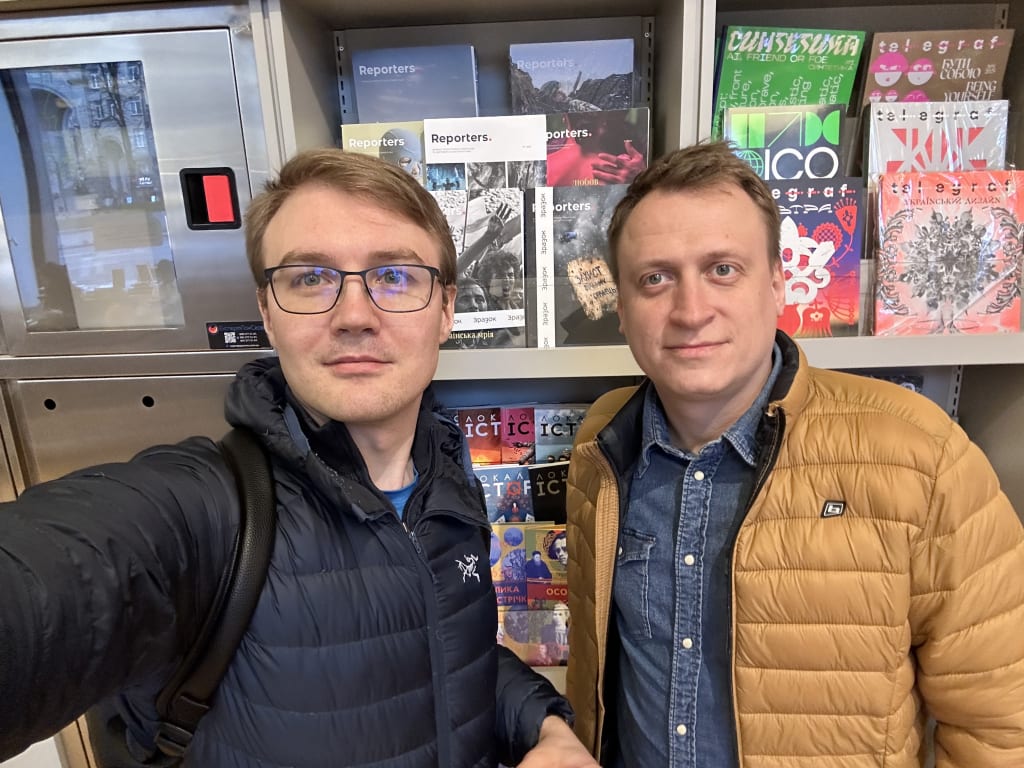
Denys Sviatokum is a Ukrainian defence-sector coordinator and industry leader serving as Chairman of the Ukrainian Dual-Use Technology Cluster, an organization uniting more than 70 companies focused on defence and dual-use innovation. His work centers on connecting Ukrainian battlefield-tested technologies with international partners, facilitating integration, joint development, and scaling of operational solutions. In parallel, he serves as a Board Member of the Federation of Employers of Ukraine “Defence,” representing over 500 companies in the national defence industry. Through these roles, Sviatokum contributes to strengthening Ukraine’s industrial coordination, international collaboration, and technological resilience amid ongoing war conditions.
Scott Douglas Jacobsen interviews Denys Sviatokum on Ukraine’s rapidly expanding dual-use technology sector, focusing on how wartime necessity has accelerated drone production, industrial integration, and asymmetric defence strategy. Sviatokum explains his roles in the Ukrainian Dual-Use Technology Cluster and FEU Defence, arguing that dual-use framing connects civilian and military innovation while attracting Western financing and partnerships. He describes Ukraine not only as an innovator but also as an integrator of technologies across the air, ground, and maritime domains. The discussion emphasizes low-cost systems, battlefield adaptation, post-war industrial redirection, and the changing economics of modern warfare under sustained pressure from Russia’s full-scale invasion today.
Scott Douglas Jacobsen: What are your current roles?
Denys Sviatokum: I am the Chairman and co-founder of the Ukrainian Dual-Use Technology Cluster. It is an association that currently brings together more than 70 companies.
I am also a board member of FEU Defence, which is part of the Federation of Employers of Ukraine. FEU Defence brings together 17 regional and sectoral associations whose members include about 500 companies of different forms of ownership. We work to build stronger connections across the defence industry, support growth, represent members’ interests before the government, and help address structural gaps in the sector.
I focus on dual-use technology because it connects civilian and military industries and supports technology transfer for Ukraine’s future. I want Ukraine to become a country that creates value through technological innovation and shares those products with the world.
Many Ukrainian businesses have redirected their activities toward defence since the start of Russia’s full-scale invasion. This has been necessary for survival. At the same time, after the war, some of these enterprises may struggle if they remain dependent only on wartime demand. I want to help redirect that capacity into civilian innovation, production, and long-term technological development.
That is my overview.
Jacobsen: Why use the term “dual use”? What do you mean by it, and what does it replace among standard terms?
Sviatokum: Historically, “dual use” refers to goods and technologies that can be used for both civilian and military purposes, especially in the context of export controls and international trade regulation.
Today, many Ukrainian businesses and entrepreneurs have redirected their facilities, teams, and engineering capacity toward defence needs since the full-scale invasion. In my view, this also reflects the logic of dual use, because the same infrastructure and technical expertise can support both military and civilian production.
Jacobsen: For example, one drone can deliver payloads, while another could transport an injured person to a hospital.
Sviatokum: Exactly. Drones can be used in logistics, medicine, infrastructure inspection, construction support, and many other areas. That is what I mean by dual use.
A useful historical analogy is that the U.S. military originally developed GPS and later opened it to civilian use, while the internet grew in part from ARPANET, funded by the U.S. Department of Defence, before evolving into a global civilian network. I see this as a constructive model for Ukraine’s economy—building technologies that serve defence needs now and later support civilian sectors.
Ukraine also faces financing constraints in defence production. As a result, companies often adapt civilian technologies, including drones and related systems, to meet urgent military needs and close capability gaps.
Jacobsen: What other foundational concepts are important here? In terms of dual-use technology, the defence industry, drones, counter-drone systems, and related areas are of interest.
Sviatokum: One reason I emphasize the term “dual use” is that it is more legible to European and Western funding ecosystems than a narrowly military label. It creates an entry point for financing, partnerships, and cooperation involving technologies with both civilian and defence applications.
My goal is to make these opportunities clearer and more accessible for international partners and investors.
Jacobsen: How large is the industry now? And for comparison, how large was it about 12 years ago?
Sviatokum: At present, the most active segment of the sector is drone companies, though there are many others as well. Since the start of the full-scale invasion, the sector has grown significantly—from roughly $2 billion in procurement or production capacity to around $40 billion. That is about a twentyfold increase.
We now have more than 3,000 enterprises and projects operating in this space. Before the full-scale invasion, there were only about six or seven drone companies. Today, there is a wide range of companies working across different types of systems, including research and development.
In my view, Ukraine is not primarily an innovator in the traditional sense—we are integrators. We bring together technologies from different fields into unified systems and build supply chains around them. The sector is growing rapidly and transforming existing defence production models.
There have been comments from executives at companies such as Rheinmetall encouraging rapid, decentralized innovation in Ukraine. I understand that perspective. Traditionally, large defence companies invest heavily in long-term development strategies. However, the current war has disrupted that model.
Now, relatively inexpensive systems—such as drones costing around $1,000—can destroy equipment worth millions, including tanks. This fundamentally changes the economics of warfare.
Jacobsen: There are two factors here. Ukraine has a smaller population and fewer financial resources than the Russian Federation. Therefore, drones—especially cost-effective systems, including counter-drone technologies—help address both constraints while preserving personnel.
Sviatokum: That is correct. To survive, we must act asymmetrically. We focus on creating the most cost-effective solutions available. The Russian Federation has advantages in workforce, funding, and industrial scale. Because of that, Ukraine must adapt quickly and pursue asymmetric strategies. Drones and other relatively low-cost systems allow us to compensate for those disparities.
Jacobsen: The Black Sea Fleet is a good example of this.
Sviatokum: Yes, it is a strong example.
Jacobsen: When people think of drones, they usually think of aerial systems. They do not always realize that there are also maritime drones.
Sviatokum: Exactly. The concept applies to all unmanned systems—air, ground, and maritime.
The most important next step is integration across these domains. These systems can operate together as coordinated, multi-domain platforms—essentially functioning as robotic units operating across different environments.
Maritime drones have demonstrated how relatively low-cost systems can challenge traditional naval assets. Historically, major naval powers relied on large ships and expensive platforms. Now, much cheaper unmanned systems can threaten or disable them. This represents a significant shift in how naval warfare is understood.
Jacobsen: Thank you very much for the opportunity and your time, Denys.
Scott Douglas Jacobsen is a blogger on Vocal with over 130 posts on the platform. He is the Founder and Publisher of In-Sight Publishing (ISBN: 978–1–0692343; 978–1–0673505) and Editor-in-Chief of In-Sight: Interviews (ISSN: 2369–6885). He writes for International Policy Digest (ISSN: 2332–9416), The Humanist (Print: ISSN, 0018–7399; Online: ISSN, 2163–3576), Basic Income Earth Network (UK Registered Charity 1177066), Humanist Perspectives (ISSN: 1719–6337), A Further Inquiry (SubStack), Vocal, Medium, The Good Men Project, The New Enlightenment Project, The Washington Outsider, rabble.ca, and other media. His bibliography index can be found via the Jacobsen Bank at In-Sight Publishing,, comprising more than 10,000 articles, interviews, and republications across more than 200 outlets. He has served in national and international leadership roles within humanist and media organizations, held several academic fellowships, and currently serves on several boards. He is a member in good standing in numerous media organizations, including the Canadian Association of Journalists, PEN Canada (CRA: 88916 2541 RR0001), Reporters Without Borders (SIREN: 343 684 221/SIRET: 343 684 221 00041/EIN: 20–0708028), and others.
Image Credit: Scott Douglas Jacobsen.
About the Creator
Scott Douglas Jacobsen
Scott Douglas Jacobsen is the publisher of In-Sight Publishing (ISBN: 978-1-0692343) and Editor-in-Chief of In-Sight: Interviews (ISSN: 2369-6885). He is a member in good standing of numerous media organizations.
Keep reading
More stories from Scott Douglas Jacobsen and writers in Interview and other communities.
Dominique Simeone Link Esperanto, Humanism, and Language Justice
Dominique Simeone is an Italian-born multilingual freethinker, writer, and Esperanto advocate associated with SAT-Amikaro and broader international humanist networks. Public biographical materials describe early study and use of Italian, French, German, Flemish, English, and Esperanto, reflecting a long-standing interest in language and international communication. Simeone studied economics and philosophy at Paris X-Nanterre, completed Esperanto certifications in 2005 and 2006, and later published work linking Esperanto, freethought, and humanism, including “Esperanto, a way to Humanism” in International Humanist News in 2006. Simeone’s public work consistently frames Esperanto as a non-imperialist, equality-oriented tool for practical cross-border dialogue and shared ethical community internationally.
By Scott Douglas Jacobsen3 days ago in Interview




Comments
There are no comments for this story
Be the first to respond and start the conversation.