
FWB Meaning, Explained Honestly: What “Friends With Benefits” Really Looks Like in Real Life
It’s not just casual sex, it’s a quiet negotiation of boundaries, expectations, and emotional risk

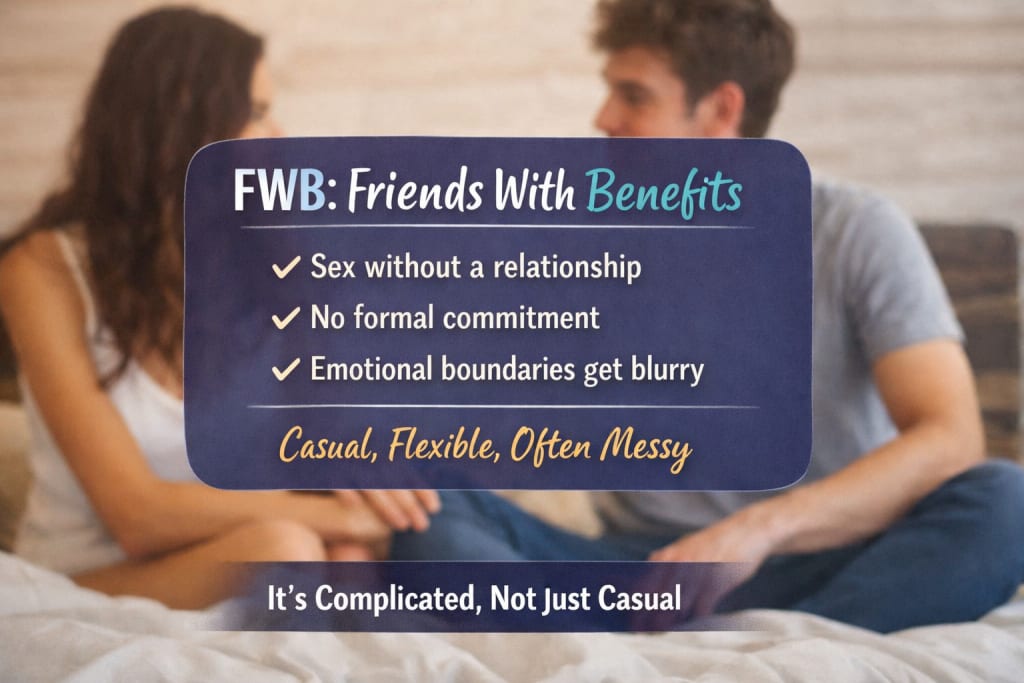
You don’t usually hear someone say, “We are in a friends with benefits situation” with complete clarity. It’s more like, “We’re hanging out… it’s chill,” or “We’re not dating, but we’re not not something either.”
That hesitation is the whole story.
Because if you’ve ever tried to define FWB, you’ve probably noticed something strange. Everyone thinks they know what it means, until they’re in one. Then the definition starts to blur, stretch, and occasionally break.
So let’s answer the question directly, without the polished gloss:
FWB, or friends with benefits, means two people who have a sexual relationship without committing to a traditional romantic partnership. But that clean definition misses the tension that makes it complicated, and honestly, interesting.
The Basic Definition, and Why It’s Not Enough
On paper, FWB sounds simple. You’re friends. You sleep together. No strings attached. No expectations of exclusivity. No pressure to build a future. No obligation to merge lives.
But in practice, almost no one experiences it that cleanly.
Because the moment you add physical intimacy to a friendship, the dynamic shifts. You start noticing things you didn’t before. The way they text, the way they leave, whether they stay the night or not.
You begin measuring small actions that wouldn’t matter in a normal friendship.
And suddenly, something that was supposed to be “simple” requires constant interpretation.
It Starts Casual, Then Patterns Form
Most FWB situations don’t begin with a contract or a clearly defined agreement. They begin with a vibe.
Two people who already get along.
A moment of chemistry.
A decision that feels low-risk at the time.
Maybe it’s after a breakup. Maybe it’s convenience. Maybe it’s just attraction that doesn’t seem worth ignoring.
At first, it feels easy. You meet, you laugh, you hook up, and then you go back to your separate lives.
But then patterns start forming.
One person texts more.
One person lingers longer.
One person starts to expect things the other never promised.
And this is where FWB stops being a definition and starts being a negotiation.
The Unspoken Rules Everyone Pretends Are Clear
Ask five people what FWB means, and you’ll get five slightly different answers.
Some think it includes sleepovers and emotional support.
Others believe it should be strictly physical, almost transactional.
Some assume exclusivity. Others actively avoid it.
The problem is, most people don’t clarify these rules upfront. They assume alignment.
That assumption is where things quietly fall apart.
Because while both people might agree on “no relationship,” they often mean very different things by it.
For one person, it means freedom. For the other, it means “not yet.”
Emotional Drift Is the Real Story
People like to say FWB works as long as “no one catches feelings.” That sounds clean. It’s also unrealistic.
Feelings don’t arrive with an announcement. They build slowly through repetition and familiarity.
You share a bed enough times, you start to associate comfort with that person. You talk late into the night, you start to care about their opinions. You rely on them in small ways, and those small ways add up.
This is emotional drift. It doesn’t mean you’re in love. It means the boundaries you set at the beginning no longer match how you feel now.
And here’s the uncomfortable part. Often, only one person notices the shift.
Why People Choose FWB Anyway
If it’s this messy, why do people keep choosing it?
Because it solves very real problems.
FWB offers connection without the full weight of commitment. It gives you intimacy without having to restructure your entire life.
For someone who just got out of a relationship, it can feel like breathing room. For someone focused on career or personal goals, it can feel efficient. For people who value independence, it can feel safer than traditional dating.
There’s also honesty in it, at least at the start. You’re not pretending to build something permanent. You’re acknowledging the present moment for what it is.
And that honesty can feel refreshing in a dating landscape full of mixed signals.
Where It Gets Complicated Fast
The complications rarely come from the physical side. They come from expectations that quietly evolve.
One person starts to prioritize the other. One person gets jealous but feels they don’t have the right to say it. One person begins to hope the situation will “naturally” turn into something more. Meanwhile, the other person is still operating under the original agreement.
This mismatch creates a specific kind of tension. It’s not dramatic enough to force a conversation, but it’s strong enough to change how interactions feel.
You start overthinking texts. You notice inconsistencies. You feel slightly off, but you can’t point to a clear violation.
That gray area is where most FWB situations live.
The Illusion of Control
FWB often feels like a controlled version of dating.
You decide the terms. You limit the emotional exposure. You keep things contained.
But control is mostly an illusion here.
Because you can set boundaries, but you can’t fully control how attachment develops, yours or theirs. And once emotions enter the picture, even subtly, the structure you built starts to feel less stable.
You might still call it FWB, but internally, it no longer feels casual.
What “No Strings Attached” Really Means
People love the phrase “no strings attached.” It sounds clean, almost clinical. In reality, it usually means “no agreed-upon responsibilities.”
But that doesn’t mean no impact.
Time spent together still creates familiarity. Physical closeness still builds memory. Consistency still creates expectation, whether acknowledged or not.
So the “no strings” idea is less about reality and more about intention. It’s what both people want the situation to be, not always what it becomes.
The Moment You Realize It’s Changed
There’s usually a moment, small but sharp, when you realize your FWB situation isn’t what it was.
Maybe they cancel plans and it bothers you more than it should. Maybe they mention seeing someone else and you feel something twist. Maybe you start wondering where you stand, even though you agreed not to ask.
That moment is important because it forces a quiet question:
Are you still aligned with the original idea, or are you staying because it’s easier than redefining things?
So, What Does FWB Really Mean?
FWB means different things to different people, but in practice, it’s this:
A flexible, often undefined relationship where physical intimacy exists without formal commitment, and where emotional boundaries are constantly being tested, adjusted, or ignored.
It’s not inherently good or bad. It depends on timing, self-awareness, and whether both people are being honest, not just with each other, but with themselves.
And that last part is where most people struggle.
Because it’s easy to agree to something casual. It’s much harder to stay casual when the experience stops feeling that way.
About the Creator
Opinion
A dedicated space for bold commentary and honest reflections on the world around us. Whether you agree or dissent, my goal is always to get you thinking.
Why Wiked: For Good is Undeservingly the ‘worse movie’
So… off the bat, we’re about to delve into something ridiculous. Just so we’re clear on that, ok? The first thing anyone that knows a thing about these dual movies… knows… is the original movie and sequel were shot together.
By Gabriel Shames3 days ago in Humans
Gen Z Relationship Boundaries Redefining Modern Dating Expectations And Communication
The culture of dating has evolved over the past decade unlike it was in the past fifty years and the Gen Z has been at the forefront of the change. Gen Z does not prioritize timelines and implicit rules like the ones followed in the traditional relationships and instead is flexible, emotionally conscious, and highly conscious of personal limits when dating. This has transformed the nature of communication, connection and choice of what people desire out of the romantic relationships.
By Olivia Smithabout 23 hours ago in Humans



Comments
There are no comments for this story
Be the first to respond and start the conversation.