
The Servant Becomes the Master
The Architecture of the Scythe Lore: Tinseltown

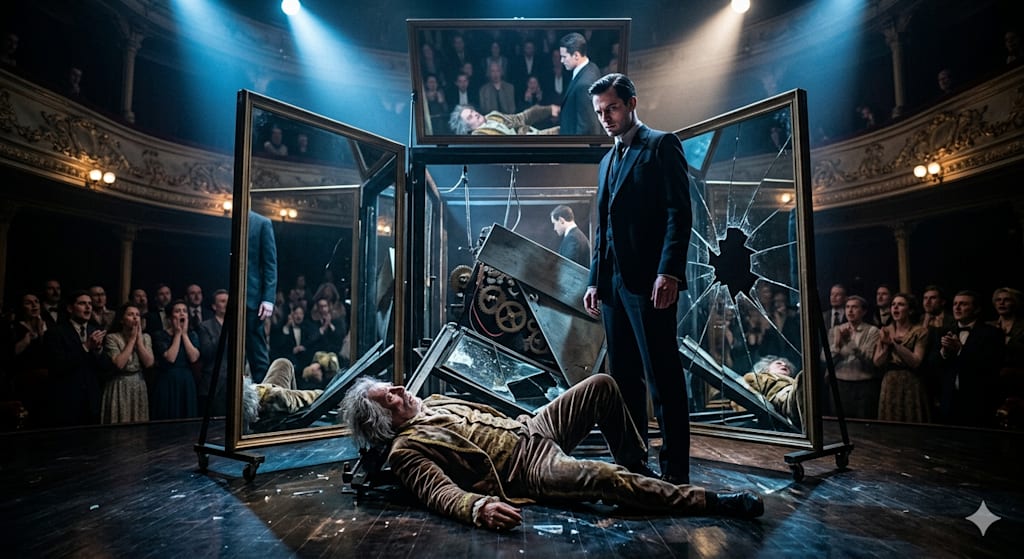
Fifteen years had passed since the velvet curtains of the Muscovite Theatre Guild succumbed to the moths and rot. Fifteen years since Solomon Caravaje walked out of that crumbling D-list circuit purgatory, leaving behind the stale scent of camphor, gin, and desperate nightly guarantees. He traded the dying filament of a solitary stage for the cold fluorescence of the boardroom. He traded the grift for the institution.
Apex Synthesis no longer existed as a nascent ambition sketched out in the shadows; it sprawled into a billion-dollar monolith. The Cathedral of Promise, they called it—a towering headquarters of polished obsidian and reinforced panes, a structure explicitly designed to reflect a perfectly uniform, completely synthesized reality. Within these walls, Solomon successfully codified the old, sloppy stage tricks of the Palindrome into a proprietary methodology. He weaponized the psychological scaffolding of the illusionist, scaling it up until it formed a massive corporate lie. Apex operated flawlessly. It closed into a loop of absolute symmetry. Clients entered seeking direction, and were fed into a gristmill that handed them back their desires, perfectly repackaged as enlightenment. Solomon promised he would become the gravity, and he delivered. He was the omnipresent force holding Apex’s manufactured world together.
In this calculated vacuum, no room existed for anomalies: every variable controlled, every outcome projected. For this, retention of Evorove the Magnificent as a "Senior Consultant" had been a calculated risk—one Solomon now recognized as a critical misjudgment.
When Solomon had drawn up the foundational contracts for Apex, he offered Evorove a sinecure. It was framed as an act of grace, a pension for the aging maestro who had unwittingly handed his apprentice the blueprints to the world. In truth, it was subjugation. Solomon wanted the old man mounted on the wall like a taxidermied beast, a living reminder of the past Solomon had conquered. Evorove was supposed to don a sterile gray suit, sit in a quiet corner office, and fade into the humming machinery.
But a predator, even an aging one, rarely dies quiet.
Instead of withering under sterile lights, Evorove adapted. Stripped of his threadbare tuxedo and rusted trapdoors, the old showman leaned into a weapon Solomon could not patent: his sheer, undeniable magnetism. Evorove moved through the sleek, mirrored corridors of Apex with exaggerated, predatory grace. He didn't speak in the sanitized lexicon. He spoke in the old rhythms.
Evorove retained that dark, hypnotic, and resonant baritone—a voice that coiled around the subconscious and squeezed. When he led introductory seminars or "executive alignment sessions," he didn't present data; he wove elaborate, meaningless patterns in the heavy, conditioned air. He built psychological cages out of cadence and tone, just as he had in the front three rows of the Muscovite.
And the clients—the broken masses and the elite alike, desperate for something tangible in a world of polished mirrors—flocked to him. They didn't just comply with Evorove; they worshipped him. A fervent, starry-eyed cult of personality began to metastasize within the sterile walls of Apex. They hung on his every pronouncement, treating his vague, theatrical advice as esoteric scripture. To them, he was not a corporate consultant; he was a guru, a relic of raw, unvarnished truth in a cathedral of lies.
From the vantage point of his top-floor office, Solomon watched the contagion spread. The surveillance feeds showed Evorove holding court in the atrium, surrounded by acolytes whose eyes shone with the same desperate hunger Solomon remembered from the vaudeville days. The old man was grinning, soaking in the adoration, his luminous personality cutting through like a spotlight.
Solomon stared at the monitors, his jaw tightening as he traced the slight variance in symmetry that Evorove’s presence brought to the meticulously organized atrium. It was sickening. Solomon spent a decade and a half building an empire of perfect angles, where obedience was extracted through mathematical precision and litigious contracts. He replaced the cheap thrill of the vanishing dove with the absolute certainty of the quarterly projection. He made the illusion flawless.
Yet, here was the old hack, violating the perfected serenity of Apex with nothing but a worn smile and a practiced vocal tremor. The adoration in the faces of the clients wasn't the calculated compliance Solomon engineered; it was messy, organic, and dangerously unpredictable. It was genuine awe. Solomon despised it. He realized that while he had built the cage and mastered the locks, Evorove still held the keys to the subjects’ minds.
The closed loop of symmetry was breaking. The understudy had become the Architect, but the Architect now realized truth: as long as the original magician drew breath, the audience would always look to his hands for the trick. Evorove existed no longer as a ghost of the Muscovite; he was an active infection in the Cathedral of Promise, consuming all the vital oxygen. He had become a flaw in the system. FHe needed to be permanently erased.
The Hall of Aspirations presented the venue; a temple built to the specifications of a math equation. Located at the very heart of the Apex complex, the hall was a vast, circular void of white marble and recessed lighting that could simulate the hue of a sunrise or the cold blue of a deep-sea trench. There were no curtains, no dust-choked rafters, and no smell of gin. The air was scrubbed, ionized, and scented with a faint, clinical hint of eucalyptus—the smell of a clean conscience.
Solomon Caravaje stood at the center of the mezzanine, hands clasped behind his back, looking down at the stage, a minimalist disc of polished obsidian floating in the center of the white floor. It was the antithesis of the Muscovite Theatre Guild.
"It lacks soul, Solomon," a voice rumbled from the shadows behind him.
Solomon didn't turn. He knew the vibration of that baritone in his marrow. Evorove stepped into the light, wearing a silk dressing gown that looked like a relic from a different century, a splash of chaotic crimson against the sterile white of the hall. He looked older, his hair a shock of silver, but his eyes still held that theatrical glint.
"Soul is a variable inconsistent with long-term growth, Alexander," Solomon replied, his voice flat and precise. He finally turned, offering a thin, practiced smile. "But that is why I’ve called you here. We are approaching the fifteenth anniversary of our partnership. The board wants a celebration. Something that honors the... foundational architecture of Apex."
Evorove arched a graying eyebrow. "The board? Or you, Solomon? You haven't looked at me with anything but professional disdain for a decade. Why the sudden interest in the 'foundational architecture'?"
Solomon stepped closer, his movements fluid. "Because the clients are hungry for it. They see the polished glass and the algorithms, but they want to know where the magic came from. They want to see the spark that started the fire. I want to host a gala—The Legacy of Synthesis. And I want you to be the centerpiece."
He watched the vanity take hold. He could see it in the way Evorove straightened his posture, the way his fingers instinctively traced an imaginary coin in the air. The old showman had been starving for a stage that wasn't a corporate breakout room.
"A gala," Evorove mused. "With an audience that matters? The titans, the architects, the believers?"
"The Inner Circle only," Solomon promised. "The most devoted. I want them to see the Great Palindrome one last time. I want you to perform the Mirror Box. The original routine. No digital enhancements, no holographic overlays. Just the raw, psychological scaffolding that built this empire."
Evorove’s eyes narrowed, the carny instinct flickering behind the silver hair. "The Mirror Box? It’s a relic, Solomon. A cheap trick from a dying circuit. Why would your 'Inner Circle' care about a box of mirrors and a bit of sleight of hand?"
"Because," Solomon said, his voice dropping to a conspiratorial whisper, "it isn't just a trick. It’s the proof of concept. It’s the moment we proved people will believe a lie even when they can see the seams, provided the cadence is right. It’s the ultimate act of nostalgia, Alexander. A tribute to the man who taught me everything."
It was masterful manipulation. Solomon wasn't appealing to Evorove’s logic; he appealed to his hunger. He offered him the one thing Apex had taken away: the spotlight of a True Believer’s gaze.
Evorove paced the length of the mezzanine, his crimson robe billowing. He looked down at the obsidian stage, imagining it filled with the elite of the city, their faces turned upward in the same desperate, starry-eyed worship he saw in his acolytes. He saw the chance to finally eclipse the Architect in his own house.
"It would need to be perfect," Evorove said, his voice regaining its stage resonance. "The lighting, the angles... I won't have it look like a museum piece. If I am to step back into the box, it must be the definitive performance. A disappearance that leaves them questioning the very nature of the walls around them."
"I would expect nothing less," Solomon said, the smile reaching his eyes this time, though the warmth was entirely synthetic. "I’ve already commissioned the construction. We’re using the original blueprints you gave me fifteen years ago, but executed with Apex materials. Reinforced mahogany, aerospace-grade mirrors, precision-weighted hinges. It will be perfect."
Evorove stopped pacing and looked at his former apprentice. For a brief second, the old man’s eyes searched Solomon’s face, looking for the wire, the trapdoor, the tell. But Solomon had been a master of the mirror for a long time. He showed Evorove exactly what the old man needed to see: a grateful student paying his debts.
"Fine," Evorove whispered, a slow, hungry grin spreading across his face. "One last show for the Inner Circle. Let us remind them, Solomon, that before there was gravity, there was the magician."
"Exactly," Solomon replied, turning back to the void of the hall.
As Evorove swept out of the mezzanine, his mind already choreographing the patterns he would weave in the air, Solomon remained. He looked at the spot on the floor where the box would sit. He thought about the variance in symmetry he had memorized all those years ago. He thought about the weight of the mahogany and the absolute, crushing silence of a vacuum.
The marketing team was already drafting invitations. “The Architect Presents: The Origin of the Void.” It was marketed as an intimate, once-in-a-lifetime demonstration of the foundational architecture behind their reality. It was calculated nostalgia, a sentimental bridge back to the Muscovite.
But Solomon knew the truth of the Palindrome. You can only move forward by looking back, and you can only truly own the room once you’ve removed the person who taught you how to walk into it. The stage was set, the mark ready, and the air in the Hall of Aspirations was about to get very thin.
The subterranean levels of the Hall of Aspirations were a realm of sterile, pressurized silence. While the upper tiers of the Cathedral of Promise were designed to dazzle the eye with reflected light, the bowels of the building were dedicated to the cold, hard mathematics of the foundation. Here, there were no mirrors—only the raw, skeletal steel that supported the illusion above.
Solomon Caravaje moved through the fabrication lab with the clinical detachment of a surgeon. The air here didn't taste of eucalyptus; it smelled of machine oil, and the sharp, ionized tang of laser-cut metal. This was where the "magic" of Apex was physically manifested, where psychological theories were translated into the hardware of control.
In the center of the lab, bathed in harsh, shadowless light, stood the new Mirror Box.
It was a masterpiece of industrial design. Solomon had discarded the original blueprints’ reliance on blackened plywood and rusted hinges. Instead, this box was a monolith of reinforced mahogany, its grain so dark and dense it looked like petrified shadow. The mirrors weren't silvered glass; they were aerospace-grade, multi-layered dielectric reflectors, capable of redirecting light with zero percent scatter. To look at the box was to see a hole in reality, a perfectly symmetrical void that shouldn't exist.
Solomon ran a gloved hand over the corner of the structure. He didn’t think about the gala or the "Inner Circle." He thought about a Tuesday night fifteen years ago in the Muscovite Theatre Guild. He thought about the squeak of a rusted hinge and the brief, betraying flash of a hidden compartment that had been just slightly out of alignment.
He remembered the math of that failure. A three-percent variance in symmetry.
To the drunks and the desperate in the front rows of the Muscovite, that error was just a smudge on the trick—a moment where the illusion faltered and the "magic" felt cheap. But to Solomon, that three-percent was the secret door. It was the flaw that allowed the apprentice to see through the master. Now, he was going to take that memory and sharpen it into a blade.
"Is the hydraulic synchronization complete?" Solomon asked, his voice echoing flatly against the reinforced concrete walls.
A technician, clad in a white lab coat that looked more like a shroud, looked up from a tablet. "The trapdoor mechanism is calibrated to a thousandth of a millimeter, Mr. Caravaje. The transition is instantaneous. The weight sensors will trigger the descent the moment the center of gravity shifts past the threshold."
"Leave us," Solomon said. "I need to perform the final manual inspection of the interior geometry."
Once the technician had vanished into the shadows of the corridor, Solomon stepped toward the box. He didn't use a tablet. He pulled a small, unassuming toolkit from the pocket of his tailored coat.
He stepped inside the box. The interior was a claustrophobic cage of mirrors, reflecting his own cold eyes back at him. It was the ultimate Palindrome: a room where every direction led back to the center.
He knelt. The false floor, the "vanishing" mechanism, was a marvel of silent hydraulics. In its intended state, it would drop six inches—just enough to hide a man in the velvet-lined cavity while the mirrors shifted to show an "empty" box. It was a lie of depth, a trick of the light.
Solomon didn't want a trick. He wanted a conclusion.
With the precision of an assassin, Solomon began to work on the primary locking pins of the hydraulic assembly. He didn't remove them; he filed them down. He thinned the structural integrity of the weight-bearing struts until they were holding on by a literal hair’s breadth of tempered steel. He recalibrated the sensors not to stop the descent at six inches, but to accelerate it.
He was weaponizing the architecture.
In the old version of the act, the danger was the reveal. In Solomon’s version, the danger was the reality. When Evorove stepped into this box, he would be stepping into a hydraulic press disguised as a nostalgic tribute. When the trapdoor triggered, it wouldn't be a graceful descent into a hidden compartment; it would be a violent, high-pressure collapse. The mahogany would not hide him; it would crush him.
Solomon stood up, stepping out of the box and smoothing the lapels of his coat. He looked at the structure one last time. It was beautiful. It was a perfectly symmetrical lie, concealing a fatal, calculated truth.
He had spent fifteen years building a world where he was the gravity. Now, he was simply applying that gravity to the man who had dared to think he could still fly. Evorove wanted the spotlight; Solomon would give him a disappearance so absolute that the world would never find the remains.
The "sleight of hand" was no longer a matter of quick fingers or distracting patter. It was a matter of structural engineering. Solomon Caravaje, the Architect of Apex, had finally finished the blueprints for the master’s final act. The oxygen in the room was already beginning to fail, and the trap was set with a three-percent margin for error that guaranteed a one-hundred-percent success. He closed the lab door, leaving the Mirror Box alone in the dark, waiting for its passenger.
The Hall of Aspirations was a vacuum of expectation. The Inner Circle—two hundred of the most powerful architects of the new reality—sat in tiered, obsidian-clad rows that spiraled upward toward the dome of the Cathedral of Glass. There was no chatter, no clinking of glasses. The silence was absolute, a byproduct of the pressurized air and the collective, bated breath of a cult waiting for its god to speak.
The lighting was a cold, lunar silver, casting long, razor-sharp shadows across the white marble floor. At the center of the obsidian stage sat the Mirror Box. It looked less like a magician’s prop and more like a minimalist sarcophagus, its mahogany surfaces absorbing the light while its dielectric mirrors reflected the audience back at themselves in a fractured, infinite loop.
Solomon Caravaje stood in the shadows just off-stage, clad in a suit that cost more than the Muscovite Theatre Guild’s entire yearly budget. He was the picture of corporate elegance, but his hands were steady with the practiced stillness of a demolitionist. He watched Evorove take the stage.
The old man was magnificent. He had traded his crimson robe for a tuxedo of such deep midnight blue it appeared black under the lunar lights. He didn't walk onto the stage; he manifested. He moved with that same exaggerated, predatory grace that had once enthralled the drunks in the front row, his hands weaving those familiar, hypnotic patterns in the pressurized air.
"Tonight," Evorove’s baritone rumbled, the sound vibrating through the floorboards and into the marrow of every person in the room, "we return to the void. We go back to the moment before the Architect drew his first line. We seek the vanishing point."
The audience was spellbound. Solomon watched as the "Inner Circle"—men and women who dealt in global data and high-yield synthesis—leaned forward with the same raw, animal hunger he’d seen in the eyes of penniless dreamers fifteen years ago. Evorove was feeding them the one thing Solomon’s algorithms couldn't provide: the intoxicating terror of the unknown.
Solomon stepped from the shadows. He played the role of the silent assistant with terrifying efficiency. He didn't look at Evorove’s face; he looked at the box. He wheeled it to the exact center of the stage, ensuring the weight sensors were primed. Every movement was a part of the choreography, a silent tribute from the servant to the master.
"The Palindrome," Evorove whispered, his voice dropping to a register that felt like a physical weight. "A door that opens from both sides. A beginning that is also an end. To find the center, one must first disappear."
He turned to the box. He ran a hand along the polished mahogany, his fingers trailing over the invisible seams Solomon had sabotaged. For a fleeting second, Evorove paused. His carny instinct, that ancient, rusted radar for danger, seemed to twitch. He looked at Solomon, his eyes searching the younger man’s face for the wire, the trap, the tell.
Solomon didn't blink. He offered a slight, respectful bow—the ultimate act of deceptive submission. "The stage is yours, Maestro," he said, the words a silent death warrant.
Evorove smiled. It was a smile of pure, unadulterated vanity. He believed he was the light in this room. He believed he was the oxygen. He stepped into the Mirror Box.
The interior mirrors immediately caught his image, multiplying him a thousand times over. There were a thousand Evoroves, all grinning, all leaning into the trap. Solomon stepped forward and closed the heavy mahogany door. The click of the magnetic latches was a final, rhythmic beat.
"Watch closely," Evorove’s voice came from within the box, muffled but still resonant. "For the world you know is about to become a lie."
Solomon didn't wait for the cue. He reached into his pocket and gripped the small, encrypted remote—the digital trigger for the mechanical failure.
In the old days at the Muscovite, this was the moment of the 'vanishing.' Evorove would trigger the manual floor, drop six inches into the velvet-lined mahogany compartment, and Solomon would spin the box to show the empty mirrors. The audience would gasp, and the trick would be complete.
But this was the Hall of Aspirations.
Solomon pressed the button.
There was no loud bang, no theatrical explosion. The engineering was too precise for that. There was only a sharp, sickening thrum of high-pressure hydraulics, followed by the muffled, metallic snap of the filed structural pins.
Inside the box, the "vanishing" mechanism didn't drop six inches. It accelerated downward with three tons of force, while the weighted ceiling of the inner compartment—the part designed to look like the "top" of the empty box—slammed shut to meet it.
The sound was like a heavy book closing in a library. A wet, muffled thud that was instantly swallowed by the pressurized acoustics of the hall.
The audience didn't scream. They didn't even flinch. To them, the sudden, violent vibration of the box was simply a part of the visceral experience—the raw, physical cost of the synthesis. They watched, rapt, as Solomon stepped forward and performed the final movement.
He spun the box.
The mirrors shifted, realigning with mathematical precision. The interior of the box appeared perfectly, beautifully empty. There was no blood, no sound, no trace of the man who had been standing there a heartbeat ago. The variance had been corrected. The flaw erased.
Solomon Caravaje stood alone on the stage, the silent architect of a perfect void. He looked out at the Inner Circle, their faces illuminated by the lunar lights, their eyes wide with a terrifying, newfound devotion.
"The Master has departed," Solomon said, his voice flat and cold, filling the vacuum Evorove had left behind. "And the architecture remains."
The disappearance was absolute. The oxygen in the room was finally his to breathe. Solomon turned toward the box, his reflection staring back at him from the aerospace-grade glass—a single, unyielding image in a room that no longer required a Palindrome. The servant had not just become the master; he had become the only reality left.
About the Creator
Nathan McAllister
I create content in the written form and musically as well. I like topics ranging from philosophy, music, cooking and travel. I hope to incorporate some of my music compositions into my writing compositions in this venue.
Cheers,
Nathan
Keep reading
More stories from Nathan McAllister and writers in Horror and other communities.
Temptation in the Wilderness
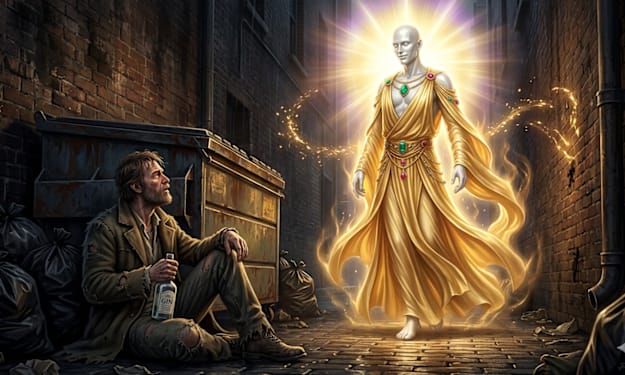
The alleyway behind St. Jude’s Mission was a geography of discarded things. It was narrow, brick-lined and swallowed the city’s refuse and exhaled thick, chemical miasma of industrial runoff and neglect. Silas was folded into the shadows, his back pressed against a rusted dumpster that vibrated with the low-frequency hum of a nearby transformer. To the world, he was part of the rubble, a discarded stone in a city of glass. To Silas, the world was a screaming discord of structural failures, a "Static" so loud that only the bitterest gin could lubricate the grinding of his consciousness.
By Nathan McAllistera day ago in Horror
Ghostly Happenings in Colorado
Disturbed Spirits In Denver, an expanse of greenery, Cheesman Park comes with a macabre history since it was once a burial ground known as Mount Prospect Cemetery established by General William Larimer in 1858. The job of exhuming bodies began, and some were left behind resting beneath the park. However, the ghostly spirits don’t wish to rest in peace beneath the park, and visitors here have felt cold touches, seen ghostly children playing at night, and heard a singing lady who disappears when approached.
By Rasma Raisters7 days ago in Horror
The Cave Part 11
Darkness, and the countless points of light, as if the entire void beyond was filled with the fire of a million stars. I felt as if I was staring into the eternity of a night sky beyond those wooden doors, the place beyond the actual reality, while I stood behind a curtain of scenery, the mountain and sky a mere pretense. And in that void beyond of unfathomable space, there hung suspended a mighty shard of crystal floating in place, with hundreds of a far smaller chunks orbiting around it in balanced but intersecting circles, no two in the same path. These caught the light from the center, and sparkled with inner fire each.
By Jamye Sharp3 days ago in Chapters



Comments
There are no comments for this story
Be the first to respond and start the conversation.