

I didn’t like the West End. It was a district of biological whimsy—old brick buildings covered in ivy, streets that curved without mathematical necessity, and a pervasive smell of roasting coffee and damp earth. It was a place where people lived in the margins, and Nora Sterling was the queen of the margin-dwellers.
Three years before the Vane Tower went up, we collided. It wasn't a romance; it was chaos.
We met at the gala for the Midtown Annex. I stood by the champagne pyramid, accepting praise for the cantilevered balconies. Nora stood by the exit, taking notes on the fire code violations. She wore a dress the color of bruised iron and a smile that suggested she knew the building's half-life.
I bought her a drink. She bought me an interrogation.
For three weeks, we occupied the same space. She moved into my penthouse like a sudden shift in atmospheric pressure. She left stacks of redacted files on my Barcelona chairs. She drank black coffee at 3:00 AM, her dual-monitor setup throwing harsh blue light across the room, while I drafted perfectly symmetrical floor plans in the dark.
I tried to map her. I wanted to reduce her chaotic energy to a predictable geometric function. One night, I traced the line of her spine, calculating the exact degree of its curve against the stark, 90-degree angles of my custom basalt bed.
She caught my hand.
"You build cages, Silas," she whispered, her voice a low hum against the floor-to-ceiling glass. "Beautiful, expensive cages. But you don't know what to do with the noise."
The fling ended the way a controlled demolition ends—abruptly, with a sudden collapse of tension and a ringing silence.
She packed her messenger bag on a Tuesday morning. I didn't ask her to stay. She didn't offer a reason for leaving. We simply recognized that my obsession with the grid could never coexist with her need to expose the rot beneath it. She walked out of my pristine, glass-walled life, taking the chaotic energy of the margins with her.
She left me with nothing but the lingering scent of ozone and old paper, and a faint, unresolved resonance in the foundation of my life.
Now, years later, I wasn't just looking for an ally. I was returning to the only woman who had ever shown me the cracks in my own design.
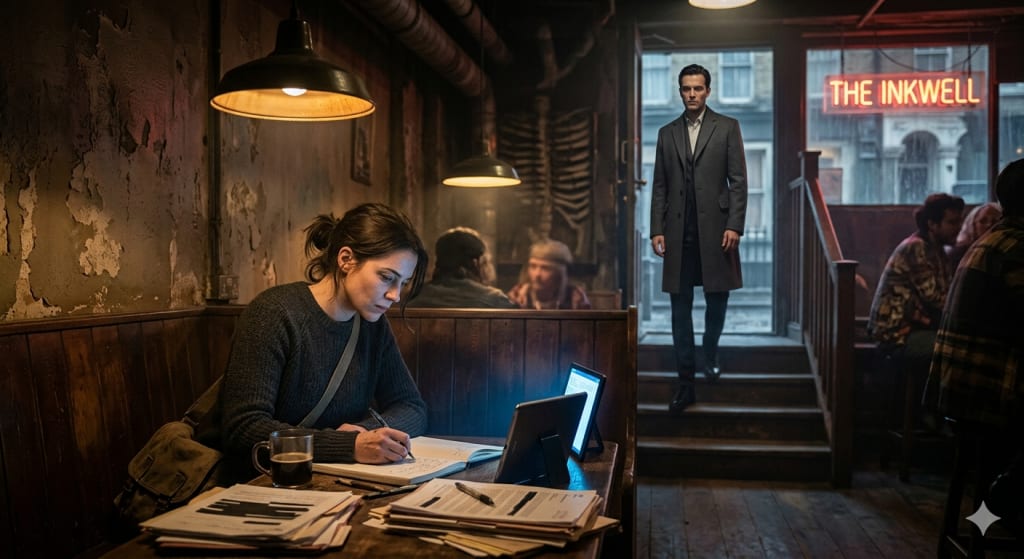
I found her at The Inkwell, a basement dive that felt like the inside of a ribcage. The air was thick with the scent of old paper and dejection. I stood in the doorway, my coat a jarring anomaly against the peeling wallpaper and flickering neon.
Nora was at a corner booth, her face illuminated by the cool, blue light of a dual-monitor setup that looked like it had been salvaged from a military surplus auction. She didn't look up when I approached.
"You’re four minutes late, Silas," she said, her fingers never leaving the keys. "For a man who obsesses over the timing of a pylon pour, your personal punctuality is surprisingly soft."
"I had to ensure I wasn't followed," I said, sliding into the booth. The seat was cracked vinyl, and it bit into my legs. "Miller has eyes in every district."
"Miller doesn't have eyes," Nora countered, finally looking up. Her gaze was clinical, stripped of the reverence I usually received. "He has sensors. There’s a difference. One implies a soul; the other implies a circuit board."
The Miller Dossier
I leaned forward, lowering my voice. "You’ve been tracking him since the Midtown collapse. You’re the only one who didn't buy the 'material fatigue' excuse the city council put out. I need to know what he’s building in the sub-basement of the Vane Foundation."
Nora reached into a weathered leather messenger bag and pulled out a thick, unmarked manila folder. She didn't hand it to me. She kept her palm flat on the cover, a gatekeeper at the vault.
"I’ve been investigating Judas Miller for six years, Silas.”
I looked over the file:
Five years ago, Miller wasn’t an errand boy. He was a god of the asphalt.
Nora’s notes began with a sort of opinion of the man, based upon her observations, research and logical deductions:
As the lead for the Narcotics Task Force in the District of Rust, Miller had mastered the art of the "Symmetric Shakedown." He didn't just take bribes; he engineered the market. He knew which shipments of industrial-grade precursors were heading to the underground labs and which ones were destined for the Order’s pharmaceutical fronts.
He had been the one to facilitate the distribution of the early prototypes of the "Clear-Head" pills. Back then, they weren't blue; they were a translucent, crystalline grey. He’d watched the first test subjects—homeless veterans and runaways—slip into a state of "ordered catatonia." They stopped shouting at the walls. They stopped resisting. They became part of the background noise of the city.
Miller had charged a twenty percent "peace tax" on every crate. He called it "managing the load-bearing capacity of the streets." He was a man of cold, hard math, and his ledger was a masterpiece of corruption. He had photos of the Commissioner's son in a heroin den on 4th; he had the forensic reports he’d "lost" regarding the bodies found in the foundations of the Vane Tower’s parking garage.
He felt no guilt. To Miller, the city was a machine, and every machine needed grease. He was just the man with the oil can.
The Structural Collapse
The collapse didn't start with an Internal Affairs investigation. It started with a man in a charcoal suit who smelled of expensive cologne and old parchment.
Nora’s notes then veered into an eyewitness account (her own, I wasn’t gonna ask how she got access to this), albeit tinged with her own assumptions, and understandable biases against Miller:
It was the night of the "Architect of the New Century" gala. While Silas Thorne was upstairs sipping vintage champagne and basking in the glow of the "Gospel of the Grid," Miller had been summoned to the service entrance of the Grand Hyatt.
He’d expected a hand-off—another envelope of "peace tax." Instead, he found Kael.
Kael didn't speak. He simply handed Miller a tablet. On the screen was a PDF titled "The Miller Architecture." It wasn't a list of crimes. It was a blueprint of his soul. Every offshore account, every recorded conversation with the cartel bosses, every timestamped photo of him planting evidence—it was all there, mapped out with the same clinical precision Silas used for his skyscrapers.
"This is a lot of work for a shakedown," Miller had sneered, though his heart had begun to hammer against his ribs like a trapped bird. "What do you want? A bigger cut?"
"We don't want your money, Detective," Kael had replied, his voice as smooth as polished marble. "We want your silence. And we want your hands. The city is entering a period of... intensive renovation. We need a man who knows how to make the inconvenient disappear without leaving a footprint."
Miller looked at the tablet. If this hit the DA’s desk, he wasn't just going to jail. He would be stripped of his badge, his home, and his identity. He would be a "statistical error" in a state-run cage.
"What's the job?" Miller asked.
"You are now the Lead Regulatory Liaison for the Order," Kael said. "When a bridge falls, you find the 'clerical error.' When a witness hears the 'Static,' you find the 'hallucination.' You will be the man who ensures the math of the city remains undisputed."
Miller didn't hesitate. He didn't care about the morality of the "Grand Harvest." He didn't care about the lives that would be ground up in the gears of the Order’s machine. He only cared that the tablet stayed dark and the dossier stayed in the vault.
He took the black radio Kael offered—the one that didn't receive police bands, but hummed with the low-frequency vibration of the "Grid."
Nora continues her tailing of Miller and gives this account:
Miller walked back into the precinct, pinned his badge to his chest, and realized for the first time that the metal was hollow. He wasn't a cop anymore. He was a load-bearing pillar for a temple he didn't even believe in.
And as long as the dossier stayed buried, he would keep the ceiling from falling.
Nora’s notes now formed the following opinions based upon her observations (including again tailing Miller, using some questionable surveillance equipment):
Miller’s first "regulatory" task didn't involve a crime scene or a body. It involved a permit.
I looked up at Nora, and said, “what’s this about a permit?”
Nora replied, “I’d like you to meet, Percy Vance. He can tell you all about that.
I said my goodbyes and went back to my apartment.
About the Creator
Nathan McAllister
I create content in the written form and musically as well. I like topics ranging from philosophy, music, cooking and travel. I hope to incorporate some of my music compositions into my writing compositions in this venue.
Cheers,
Nathan
Keep reading
More stories from Nathan McAllister and writers in Horror and other communities.
The Tithe and the Toll
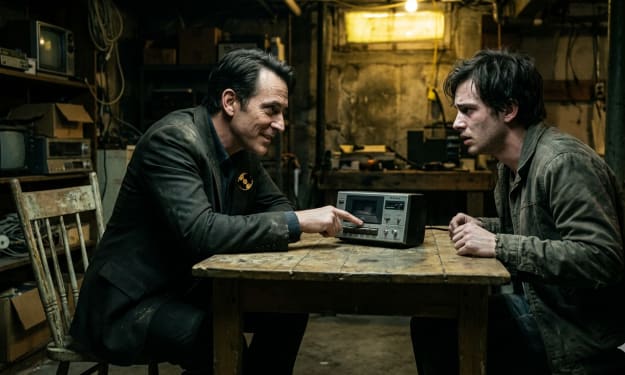
Miller pulled out a chair—a spindly, mismatched thing I’d salvaged from a dumpster and sat across from me with the grace of a king inhabiting a ruined throne. He leaned into my personal space, and for the first time in the flickering, jaundiced light of the basement, I saw the Tithe he wore. It wasn't a police badge or a municipal seal. It was a small, lapel pin made of blackened gold, shaped like a shattered vinyl record, jagged edges catching light like teeth.
By Nathan McAllister13 days ago in Horror
Watching The End Of The World From The Diner
Introduction I am not sure how to approach this. Guy Peellaert was an amazing artist who created iconic fantasy images of famous people, usually musicians or politicians, as well as creating commissioned album covers such as "It's Only Rock'n'Roll" by The Rolling Stones and David Bowie's "Diamond Dogs" which you can read more about below.
By Mike Singleton 💜 Mikeydred 4 days ago in Art


Comments
There are no comments for this story
Be the first to respond and start the conversation.