
Book Review: "Parade's End" by Ford Madox Ford (Pt. 3)
Volume 3: "A Man Could Stand Up"

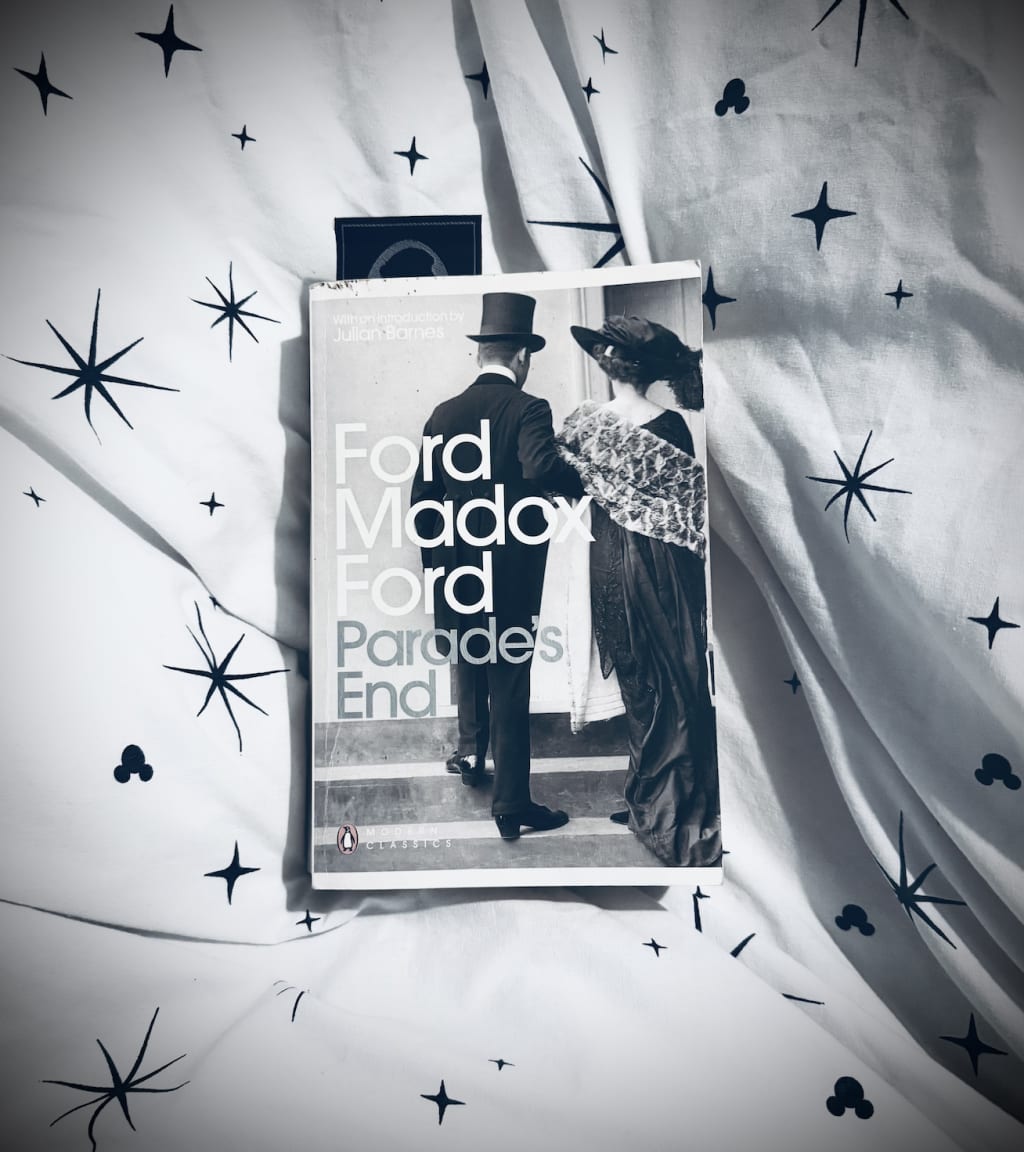
Rating: 5/5 - a slightly more intriguing and more dramatic story than that presented in volume 2. BUT, volume 1 is still the best of them all...
***
This volume opens on Armistice Day, (November 11, 1918), in Valentine Wannop’s school where she is a teacher. Fireworks and street celebrations are depicted in the opening chapters. This is Ford creating a chaotic, jubilant atmosphere in order to showcase the celebratory mood of the day. The external noise reflects the internal confusion as the world shifts abruptly from war to peace. The question still stands about whether our characters will receive the same peace, though Ford is not always that straightforward in his depictions of opposition.
Valentine is summoned from her duties as a physical instructor to take a telephone call she can barely hear over the din. The broken communication heightens tension. Eventually, she learns that Tietjens is back in London and in urgent need of assistance. I think that Valentine is definitely one of the better and more interesting characters, and to open the volume with her rather than with Sylvia really does ease us into the volume better than that of volume 2 which, in my opinion has far too much of Sylvia in it. The increasing connection between Tietjens and Valentine is depicted as her being contacted on the day of celebration, but the strange nature of the call is not without its worry. Ford is messing with our emotions on purpose.
The caller is Edith Ethel Duchemin, now Lady Macmaster, whose malicious manipulation surfaces. She has already compromised Valentine’s reputation by linking her name with Tietjens in conversation with the headmistress, reinforcing the persistent social scrutiny and moral judgment surrounding Valentine. Oh when I read this in the book and went mad. I could not believe this woman was back. There's a special place in hell for her and Sylvia - poor Valentine! But then again, she does tell her that Tietjens needs urgent help so I guess that's something. I really don't know how to feel right now and I hoped that nothing would go wrong for the new lovers.
Reflecting on her uncertain place in this new world as a woman who basically shifted the social landscape, Valentine reaches a decisive emotional conclusion. If Tietjens still wants her, she will bind her life to his, regardless of social consequence. Her resolve signals both romantic commitment and a willingness to defy expectations. We get a revisiting of some of the great plot points of Some Do Not and we get another look at the love story between Tietjens and Valentine whilst he was being basically ignored by his wife, Sylvia. Ford is basically telling us that nothing of love was ever really founded upon convention. In order to be equally in the relationship, one must push for it against the social convention which forces women to be the villains of the story when they pursue what they want. Valentine really is that same suffragette we met in volume 1.
Part 2 of this volume shifts back to April 1918 on the Western Front. Tietjens experiences a fleeting calm while conversing with his sergeant before bombardments resume. Though less graphic than earlier depictions, the violence rekindles memories of traumatic losses, including the horrific death of the welshman. There is no question that Ford's images of war are among the best in literature. The Good Soldier is of similar calibre. But they are also incredibly depressing and more than often, I actually have to stop reading because some of the imagery is simply upsetting to a degree I do not want to get lost in them. Sometimes, flow state is a bad idea.
There is a psychological growth in our main character then. This development gathers in Tietjens’ private resolution about his post-war future. He chooses to abandon professional ambition and social entanglements, intending instead to live quietly with Valentine and earn a living selling antiques, an embrace of simplicity over status. Tietjens has finally got what he wants - a solution to his problem. Once you read this as the reader, you actually feel this wash of calm over you because once concerned with 'face' and 'public image', Tietjens doesn't care anymore. War makes everyone the same and nothing matters but how one is going to enjoy their life and continue.
In Part 3 of the volume, Valentine goes to Gray’s Inn to meet Tietjens, while her mother attempts to prevent their union through manipulative phone calls. As Tietjens’ men visit and celebrate, war memories surface amid drunken dancing. The celebration really is that lasting image because for once, you can see some bubbling happiness even though it is overshadowed by something that is almost uncomfortable - something remembered from the war.
Ford is such a brilliant writer that there were times whilst I was reading Parade's End where I felt almost too into it. I would get lost in it and then, before I knew it - the section would be over and it was time to review it. I was almost sad to see this part go because I know there's something big on the way - I can feel it in my bones.
About the Creator
Annie Kapur
I am:
🙋🏽♀️ Annie
📚 Avid Reader
📝 Reviewer and Commentator
🎓 Post-Grad Millennial (M.A)
***
I have:
📖 300K+ reads on Vocal
🫶🏼 Love for reading & research
🦋/X @AnnieWithBooks
***
🏡 UK
Keep reading
More stories from Annie Kapur and writers in Geeks and other communities.
Book Review: "Parade's End" by Ford Madox Ford (Pt. 2)
Rating: 4/5 - Not as great as the opening volume, but definitely not worth less than a 4 overall... *** Volume 2, No More Parades goes deeper into the psychological state that war inflicts upon the characters, especially our main character. Tietjens struggles to move nearly 3,000 troops from Rouen to the front, obstructed by strange orders, corrupt supply officers, a French railway strike, and harassment from British Garrison Police targeting Canadian volunteers. Of course, Ford's presentation of war here is that difficulty will always be horrific when people's lives are on the line and yes, people's lives are definitely on the line. As amid administrative chaos and German shelling, a Welsh soldier bleeds to death in Tietjens’ arms. Tietjens has tons of guilt over previously denying him leave to confront his wife’s infidelity. This is reflective of his own position - he too has a wife who has been unfaithful but he cannot confront her because he too has been unfaithful. He didn't know this man's position and he was needlessly harsh to him, denying him one last possibility to make amends or break it off with her. He broods the anger towards his own marriage.
By Annie Kapur12 days ago in Geeks
Revisiting Highlander (1986): The Sword That Never Dies
Plot Summary Highlander (1986) follows Connor McLeod, an immortal Scottish swordsman who has survived through history, while others age and die. As one of the "Immortals", he can only be killed by decapitation, and he must fight other Immortals in a deadly competition known as "The Gathering", where the last survivor will wield ultimate power. McLeod struggles with love, loss, and the burden of eternal life, forming bonds across various generations while confronting adversaries from his past
By TheScreenAnalyst7 days ago in Geeks



Comments
There are no comments for this story
Be the first to respond and start the conversation.