

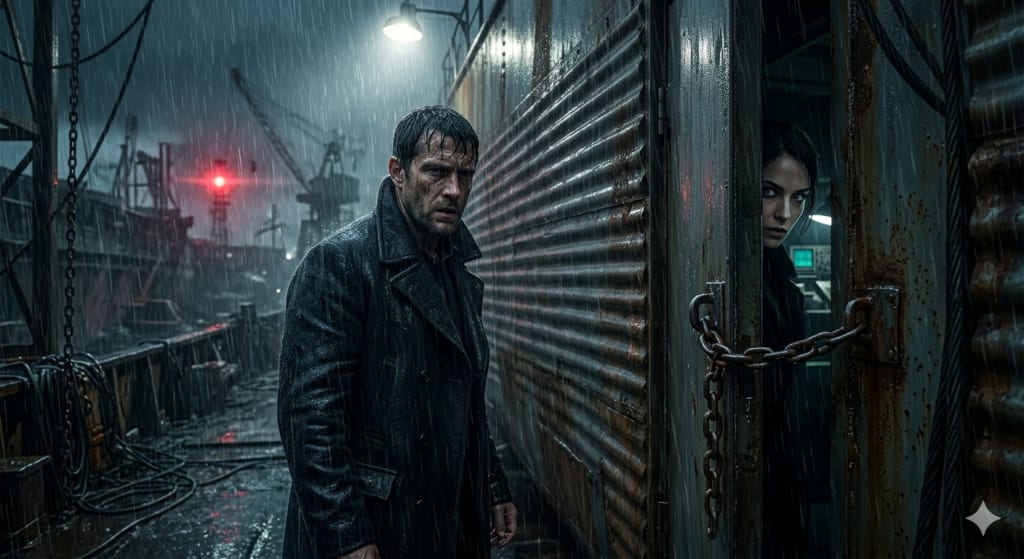
The rain in the shipyard didn't fall; it vibrated. I arrived at the address Nora had provided in her Miller file at precisely eight o'clock.
I stood outside the corrugated metal hull of a workshop housed within a dry-docked trawler, my coat soaked through. Behind, my eyes pulsed in time with the distant, rhythmic thrum of the city’s heart. Elena was gone. The police called it a "structural failure" in her apartment—a freak collapse of a load-bearing wall. But I had seen the "Shadow-Traces" on the plaster before I was ushered out. I had seen the way the rebar had twisted into shapes that shouldn't exist in a Euclidean universe.
I hammered on the metal door. "Nora! Open up!"
The door groaned open six inches, held by a heavy industrial chain. Nora Sterling’s sharp, hyper-alert eyes peered out from the gloom. As a journalist, she spent her life looking for the cracks in the city's veneer, and right now, she was staring directly at one.
"You look like hell, Thorne," she said. "You’re radiating noise."
"Elena is dead," I rasped.
The chain rattled, and the door swung wide. Nora didn't offer condolences; she didn't have the temperament for it, and the story always came first. "I know," she said, turning her back on me and walking deeper into the belly of the ship. "That's why I set this up. I have the paper trail, but you need to see the math."
The interior of the workshop was a graveyard of dead electronics and architectural blueprints. Oscilloscopes flickered with sickly green waves, and a soldering iron hissed on a workbench. Standing over a desk, illuminated by the harsh glare of a drafting lamp, was Percy Vance.
Percy looked like a man being slowly eaten from the inside out. He had a hollow, haunted look of someone carrying a weight far exceeding his structural capacity. It was guilt. His dealings with Miller had lined his pockets, but the toll etched into dark circles under his eyes.
“Silas, this is Percy Vance. Percy explain to Silas your interaction with Detective Judas Miller”, Nora said.
Percy gave account of his dealings with MIller, I saw it from Percy’s view, almost instinctively:
I found Miller standing on the observation deck of the Blackwood Bridge. It was three in the morning. The city below was a sprawling circuit of orange sodium lights, but from this height, it looked like a flickering, dying organism.
I, a junior structural inspector, was waiting for him. I’m twenty-four, idealistic, and was vibrating with a terror that had nothing to do with the height. I held a tablet with a thermal imaging overlay of the bridge’s western pylon.
"Detective, I don't think you understand," I stammered, "the stress fractures aren't following the load-bearing lines. Look at the heat signature. The concrete is screaming."
Miller didn't look at the tablet. He looked at me. He saw the way my hands shook—not from the wind, but from a fundamental realization that the physics I had studied in college were being overwritten.
"It’s not a fracture, Percy," Miller said, his voice flat, practiced. "It’s a clerical error. You’ve miscalibrated your sensors."
"Miscalibrated? Sir, the pylon is emitting a low-frequency hum that registered on our seismic monitors as far away as the District of Rust! It’s not a sound; it’s a... a vibration of intent. If we don't close the bridge—" I said.
"If we close the bridge," Miller interrupted, stepping into my personal space, "the city loses four million dollars an hour in commerce. The Vane Corporation loses its primary artery for the 'Grand Harvest' logistics. And you, Percy, lose your career for being the boy who cried wolf because he couldn't read a thermometer."
The Erasure
Miller reached out and took the tablet from my fingers. With a casual flick of his thumb, he navigated to the system's root directory. He didn't delete the file; he simply "retuned" the data. He adjusted the threshold for the thermal alarms, raising the "critical" limit by forty percent.
On the screen, the angry, pulsating red fractures in the pylon faded into a calm, compliant blue.
"See?" Miller whispered. "The math is fine. The architecture is sound."
"But I saw it," I whispered, tears welling in my eyes at that point. "I felt the bridge... it felt like it was waiting for something."
Miller said dismissively, "That’s the problem with you kids. You think the world is made of stone and steel. It’s not. It’s made of narratives. And right now, the narrative says this bridge is the safest structure in the state."
Miller watched as the first morning commuters began to trickle across the bridge—thousands of tons of steel and flesh moving over a pylon that he knew was structurally compromised by a metaphysical frequency.
He seemed to notice a slight tremor in his own pocket.
He didn't look like a monster. He looked like a successful middle-manager. He had protected his pension. He had kept his ranch in the suburbs. He had ensured that the "Order" of his life remained undisturbed.
Nora interrupted, at this point, and I snapped back to reality, she opined, based upon her observations and research:
“The fact that the bridge would eventually fall wasn't Miller's problem. That was just ‘Entropy.’ His job was simply to make sure that when it happened, the blueprints showed that everything was exactly where it was supposed to be.”
Nora looked at her notes, and then detailed another meeting she observed (and surveiled) between Miller and Kael, again I slipped into another's perspective this time Nora's:
"Yield is low, Miller," a voice whispered.
Miller didn’t turn his head. Kael stood a half-step behind him, dressed in the high-visibility vest of a municipal gas technician. In his hand, Kael held a device that looked like a ruggedized tablet, its screen glowing with a jagged, violet waveform.
"It’s a localized event, Kael. A delivery truck and a storefront. What did you expect? The Blackwood Span?" Miller’s voice was a low growl, barely audible over the crackle of the police radios.
"I expected more 'Static' from the witnesses," Kael countered, tapping the screen. "Look at the spikes. The driver is in shock, yes, but the crowd is just... annoyed. They’re worried about their commute. There’s no genuine resonance here. The grief is shallow."
Miller looked at the crowd. He saw the faces illuminated by the sirens—people holding up phones, recording the wreckage of the truck, their expressions more curious than devastated. He felt a flicker of professional disdain. The citizens of the Rust were becoming despaired, and despair was a flat, dull emotion. It didn't "ring" the way pure, sudden terror did.
"The Foundation needs a high-frequency surge for the Phase Two calibration," Kael continued, his thumb scrolling through a map of the city’s plumbing. "If we don't hit the quota in the North District, they are going to start looking for 'manual' adjustments."
Miller stiffened.
I realized Miller had seen what a "manual adjustment" looked like—a tenement fire that shouldn't have spread, a balcony railing that had been pre-stressed to snap during a birthday party. The Order didn't care about the people; he cared about the "Harmonic Load."
"We have the Thorne variable now," Miller said, nodding toward the dark basement window across the street where he knew Silas was hiding. "He’s seeing it. He’s reacting to it."
"Thorne is a broken instrument," Kael spat. "He’s a ghost-architect with a scrambled brain. Why they wants him monitored instead of erased is beyond me."
"Because Thorne built the Grid, Kael. He knows the 'Song' better than anyone. If he starts recognizing the frequencies, he becomes the best diagnostic tool we have. Or the most dangerous interference."
Miller watched as the paramedics loaded a stretcher into an ambulance. He checked his watch. The "Harvest" window was closing. The energy from the accident was dissipating into the gray noise of the city, absorbed by the very pavement Silas had designed to be a "Grounding Wire."
"Pack it up," Miller ordered. "Check the sensors on the 4th Street Viaduct. I want a report on the atmospheric tension before the morning rush. If the wind picks up, we might get a natural resonance spike."
Kael grumbled but tucked the tablet into his vest. He vanished into the shadows of the alley, moving with the practiced invisibility of a man who spent his life in the city’s marrow.
Miller stayed a moment longer. He looked up at the towering silhouette of the Vane Foundation building in the distance, its spire piercing the clouds like a needle ready to draw blood.
Nora, shook me from my hypnosis and speculated that:
He didn't believe in the "Spiritual Growth" the Foundation preached in its brochures. He believed in the Grid. He believed in the math.
And right now, the math told him that Silas Thorne was about to become the loudest note in the symphony.
Behind Percy, a map of the city consumed the entire wall. It wasn't the "Gospel of the Grid" I had helped build. This was a map seen through a distorted lens. Red lines traced the major thoroughfares, clustering like bruised veins around the Vane Tower.
"You think Elena was the first?" Nora asked, her voice flat. She picked up a tablet, bringing up a series of heavily redacted municipal reports. "I’ve been tracking these 'Subsidence Events' for the paper for three years. Every time the Foundation announces a record-breaking quarter, a bridge fails. A tenement collapses. A woman like Elena 'accidentally' falls into the teeth of the city."
"It’s math," I said, though my voice lacked conviction. "Materials fatigue. Soil liquefaction. You can’t blame a hedge fund for gravity."
"You can when they engineer the gravity," Percy said, his voice a ragged whisper. He stepped away from the desk, his hands trembling as he gestured to a set of schematics. "Look at the sub-basement. The 'Black Cell' you designed for the server farm."
I looked. My own lines stared back at me—precise, cold, perfect. But Percy had drawn something inside them. A series of chambers shaped like a human ear, stacked in a recursive, narrowing spiral.
"That’s not a server farm," I whispered. My stomach turned. "That’s a resonator."
"I drafted the preliminary load tests for Miller," Percy confessed, unable to meet my eyes. "I didn't know what he was actually building until it was too late. The Foundation isn't just managing money, Silas. They’re managing the Static. We’re being eaten by architecture."
“What is this Foundation?” I asked.
Nora stepped forward, the light from the oscilloscope casting sharp, green shadows across her face. "The Order,' Silas, the Order of Dionysus. It’s leader, Julian Vane. Yes, that Vane–Juliane Vane, the Director, as the brother of Elena. Its public face is the Vane Foundation and to the board of directors, they’re a non-profit. To the city council, they’re the source of every major construction grant and zoning 'miracle' in the tri-state area. But that’s just the skin."
She tapped a heavy finger on the blueprint of the Vane Tower, right where the structural supports met the bedrock. "The core is a closed circle of the city’s elite. You’ve shaken their hands at a dozen galas without ever seeing the blood under their fingernails. There’s Julian Vane at the top, providing the capital, and your brother Marcus, the strategist who ensures the city’s expansion always follows the paths of highest interference. They aren't interested in philanthropy; they’re interested in the harvest. They’ve turned your 'Gospel' into a functional circuit-board, Silas. Every spire you designed is a tuning fork, and every person living in their shadow is just a battery being drained by the frequency."
Percy grabbed the edges of the drafting table, leaning in. "You built the cage, Silas. You’re the only one who knows where the hinges are. If you want to know what happened to Elena, you stop looking at Nora's police reports and start looking at the blueprints you hid in the Vane Vault."
My head suddenly shifted, the white noise resolving into a single, low-frequency hum that seemed to originate from the north. Toward the spire.
"The Vane Tower," I said, the realization tasting like copper in my mouth. "The top three floors... I was never allowed to visit them during construction. They said it was 'proprietary tech.'"
"It’s not tech," Percy said, his eyes reflecting the jagged green heartbeats of the oscilloscopes. "It’s the throat of the beast. Go snoop, Architect. See if you like what your 'Gospel' actually sounds like when it's screaming."
"You think they’re just greedy," Percy continued, his voice dropping into a low, rhythmic cadence. "You think it’s about money. That’s your first mistake, Silas. Money is just a medium. The Order deals in the only currency that doesn't depreciate: Applied Suffering."
I leaned against a stack of discarded hard drives, my head throbbing. "Applied suffering? That sounds like a bad philosophy seminar."
"It’s the Second Law of Thermodynamics, rewritten in blood," Percy snapped, pointing a shaking finger at the map, specifically at the jagged stress points where the Blackwood Bridge met the shore. "Entropy is the natural state of the universe. Everything wants to fall apart."
The realization hit me like a physical blow. I thought of my cold, unyielding lines. "My buildings," I whispered.
"They’re sponges," Percy corrected. "The Vane Tower isn't a monument to your genius; it’s a celestial vacuum. It’s designed to vibrate at the exact frequency of human anxiety."
"And Elena?" I asked, my voice cracking. "Why her?"
Nora answered this time, stepping out of the shadows. "Because she was a 'Harmonic.' She felt the Static, just like you do now. She was a leak in the system. If people start hearing the scream behind the walls, the walls stop working."
Percy reached into his coat and pressed a cold, metallic object into my hand. It was a keycard, but the plastic was scorched, the magnetic strip replaced with a thin filament of copper wire.
"This is the back door to the Vane Vault," Percy said. "I smuggled it out when I realized what Miller was doing. If you want to stop being a part of their 'maintenance,' you need to see the blueprints they didn't let you sign. Silas, you’re still the Glass King. And kings are the first thing people tear down in a failure."
I looked at the card, then back at the map. My head wasn't just noise anymore. It was a direction.
"I’m going in," I said.
"I know," Percy replied, turning back to the flickering screens, a man condemned by his own drafting pen. "Just remember: in a building designed to eat people, the architect is the main course."
About the Creator
Nathan McAllister
I create content in the written form and musically as well. I like topics ranging from philosophy, music, cooking and travel. I hope to incorporate some of my music compositions into my writing compositions in this venue.
Cheers,
Nathan
Keep reading
More stories from Nathan McAllister and writers in Gamers and other communities.
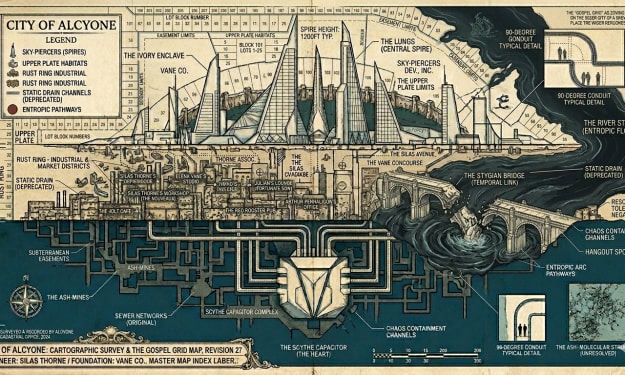
The Gospel of the Grid
The rain in the District of Rust didn’t wash things clean; it merely redistributed soot. It clung to the windshield of Percy Vance’s city-issued sedan, a greasy film that turned the neon signs of the nearby dispensaries into blurred bruises. Percy sat in the idling car, the heater humming a discordant note that seemed to vibrate against the base of his skull. In his lap lay the permits for the Sector 4 Urban Renewal Project—specifically, the blueprints for the cul-de-sac at the end of O’Malley Street.
By Nathan McAllister3 days ago in Gamers
U4gm Delve Is Now the Ultimate Fossil Hunt in Path of Exile 3.28
For Path of Exile players, few things are more thrilling than crafting the perfect piece of gear. Fossils—rare crafting materials that allow precise control over item modifiers—have always been highly sought after. With the 3.28 Mirage League update, Grinding Gear Games has made a significant change: fossils now drop exclusively in Delve dungeons.
By Billo Naliabout 8 hours ago in Gamers
Evony by Top Games: Setting Its Own Path and Proven Over Time
Genres such as SLG and RPG are showing signs of slowing growth, prompting developers to explore hybrid gameplay models—blending mechanics like tower defense with idle systems or combining RPG elements with simulation—to sustain innovation and maintain player engagement. At the same time, creative fatigue is emerging as a growing challenge across the industry. The pace of creative iteration has accelerated dramatically, moving from quarterly updates to monthly cycles, and, in many cases, now to weekly refreshes. In mature markets especially, the average lifespan of a creative asset has shrunk to less than five days, placing mounting pressure on teams to produce advertising content that is not only faster but also more precise and effective. Meanwhile, compared with the broad, volume-driven acquisition strategies of 2022–2023, the first half of 2025 reflects a clear shift toward precision targeting—focusing on users with higher retention potential and stronger lifetime value, particularly within the iOS ecosystem.
By Cool Gamer4 days ago in Gamers
Thirty (one) and Neither Flirty nor Thriving.
I'm thirty-one and orbiting the same few mistakes like they're landmarks. London is already awake before I am (or before I've slept) - sirens somewhere far enough to ignore, buses sighing at stops, people moving with purpose I can't quite borrow. I lie there for a bit, tasting last night at the back of my throat, trying to remember if I meant to drink that much or if it just...happened again.
By Stacey Vella5 days ago in Psyche


Comments
There are no comments for this story
Be the first to respond and start the conversation.