
Vascular Closure Devices Market Trends: Shift Toward Ambulatory Care, Efficiency in Procedures & Industry Forecast to 2033
How expansion of ambulatory surgical centers, increased same-day discharge procedures, and focus on efficiency are boosting vascular closure device demand

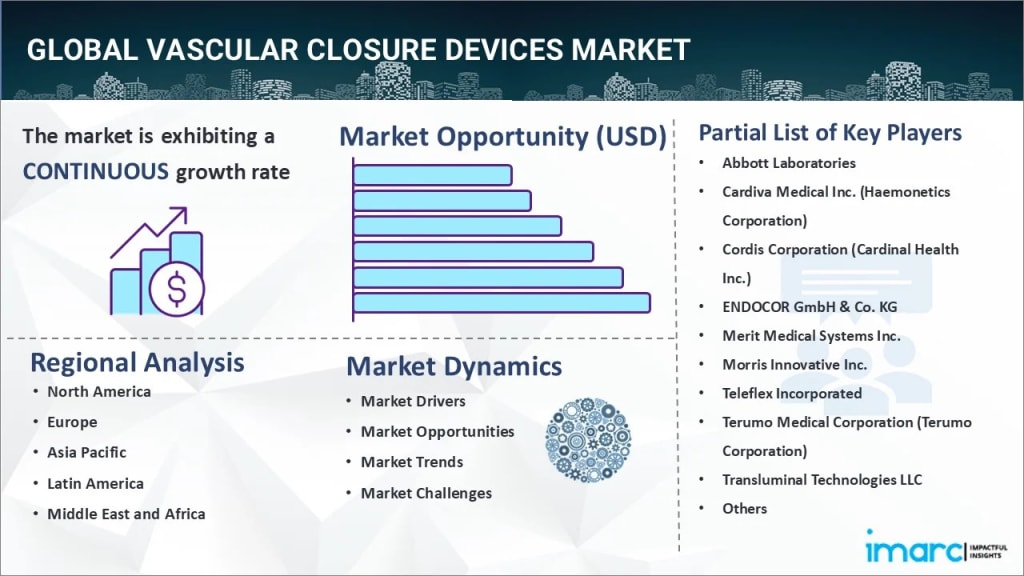
Increasing prevalence of cardiovascular diseases, the surge in minimally invasive surgeries, and the rising demand for rapid hemostasis are driving the global vascular closure devices market. These factors are further supported by a growing geriatric population, advancements in large-bore closure technologies, and the expansion of ambulatory surgical centers. According to IMARC Group’s latest data, the global vascular closure devices market size reached USD 1.56 Billion in 2024. Looking forward, IMARC Group expects the market to reach USD 2.40 Billion by 2033, exhibiting a CAGR of 4.9% during 2025-2033.
Vascular closure devices (VCDs) have transitioned from specialized tools to a standard of care in modern catheterization labs, now representing a multi-billion-dollar global industry. The market is fueled by a collective shift toward interventional cardiology and radiology procedures that prioritize patient safety and hospital efficiency. Key segments include active approximators (suture- and clip-based) and passive approximators (collagen plugs and sealants), with active devices currently leading the revenue share due to their immediate mechanical sealing capabilities. As healthcare providers look to reduce bed-turnover time and minimize post-procedural complications like hematomas, the integration of bioresorbable materials and next-generation large-bore devices is becoming a primary focus for clinicians worldwide.
Get Your Hands on the Free "Vascular Closure Devices Market" Report Sample
Vascular Closure Devices Market Growth Drivers:
- Rising Prevalence of Cardiovascular Diseases (CVDs)
The global burden of heart-related conditions remains a primary catalyst for market expansion. With cardiovascular diseases accounting for an estimated 17.9 million deaths annually according to the WHO, the volume of diagnostic and interventional procedures like angiography and angioplasty has surged. In the United States alone, over 1.1 million cardiac catheterizations are performed each year. This high procedural volume necessitates reliable closure solutions to manage arterial punctures efficiently. As sedentary lifestyles and aging demographics increase the incidence of coronary artery disease, hospitals are increasingly adopting VCDs to handle the steady influx of patients requiring vascular access.
- Shift Toward Minimally Invasive Surgeries and Early Ambulation
Modern healthcare is moving rapidly toward "same-day discharge" models to improve patient throughput and reduce costs. Vascular closure devices play a critical role here by significantly cutting down the time to hemostasis compared to traditional manual compression, which can take up to 30 minutes of physical pressure. By using suture- or clip-based devices, clinicians can allow patients to walk (ambulate) within just a few hours. This efficiency not only enhances patient comfort but also allows hospitals to free up recovery beds faster. The demand for these devices is especially high in Ambulatory Surgical Centers (ASCs), where rapid recovery is essential for operational success.
- Technological Innovations in Large-Bore and Bioresorbable Materials
The industry is witnessing a wave of innovation focused on "large-bore" access sites, which are required for complex procedures like Transcatheter Aortic Valve Implantation (TAVI). Traditional closure methods often struggle with these larger 12F to 24F punctures, leading to the development of specialized devices that offer secure, mechanical closure. Furthermore, the move toward bioresorbable polymers ensures that no permanent metal or synthetic material is left in the artery, reducing long-term inflammatory risks. Market leaders are investing heavily in these next-gen platforms, as seen in the recent surge of FDA approvals for collagen-based and suture-mediated systems designed for complex vascular landscapes.
Vascular Closure Devices Market Trends:
- Rapid Expansion of Ambulatory Surgical Centers (ASCs)
There is a notable migration of cardiovascular procedures from traditional hospital settings to specialized outpatient facilities. ASCs are becoming a preferred choice for patients due to lower costs and specialized care environments. To maintain high turnover rates, these centers rely heavily on vascular closure devices that offer predictable results and minimal recovery time. This trend is bolstered by favorable reimbursement policies in regions like North America and Europe, where healthcare payers incentivize outpatient care. Consequently, manufacturers are tailoring their product portfolios and pricing strategies to meet the specific high-volume needs of these rapidly growing outpatient vascular centers.
- Strategic Consolidation and Portfolio Expansion
The competitive landscape is being reshaped by aggressive mergers and acquisitions aimed at creating "one-stop-shop" interventional portfolios. Major medical technology firms are acquiring niche startups that specialize in unique closure mechanisms, such as extravascular sealants or robotic-assisted closure. For instance, recent industry movements in late 2024 and early 2025 have seen multi-million dollar deals to secure patents for hemostatic patches and large-bore venous closure systems. This consolidation allows larger entities to offer a comprehensive range of products from entry-level compression bands to high-end suture devices strengthening their market position across both developed and emerging healthcare economies.
- Growing Adoption of Radial Access Procedures
While femoral access remains a dominant segment, there is a global trend toward transradial (wrist) access for coronary interventions. Clinical data increasingly suggests that radial access reduces bleeding complications and improves patient outcomes. This shift has prompted the development of specialized radial closure devices, such as pneumatic compression bands and hemostatic patches. While these are often lower in cost than femoral VCDs, their high-frequency use in diagnostic procedures is creating a significant new volume-driven market segment. Manufacturers are responding by innovating in ergonomically designed wrist bands that provide targeted pressure without compromising local circulation, catering to the "radial-first" philosophy adopted by many modern cath labs.
Recent News and Developments in Vascular Closure Devices Market
- January 2026: Haemonetics announced the successful acquisition of Vivasure Medical for approximately USD 116 million. This move is designed to integrate Vivasure’s bioabsorbable, percutaneous large-bore closure technology into Haemonetics' existing vascular portfolio, specifically targeting the growing structural heart market.
- October 2025: Terumo Interventional Systems received FDA 510(k) clearance for its new OPUSWAVE Dual Sensor Imaging System. While primarily a diagnostic tool, its integration with Terumo's closure platforms highlights the industry trend toward combining imaging with vascular access management for improved procedural safety.
- August 2024: Haemonetics launched the VASCADE MVP® XL, a mid-bore venous closure system. The device features 58% more collagen than previous versions, specifically engineered to provide robust closure for procedures involving 10-12F sheaths, such as cryoablation for atrial fibrillation.
Note: If you require specific details, data, or insights that are not currently included in the scope of this report, we are happy to accommodate your request. As part of our customization service, we will gather and provide the additional information you need, tailored to your specific requirements. Please let us know your exact needs, and we will ensure the report is updated accordingly to meet your expectations.
About the Creator
Andrew Sullivan
Hello, I’m Andrew Sullivan. I have over 9+ years of experience as a market research specialist.
Keep reading
More stories from Andrew Sullivan and writers in Futurism and other communities.
Eyewear Market Trends: Youth Fashion Influence, Influencer Marketing & Industry Outlook to 2034
The rising prevalence of vision-related disorders, the growing influence of luxury fashion, and the rapid integration of smart technologies like augmented reality are fundamentally reshaping the eyewear landscape. Consumers are increasingly viewing spectacles and sunglasses not just as medical necessities, but as vital lifestyle accessories that combine ocular health with personal expression. According to IMARC Group’s latest data, the global eyewear market size was valued at USD 179.7 Billion in 2025. Looking forward, IMARC Group estimates the market to reach USD 295.4 Billion by 2034, exhibiting a CAGR of 5.70% from 2026-2034. North America currently leads the global landscape, while the Asia-Pacific region is emerging as a high-growth hub due to rising disposable incomes and massive urban populations.
By Andrew Sullivana day ago in Futurism
How to Choose the Right Hosting for Your Elementor Website in 2026
Elementor is a WordPress page builder with over 10 million active installations in 2026. It gives website owners full visual control over their page layouts, sections, and design elements. However, no matter how well an Elementor website is designed, its performance depends entirely on the hosting environment running underneath it. The wrong hosting choice produces slow load times, unreliable uptime, and poor Google search rankings that no amount of design optimization can fix.
By Shane Smith3 days ago in Futurism



Comments
There are no comments for this story
Be the first to respond and start the conversation.