
The Lunar Joke That Became Reality: Artemis 2 is Already There! 🚀
NASA launched on April Fools' Day, but the records being broken right now are the most serious thing in the history of space exploration. 🌑

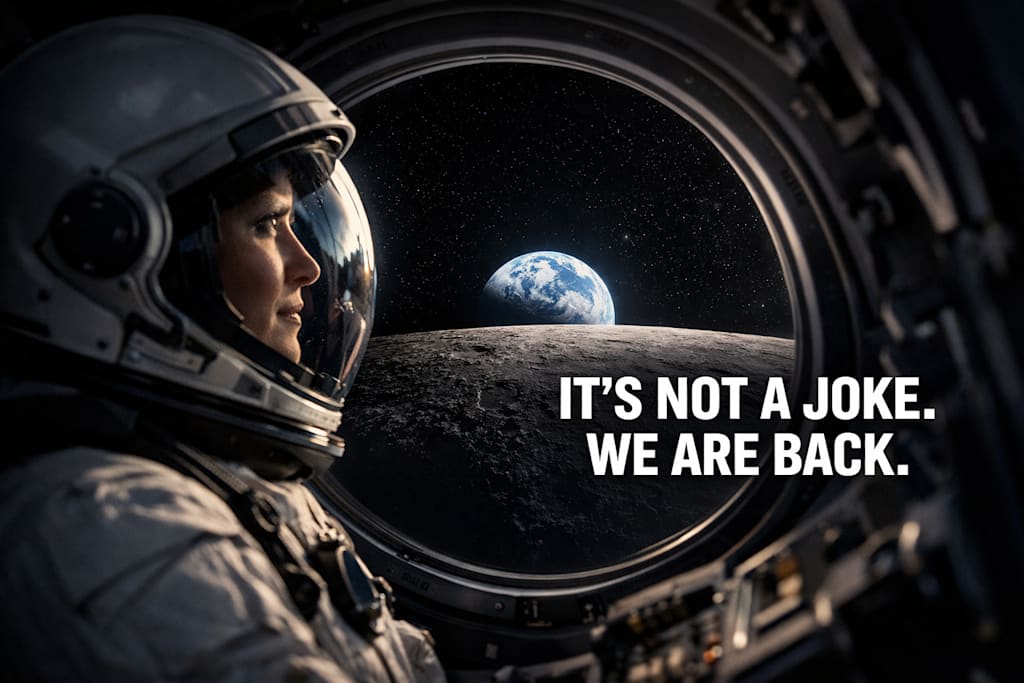
Everything coincided with April Fools' Day, so I wasn’t a hundred percent sure at first, but now I know: Artemis 2 has flown! 🛰️ It’s truly fascinating how thin the line has become between monumental historical events and internet memes.
✨ When the massive engines of the SLS (Space Launch System) rocket lit up the Florida sky on April 1, 2026, many of us rubbed our eyes in disbelief, wondering if this was another brilliant NASA prank or if the moment had finally arrived. Fortunately, it was no joke. After years of delays, technical challenges, and endless testing, humanity has officially returned to the neighborhood of the Silver Globe!
👨🚀 MISSION ARTEMIS 2: THE "BIG FOUR" ON BOARD
This isn’t just another routine test flight. It is the first crewed mission since 1972 (the time of Apollo 17) to leave Low Earth Orbit and venture into deep space. On board the Orion capsule are four heroes who are currently writing a new chapter of history: Reid Wiseman, Victor Glover, Christina Koch, and Jeremy Hansen.
🌍 Each of these names is a powerful symbol of a new era. Christina Koch is the first woman to venture into deep space, Victor Glover is the first person of color on a lunar mission, and Jeremy Hansen is the first Canadian to leave Earth's immediate vicinity. It’s a clear signal: this time, we are returning to the Moon as a united humanity, not just a single nation in a political race.
🛰️ HOW DOES THE JOURNEY LOOK?
The Artemis 2 mission does not involve a landing on the surface just yet—we have to wait for Artemis 3 for that. The current flight lasts about 10 days and serves as the most rigorous test ever conducted on a crewed spacecraft.
📍 1. High Earth Orbit (HEO): Immediately after launch, Orion spent significant time orbiting Earth. This was a crucial "check-up" phase—astronauts tested life-support systems and manual spacecraft control. If anything had failed, they were still close enough to return home.
📍 2. The Leap Toward the Moon: Once the systems were confirmed to be healthy, the TLI (Trans-Lunar Injection) maneuver took place. Orion fired its engines and shot toward the Moon at incredible speeds.
📍 3. The Lunar Loop: A few days ago, on April 6, the crew flew past the far side of the Moon. They used lunar gravity as a "slingshot" to head back toward Earth. It was during this moment that the record for distance from our planet was broken—over 400,000 kilometers! No human being has ever been this far from home.
🏗️ FOUNDATIONS OF SUCCESS: WHAT HAPPENED BEFORE?
Artemis 2 would not be possible without the success of the Artemis 1 mission in late 2022. Back then, the SLS rocket and the Orion capsule underwent their baptism by fire, but with empty seats. That mission proved that Orion's heat shield could withstand the hellish temperatures of atmospheric reentry (approximately 2800°C).
🔧 In the meantime, NASA had to tackle technical hurdles—specifically with the heat shield, which wore down slightly differently than computer models predicted during the first flight. This is why we waited until 2026 for the crewed launch. Crew safety was the priority that ultimately won over political haste.
🤔 WHY IS THIS SO IMPORTANT?
Skeptical voices are often heard asking: "Why go back when we’ve already been there?" The answer is simple: this time, we aren't going there just to leave a flag. We are going there to stay.
💎 Science: The Moon’s South Pole hides water ice in permanently shadowed craters. Water can be turned into oxygen to breathe and hydrogen fuel. If we learn to extract it, the Moon will become our "gas station" on the way to Mars.
💎 Technology: Testing deep-space radiation protection systems during Artemis 2 is the key to planning safe, multi-year journeys to the Red Planet.
💎 Economy: Space is becoming a new market. Rare mineral mining and space tourism are no longer science fiction but real business plans for major corporations.
🌊 WHAT AWAITS US IN THE COMING DAYS?
Currently, the Orion crew is racing back toward Earth. They face the most difficult stage ahead—reentering the atmosphere at nearly 40,000 km/h. If everything goes according to plan, we will see the spectacular deployment of parachutes over the Pacific Ocean on April 10, 2026.
🔭 The success of Artemis 2 opens the door for Artemis 3, which aims to land humans on the lunar surface before 2030. Looking at what is happening right now, I feel we are living in the most exciting times for space exploration in decades. The internet might have made jokes about the launch date, but the numbers don't lie—the boundaries of our world have just shifted by another several thousand kilometers.
🌌 It is an incredible feeling to know that up there, in that small metal pod, four people are looking down at our planet from a perspective no one has experienced in half a century. The joking and the waiting are over—the true Lunar Era has begun!
Do you think that following this success, we will be able to maintain the momentum and land on the surface within the next three years? ⏳🔭
About the Creator
Piotr Nowak
Pole in Italy ✈️ | AI | Crypto | Online Earning | Book writer | Every read supports my work on Vocal
Keep reading
More stories from Piotr Nowak and writers in Futurism and other communities.
Ray Kurzweil and the 2045 Singularity: Will AI Make Us Immortal? 🤖🧠
In the world of technology, few visionaries spark as much admiration and controversy as Ray Kurzweil. This 78-year-old scientist, inventor, and Principal Researcher at Google has been immersed in artificial intelligence for over six decades 🔮. While others forecast the future a year or two in advance, Kurzweil looks decades ahead, painting a vision of a world where the boundary between human and machine finally vanishes. ✨
By Piotr Nowaka day ago in Futurism
How machines can learn from human behaviour
In order to understand where we are and where we are going, we need to understand where we were first. - Susan Fourtane Could a human behaviour simulator be embedded into a robot or online avatar to the point that it’s hard to distinguish between a real person or artificial intelligence? Scientists have been upping the stakes in this “Turing test” for years, to the point that human-mimicking programmes are ready to answer tricky questions, assist people with online shopping or be companions.
By Susan Fourtané 20 days ago in Futurism



Comments
There are no comments for this story
Be the first to respond and start the conversation.