
Padme Amidala: The Quiet Architect of the Prequel Era
She wasn’t just fighting a war. She was trying to save the Republic from itself.

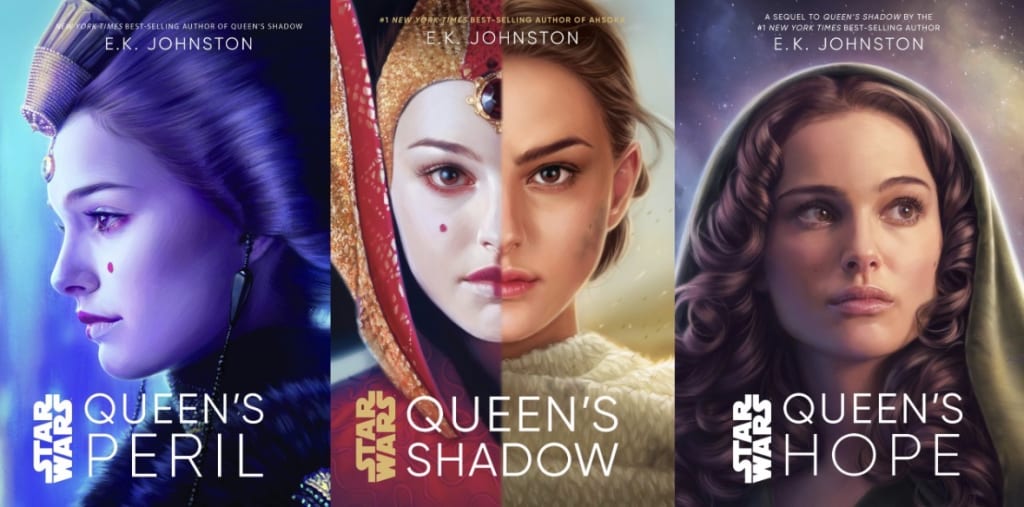
When most fans talk about the Star Wars Prequel Trilogy, the conversation centers on Anakin Skywalker’s fall to the dark side. Padme Amidala is often reduced to a tragic love interest-turned doomed baby mama–or at most, a visually stunning figure whose wardrobe inspires cosplay and Disney weddings at Galaxy’s Edge. But Padme was more than a symbol or a love story. She was a moral compass, a political visionary, and one of the few leaders actively working to hold the Republic together while the galaxy fell apart.
Seeing the Galaxy Through Padme’s Eyes
E.K. Johnston’s Queen’s Trilogy offers a perspective largely ignored by the films. From becoming Queen of Naboo at fourteen to navigating the halls of the Senate on Coruscant, Padme is depicted as a diplomat, strategist, and leader deeply aware of Palpatine’s growing shadow.
Unlike other senators, she saw Sheev Palpatine’s manipulations early on and worked tirelessly to counteract them. Her relationships-both personal and political–were crucial tools: her handmaidens were trusted allies, fellow senators were coalition partners, and her marriage to Anakin Skywalker underscored the cracks in the Jedi Order itself.
Padme wasn’t reacting to the galaxy. She was trying to change it.
Humanitarianism at the Heart of Leadership
The Queen’s Trilogy reveals that Padme’s parents were humanitarian workers who traveled to planets devastated by natural disasters. This upbringing instilled a worldview grounded in compassion, ethics, and action.
During the Clone Wars, she worked alongside Duchess Satine Kryze to protect Mandalore and its citizens, demonstrating that her concern for human life extended beyond political expediency. Padme consistently prioritizes saving lives, stabilizing vulnerable systems, and preventing future crises–a rare form of leadership in a galaxy consumed by war.
Defending the Clones
Padme’s empathy wasn’t limited to civilians. She advocated for the clones, recognizing their humanity and individuality when the Republic treated them as expendable tools.
- She pushed legislation to grant citizenship to the clones and ensure their well-being.
- She called for a ban on producing more Fett clones, challenging the Republic’s militarization.
Her advocacy highlights a consistent theme: wherever institutions fail, or moral compromise threatens lives, Padme intervenes. She fights not with a lightsaber, but with vision, legislation, and diplomacy.
The Jedi Order and the Cost of Orthodoxy
Padme’s relationship with Anakin Skywalker exposes the cracks in the Jedi Order’s rigid orthodoxy. The code forbade attachments, but it failed to equip Jedi with tools to navigate real human relationships. This secrecy and emotional suppression left Anakin vulnerable to fear and manipulation–mirroring systemic failures within the Order itself.
By the time the prequels unfold, the Jedi were already in structural decline, as highlighted in the High Republic book series and on The Acolyte. Padme’s death removes one of the Republic’s few stabilizing forces, leaving the galaxy exposed to the rise of tyranny.
Palpatine’s Inverted “Jedi”
The Empire’s inquisitors are essentially Palpatine’s dark mirror of the Jedi Order: Force-sensitive agents trained for obedience, fear, and control rather than justice or peacekeeping. Padme’s death makes this inversion even more tragic–her vision of moral governance, humanitarian ethics, and systemic responsibility is gone, replaced by authoritarian replication of the very structures she tried to preserve.
A Legacy That Echoes Across Generations
Even after her death, Padme’s influence continues. In Andor, Bail Organa and Mon Mothma carry forward her ideals, quietly resisting the Empire while nurturing the early Rebellion. Her work with refugees, her legislative advocacy, and her coalition-building in the Senate laid a foundation that would later save the galaxy.
Even in the Sequel Trilogy, the Jedi’s mistakes–like taking Padme and Anakin’s grandson, Ben Solo, from his parents, Han and Leia (Padme and Anakin’s daughter)-echo Padme’s warnings about the human costs of rigid systems. Her approach, valuing empathy, relationships, and pragmatic morality, could have prevented repeated tragedies had it been more widely adopted.
Padme’s death was personal. It was institutional. The Republic lost one of its truest friends and defenders.
More Than A Tragic Figure
Padme Amidala deserves recognition as a hero of the prequel era. She was the moral and political counterweight in a galaxy collapsing under war, corruption, and authoritarian manipulation. From her humanitarian upbringing to her advocacy for clones and refugees, from negotiations with the Separatists to the moral guidance she provided allies, she consistently sought to protect lives and principles–even when the odds were impossible.
The films often reduce her to a tragic figure in Anakin’s story. But the Queen’s Trilogy, The Clone Wars, The Bad Batch, and even Andor remind us that Padme’s vision, courage, and compassion shaped the galaxy in ways no lightsaber duel could. She fought not for glory, but for the people, and her legacy continues to resonate long after her passing.
Padme Amidala wasn’t just part of the story. She was the quiet architect of hope.
About the Creator
Jenna Deedy
Just a New England Mando passionate about wildlife, nerd stuff & cosplay! 🐾✨🎭 Get 20% off @davidsonsteas (https://www.davidsonstea.com/) with code JENNA20-Based in Nashua, NH.
Instagram: @jennacostadeedy
Keep reading
More stories from Jenna Deedy and writers in Futurism and other communities.
When Hollywood Goes Digital: The Ethical Perils of AI in Film and TV
Hollywood has consistently embraced technological advancements, from ancient sound and Technicolor to modern computer-generated imagery (CGI), all of which have reshaped storytelling. However, artificial intelligence (AI) represents a more profound shift, affecting the very core of creative expression.
By Jenna Deedy6 months ago in Futurism
Inside the Evolution of AI in Personalized Medicine and Patient-Centric Care
Healthcare is rapidly transitioning from generalized treatment models to data-driven and individualized care. For decades, medical decisions were largely based on population averages—what works for most people was assumed to work for everyone. However, advances in data science, genomics, and machine learning are enabling a new era where treatments are tailored to the unique characteristics of each patient.
By Steve Waugh6 days ago in Futurism
Optical Coherence Tomography Market: Regulatory Approvals, Clinical Adoption Trends & Growth Outlook
According to IMARC Group's latest research publication, The global optical coherence tomography market size was valued at USD 2.6 Billion in 2025. Looking forward, IMARC Group estimates the market to reach USD 7.0 Billion by 2034, exhibiting a CAGR of 11.13% from 2026-2034.
By sujeet. imarcgroup8 days ago in Futurism
The Rivers of Babylon
The iconic disco group Boney M from the 1970s left an indelible mark on the music world with their infectious beats and unforgettable melodies. Formed in West Germany, the group's vibrant sound, blending Caribbean rhythms with European pop sensibilities, quickly catapulted them to international stardom.
By Rasma Raisters5 days ago in Beat


Comments
There are no comments for this story
Be the first to respond and start the conversation.