
My Digital Conscience on the Line: How AI Watched My Hands in the Factory 🛠️🤖
Beyond the Screen: My Experience Working with Industrial AI 🤖

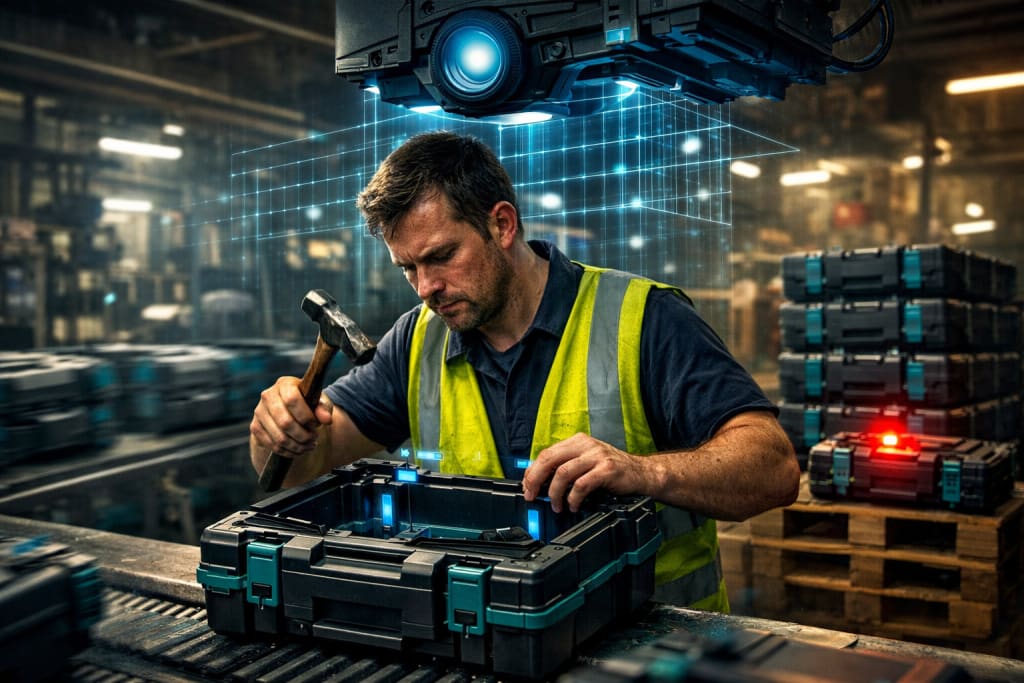
Before I packed up my life in England and headed for the sunny shores of Italy ✈️🇮🇹, my daily reality was measured in hundreds of black and teal plastic components. I worked in a plastic manufacturing plant—a place where, theoretically, simple forms and repetition rule the day. It was there, on the production line for Makita power tool cases, that I first realized Artificial Intelligence isn’t just for Silicon Valley developers 💻. It’s a technology that has already "put on its high-vis vest" and is working side-by-side with us on the factory floor. 🏭
The Rhythm, the Pins, and the Massive Volume 📦💨
My workstation was the very definition of mass production. The task seemed simple enough: a box would slide onto my station from the belt, and I had just a few seconds to complete a specific sequence of movements:
Hammer in two pins holding the lid 📍
Snap on two latches 🔒
Close the whole thing and stack the finished product on a pallet ✅
Sounds easy? Try doing that hundreds of times an hour. At such a massive scale, where boxes are coming at you non-stop and the counter never pauses, you stop being a person and start becoming a cog in the machine ⚙️. In that kind of rhythm, your biggest enemy isn't physical exhaustion—it’s routine. After four hours, your brain enters "autopilot" mode. And that is exactly when the AI steps in. ⚡
The Inspector Who Never Blinks 👁️🚫
Installed right above my station was a system we called the Visual Inspector. This wasn't just a standard security camera. It was an advanced computer linked to a lens that constantly scanned my workspace. This system had been "trained" on thousands of images of a perfectly assembled toolbox. 📸
The algorithm analyzed my every move in real-time:
Were both pins correctly driven in? 📍📍
Are the latches in their proper place? 🔐
Is the lid fully closed before it hits the pallet? 📦
If I forgot a single step—which, at that breakneck pace, happens to everyone eventually—the computer reacted instantly. Before I could even take the product off the bench, a red warning flashed on the screen 🚨. The system was my digital conscience. It knew about the error a fraction of a second after I made it, often before my own brain even registered that something was missing. 🧠💥
AI is Closer Than We Think 🌍🤔
My experience in that British factory made me realize that AI in daily life isn't just about talking phones or Netflix recommendations 🎬. It’s a technology that is quietly taking over the most monotonous and high-responsibility tasks in industry and services.
We’re already encountering similar solutions everywhere:
In Supermarkets: Smart scales in the produce section that use cameras to recognize if you're weighing Granny Smith apples or tomatoes, so you don't have to scroll through codes 🍎🥦.
In Logistics: Vision systems that scan parcels on sorter belts, detecting cardboard damage or unreadable labels faster than any human ever could 📦🚚.
In Agriculture: Machines that distinguish weeds from crops, allowing farmers to use the absolute minimum amount of chemicals 🌿🚜.
These aren't "sci-fi robots." They are discreet assistants making processes error-proof.
Partner or Overseer? 🤝🕵️♂️
Working under the gaze of the Visual Inspector gave me mixed feelings. On one hand, there was a huge sense of psychological comfort. I knew that if a box passed my station and the system "accepted" it, the customer anywhere in the world would receive a perfect product 🌟. The AI was my safety net.
On the other hand, being under the constant observation of an algorithm that never gets tired, never has a bad day, and never forgives even the smallest slip-up, creates a unique kind of pressure ⚖️. The machine didn’t judge me as a human, but its cold precision meant every one of my movements had to be flawless.
I left the English factory for the Italian lifestyle ☀️🍕, but the reflection on how technology is reshaping our work stayed with me. AI has stopped being a futuristic vision—it’s now a standard piece of equipment on factory floors, in warehouses, and in the backrooms of our shops.
What’s Your Story? 🗣️💬
My experience with the Makita boxes is just one example of how AI is entering our daily professional lives. I’m curious—have you experienced the "presence" of similar systems in your own work? 🕵️♀️
In your workplace—whether it’s an office, a warehouse, or a shop—have you noticed algorithms "watching your hands"? 👀
Do you feel this help makes your life easier by taking the weight of error-making off your shoulders? ✅
Or is it the opposite? Does the eye of the camera and the knowledge that every move is being analyzed by a processor irritate you? 🤖⚙️
Share your stories in the comments! It’s time to demystify AI and talk about what it actually looks like to collaborate with machines "on the ground," at the assembly line, and in our daily tasks. 👇💬
About the Creator
Piotr Nowak
Pole in Italy ✈️ | AI | Crypto | Online Earning | Book writer | Every read supports my work on Vocal
Keep reading
More stories from Piotr Nowak and writers in Futurism and other communities.
The Digital Arena of Giants: How Arena.ai Democratized Access to AI 🤖
We live in an era of "subscription fatigue." Want to write better emails? That’ll be $20 a month. Want to generate advanced graphics? Another $20. Want to analyze data with the most powerful model on the market? Pull out your credit card and get your wallet ready 💳. In this landscape of paywalls, the Arena.ai platform (widely known as the LMSYS Chatbot Arena) stands out not just as a free alternative, but as the most important testing ground of modern civilization.
By Piotr Nowak4 days ago in Futurism
How machines can learn from human behaviour
In order to understand where we are and where we are going, we need to understand where we were first. - Susan Fourtane Could a human behaviour simulator be embedded into a robot or online avatar to the point that it’s hard to distinguish between a real person or artificial intelligence? Scientists have been upping the stakes in this “Turing test” for years, to the point that human-mimicking programmes are ready to answer tricky questions, assist people with online shopping or be companions.
By Susan Fourtané 12 days ago in Futurism
Touchscreen Controller Market Insights: Revenue Projections & Regional Analysis
According to IMARC Group's latest research publication, the global touchscreen controller market reached USD 12.4 Billion in 2024. Looking forward, IMARC Group expects the market to reach USD 44.2 Billion by 2033, exhibiting a growth rate (CAGR) of 13.7% during 2025-2033.
By sujeet. imarcgroup5 days ago in Futurism



Comments
There are no comments for this story
Be the first to respond and start the conversation.