
Japan Home Appliances Market: Smart Living, Energy Efficiency & Connected Homes
The Japan home appliances market is evolving with smart technologies, energy-efficient solutions, and connected devices, enhancing convenience and modern living.

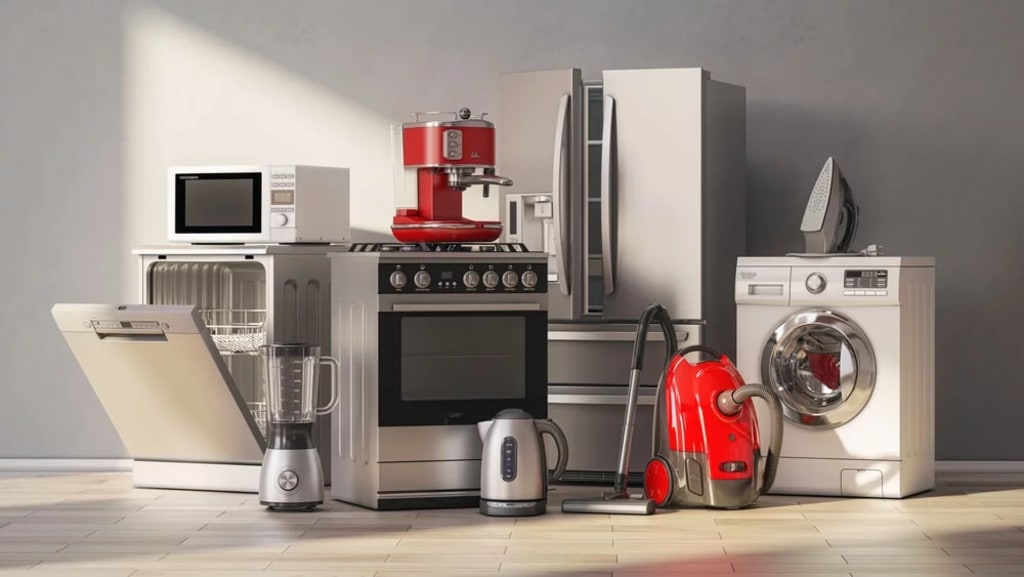
Japan home appliances market size reached USD 27.9 Billion in 2025. Looking forward, IMARC Group expects the market to reach USD 41.0 Billion by 2034, exhibiting a growth rate (CAGR) of 4.36% during 2026-2034. The escalating growth of e-commerce, which has made it easier for consumers to research, compare, and purchase home appliances online, is primarily driving the market, supported by rising demand for energy-efficient, AI-integrated, and smart-connected products across residential households.
Japan's home appliances market sits at the intersection of two powerful forces: a society that genuinely values quality and technological precision, and a set of demographic and environmental pressures that make upgrading household technology both practical and necessary. With over 200 companies competing in the space, refrigerators commanding a 23.38% market share as the anchor product category, and online sales now accounting for 42.88% of all appliance purchases, this is a market that moves on innovation rather than just volume. Smart appliances — those that connect, learn, and adapt — are the fastest-growing segment, and government rebate schemes are actively accelerating the replacement cycle across millions of households nationwide.
Japan Home Appliances Market Growth Drivers:
- Government Energy Efficiency Mandates and Replacement Incentives
Japan's Ministry of Economy, Trade and Industry updated national energy-saving labels for air conditioners in 2023, introducing a redesigned 1.0–5.0 star scale to improve consumer guidance. More directly, Tokyo's Zero Emi Point programme tripled its rebate ceiling from JPY 26,000 to JPY 80,000 in October 2024 to accelerate replacement of ageing appliances. Nationwide, subsidies reaching JPY 200,000 (approximately USD 1,360) for high-efficiency models are shortening replacement cycles — particularly for long-use appliances over 15 years old. These policy levers are directly stimulating appliance retail volumes while steering consumers toward premium, energy-certified products.
- Ageing Population Driving Demand for User-Friendly, Health-Focused Appliances
Japan has the world's oldest population, with one in three residents now over 65 — and that single demographic fact is reshaping what home appliances need to do. Manufacturers are designing washing machines with larger, clearer controls, refrigerators with voice guidance, and air purifiers with health monitoring features specifically for elderly users who want to stay independent at home. Japan saw a 39.1% year-on-year rise in housing construction in 2025, adding fresh demand for new appliance fitouts. Combined with household disposable income projected to reach JPY 4.5 million per annum, the demographic and economic fundamentals are pulling in the same direction.
- E-Commerce Expansion and Rising Household Spending on Premium Products
Online has become the channel of choice for appliance research and purchase in Japan, with e-commerce accounting for 42.88% of total appliance sales in 2024 — up significantly from a few years prior. Retailers like Yamada Denki and Nojima are integrating rebate navigation tools into their platforms to simplify the subsidy process for consumers, increasing conversion rates on premium, energy-compliant models. Smart refrigerators — the fastest-growing sub-segment within major appliances — are registering particularly strong online traction, as detailed product specifications and comparison features suit the digitally savvy Japanese consumer who researches thoroughly before buying.
Japan Home Appliances Market Trends:
- Smart and IoT-Connected Appliances Becoming the New Standard
AI and IoT integration has moved from a premium niche to an expected feature in Japan's home appliances. Smart refrigerators with freshness alerts, washing machines with remote diagnostics, and air conditioners that learn household usage patterns are all gaining mainstream adoption. Smart home device penetration is on track to approach 26% of Japanese households, supported by the country's high smartphone adoption rate and maturing 5G infrastructure. Panasonic's January 2025 launch of its AI-driven 'Panasonic Go' initiative at CES — underpinned by over USD 10 billion in AI investment and a partnership with Anthropic — signals how deeply Japanese manufacturers are embedding intelligence into their product roadmaps.
- Sustainability, Eco-Labels, and the Green Appliance Shift
Environmental consciousness is doing real commercial work in Japan's home appliances market. The government's Top Runner program — which sets mandatory efficiency benchmarks for manufacturers — combined with Japan's 2050 carbon neutrality target, has forced product development in a greener direction across all major categories. The Housing Eco-Point system incentivizes energy-efficient appliances during home renovation, while local government rebate schemes reinforce eco-friendly purchasing decisions at the point of sale. Brands like Panasonic, Daikin, and Mitsubishi Electric are competing heavily on energy ratings and recyclable materials, using sustainability credentials as a primary point of differentiation in a mature, crowded market.
- Premiumization, Niche Brands, and the Design-Conscious Consumer
Japan's appliance market is bifurcating. On one side, mass-market efficiency drives volume through multi-brand retail and online channels. On the other, premium and design-forward brands are carving out rapidly growing niches. Balmuda — known for its minimalist, design-led toasters and air purifiers — and Iris Ohyama — with its practical, value-conscious smart appliances — are both winning market share from younger, design-conscious urban consumers who treat appliances as lifestyle products. Panasonic's March 2025 launch of the HomeCHEF Connect 4-in-1 Multi-Oven, featuring microwave, convection bake, air fry, and broil modes in a single countertop unit, illustrates where the premium small-appliance segment is heading: multi-function, compact, and software-connected.
Recent News and Developments in Japan Home Appliances Market:
- March 2026: Sharp unveils over 20 new compact kitchen appliances at KBIS, emphasizing smart connectivity and slim designs for urban small spaces, enhancing premium features in limited footprints.
- February 2026: Sharp launches 24-inch counter-depth French Door Refrigerator and wall oven with European convection plus air fryer, boosting space efficiency and high-design appeal for compact homes.
- January 2026: Mitsubishi Heavy Industries Thermal Systems releases S Series air conditioners meeting 2027 energy targets, incorporating user-friendly automation to improve efficiency compliance.
- December 2025: Panasonic expands nanoe™ X clean technology integration across appliances, surpassing 100 million units shipped for superior air purification and healthier indoor environments.
- November 2025: Industry adopts AI-based smart features in laundry appliances, including load sensing, IoT connectivity, and automatic detergent dispensing, reducing vibration for apartment suitability.
Note: If you require specific details, data, or insights that are not currently included in the scope of this report, we are happy to accommodate your request. As part of our customization service, we will gather and provide the additional information you need, tailored to your specific requirements. Please let us know your exact needs, and we will ensure the report is updated accordingly to meet your expectations.
About the Creator
Kishan Kumar
My name is Kishan Roy and I am a market analyst having 5 years of experience and a skilled researcher with a keen eye for consumer trends and data-driven insights.
Keep reading
More stories from Kishan Kumar and writers in Futurism and other communities.
Japan Robotics Market: Automation Revolution, AI Integration & Industrial Transformation
The Japan robotics market size was valued at USD 2.9 Billion in 2025. Looking forward, IMARC Group estimates the market to reach USD 3.3 Billion by 2034, exhibiting a CAGR of 1.71% from 2026-2034. The market is witnessing rapid growth, principally bolstered by advancements in industrial automation and escalating demand for service robots. Additionally, the rapid integration of artificial intelligence (AI) and machine learning (ML), the advent of collaborative robots, and growth in robotics for healthcare and elder care further contribute to the market revenue.
By Kishan Kumar12 days ago in Futurism
How machines can learn from human behaviour
In order to understand where we are and where we are going, we need to understand where we were first. - Susan Fourtane Could a human behaviour simulator be embedded into a robot or online avatar to the point that it’s hard to distinguish between a real person or artificial intelligence? Scientists have been upping the stakes in this “Turing test” for years, to the point that human-mimicking programmes are ready to answer tricky questions, assist people with online shopping or be companions.
By Susan Fourtané 12 days ago in Futurism
Saudi Arabia Electric Drives Industry Trends: Efficiency Standards, Automation & Competitive Landscape
According to IMARC Group's latest research publication, Saudi Arabia low voltage electric motor market reached USD 147.5 Million in 2025. The market is projected to reach USD 204.7 Million by 2034, exhibiting a growth rate (CAGR) of 3.71% during 2026-2034.
By Shubham Sharma 4 days ago in Futurism


Comments
There are no comments for this story
Be the first to respond and start the conversation.