
The Cartographer of Dying Stars
Some maps lead you home. Others lead you to what you were always meant to become.

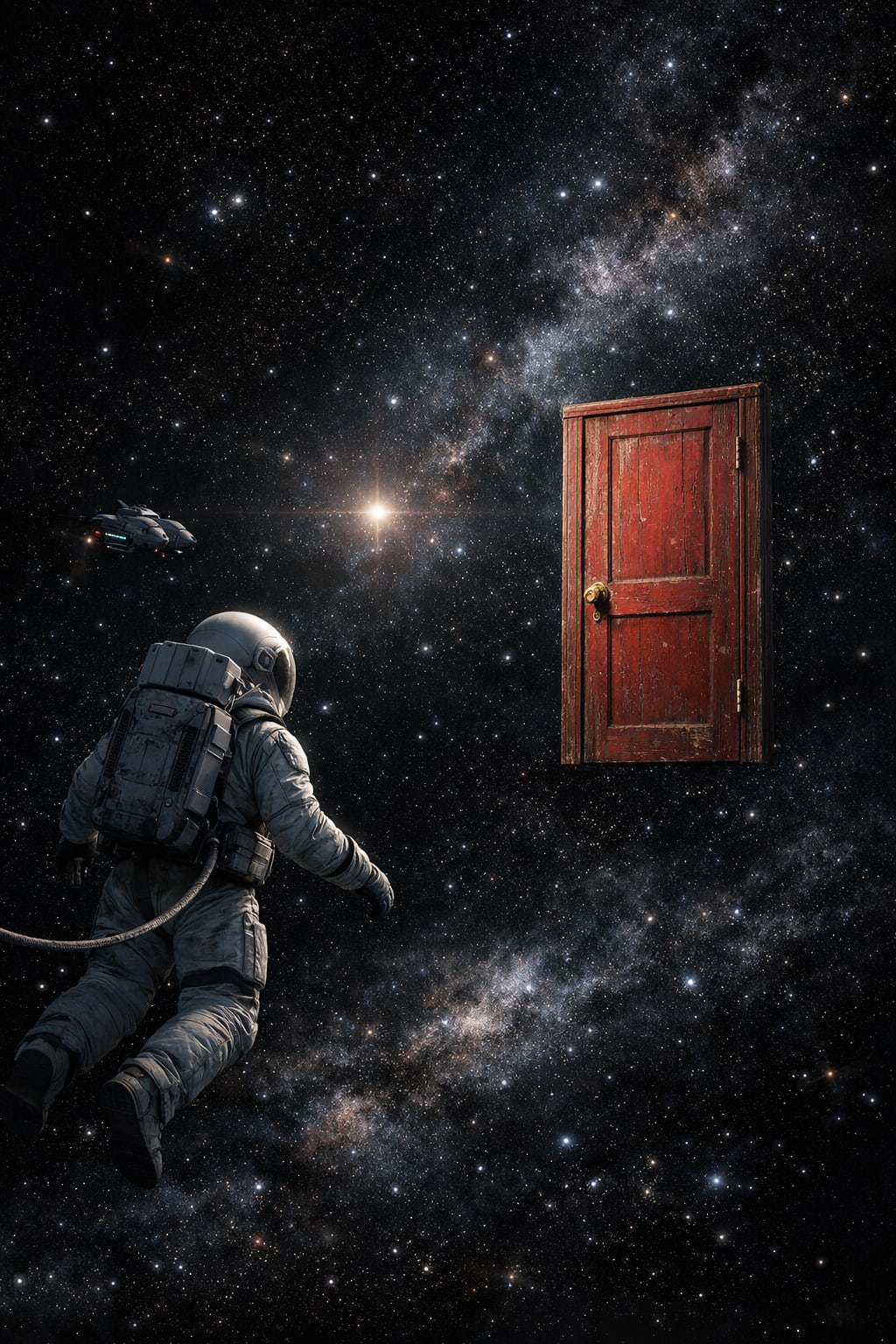
The last thing Maren Voss expected to find at the edge of the observable universe was a door.
Not a metaphorical door — not a wormhole dressed in poetry, not a quantum threshold with a name that sounded poetic in a research paper. An actual door. Rectangular. Painted a fading shade of red, the kind of red that reminded her of her grandmother's barn in the Swiss lowlands, the one that burned down the summer she turned nine. It floated against the absolute black of deep space like a forgotten thought, hinges intact, brass handle catching the light of a star that had no business being this far out.
Maren pressed her palm against the viewport of Sable, her one-woman surveying vessel, and said nothing for a very long time.
She was three years into a five-year solo cartography mission for the Interstellar Meridian Commission — the IMC, which her colleagues called "Imaginary Maps and Conjecture" after their third glass of something warm. Her job was to chart stellar drift in Sector 9-Omega, a region so remote that light from Earth's sun arrived here already old, already tired. She had not spoken to another human being in forty-one days. She had been eating reconstituted lentil soup for eleven of those days because the synthesizer's flavor module had quietly died, and she hadn't had the motivation to fix it.
She had the motivation now.
It took her six hours to suit up, calculate a safe intercept trajectory, and talk herself out of turning around four separate times. The door did not move as she approached it on her tether. It did not shimmer or hum or do any of the things mysterious objects were supposed to do in the old science fiction serials she'd grown up watching with her father. It simply existed, with the calm authority of something that had always been there and was merely waiting to be noticed.
The brass handle was warm through her glove. That alone should have been impossible.
She turned it.
The door opened onto a room.
Not the vacuum of space — a room. Roughly four meters by four meters, with walls the color of old paper and a floor of dark wood that creaked under her boots the moment she stepped inside and gravity, inexplicably, caught her. A desk occupied the center. On the desk: a brass lamp, burning with amber light from no visible source. A leather-bound logbook, its pages dense with handwriting in a dozen languages. And a chair, occupied by a man who looked up from his reading as though he had been expecting her for precisely this long and not a moment more.
He was old — genuinely, deeply old in a way that had moved beyond age into something else entirely. His skin had the quality of old maps: layered, cross-hatched with experience, slightly translucent at the edges.
"Cartographer," he said. Not a question.
"Yes," Maren said, because denying it seemed beside the point.
"Good." He closed his book. "The last one was a botanist. Lovely woman, but she kept trying to classify me." He gestured to the chair across from him, which Maren realized had not been there a moment ago. "Sit. We have perhaps two hours before this sector's drift carries your vessel out of tether range, and there is a great deal to discuss."
His name, he told her, was something unpronounceable in any human language, so she was welcome to call him what the previous visitors had called him: the Index. He had been here — here, at the outermost edge of mapped space — for longer than human civilization had existed. Not because he was imprisoned. Not because he was lost.
Because someone had to keep the record.
He showed her the logbook. It was not a single book — she understood that as soon as she touched it — but something more like a living archive, containing the observations of every sentient species that had ever reached this boundary. There were entries in chemical gradients. In color sequences. In mathematical notation so elegant it made her eyes ache. There were entries that were simply emotions, somehow pressed into the page like flowers.
"Every civilization that develops spacefaring technology," the Index said, folding his hands on the desk, "eventually sends someone here. Not always intentionally. The ones with the right quality of attention tend to arrive eventually."
"What quality?" Maren asked.
"The willingness to chart what cannot benefit you personally." He looked at her steadily. "You are three years into a mission that will not make you famous. Sector 9-Omega will not yield habitable planets. There is no resource extraction here, no strategic value. Your commission barely funded it. And yet here you are, measuring stellar drift in the dark, because someone ought to know precisely how the stars are moving, even the ones no one will ever visit."
Maren thought about her grandmother's barn. She had spent the summer after it burned drawing maps of where everything had stood — the hay loft, the rusted weathervane, the particular way the light fell through the south-facing window in the afternoon. Her mother had thought it was grief. Maybe it was. But it had also felt like rescue. Like insisting that something lost still deserved to be precisely located.
"What do you need from me?" she asked.
"A new entry," the Index said simply. He slid the logbook across the desk. "Tell me what you have found out here. Not the data — you have instruments for that. Tell me what it has been like, to be a human alone at the edge of the known."
She wrote for ninety minutes. She wrote about the lentil soup and what silence sounds like when it has no echo. She wrote about the way a star's spectrum, rendered through her instruments, looked not unlike stained glass. She wrote about her father falling asleep during those old serials and how she would watch the rest alone, not because she liked being alone, but because she loved the stories too much to pause them, and how that tension — the wanting of company and the refusal to interrupt the journey — had quietly defined her entire life.
When she finished, her handwriting looked small and earnest on the ancient page.
The Index smiled — the first time he had smiled — and it was the expression of someone who has been given exactly the right word for something they have felt for centuries.
"The door will always open for you," he said. "If you return."
She stepped back through it into the cold and the black and the waiting stars, her tether still taut, Sable drifting three hundred meters off her port side, the brass handle warm behind her even as the door dissolved back into the deep.
She floated there for a moment, alone, at the edge of everything.
Then she turned back toward the measurable dark, lit up her instruments, and got back to work.
Some things needed to be mapped — not because anyone was coming, but because the universe deserved the dignity of being precisely known.
About the Creator
Alpha Cortex
As Alpha Cortex, I live for the rhythm of language and the magic of story. I chase tales that linger long after the last line, from raw emotion to boundless imagination. Let's get lost in stories worth remembering.
Keep reading
More stories from Alpha Cortex and writers in Fiction and other communities.


Comments
There are no comments for this story
Be the first to respond and start the conversation.