
City of plague:A new Yorker’s pandemic chronicle Pt 23.
The Elevator Inspector Who Couldn’t Fix the Elevator

A small pandemic incident that taught me an unexpected lesson about work, responsibility, and knowing one’s place.
One morning during the long months of pandemic lockdown, I received an unexpected phone call from Ms. Lin.
She had been working from home for weeks, just like most office workers in New York at the time. Our company’s office was nearly empty, and the building felt quieter than it ever had before.
Her tone on the phone was unusually serious.
“Kaide,” she said carefully, “today the elevator maintenance company will be coming to inspect the elevators in both of our buildings. Because inspections were suspended during the pandemic, this one is very important.”
She paused to make sure I understood.
“I need you to be at the building entrance at exactly nine o’clock. When the technician arrives, open the main door for him, guide him up to the roof, and unlock the safety door so he can enter the elevator machinery room.”
Then she repeated the instructions again, slowly, as if worried I might forget.
Under normal circumstances, elevator inspections happened once a month without fail—rain or shine, snow or heat. It was routine, almost mechanical.
But for several months during the worst of the pandemic, the inspections had stopped entirely. Workers stayed home, offices closed, and even services that once seemed permanent were suddenly interrupted.
Now everything was slowly restarting.
Waiting on Broadway
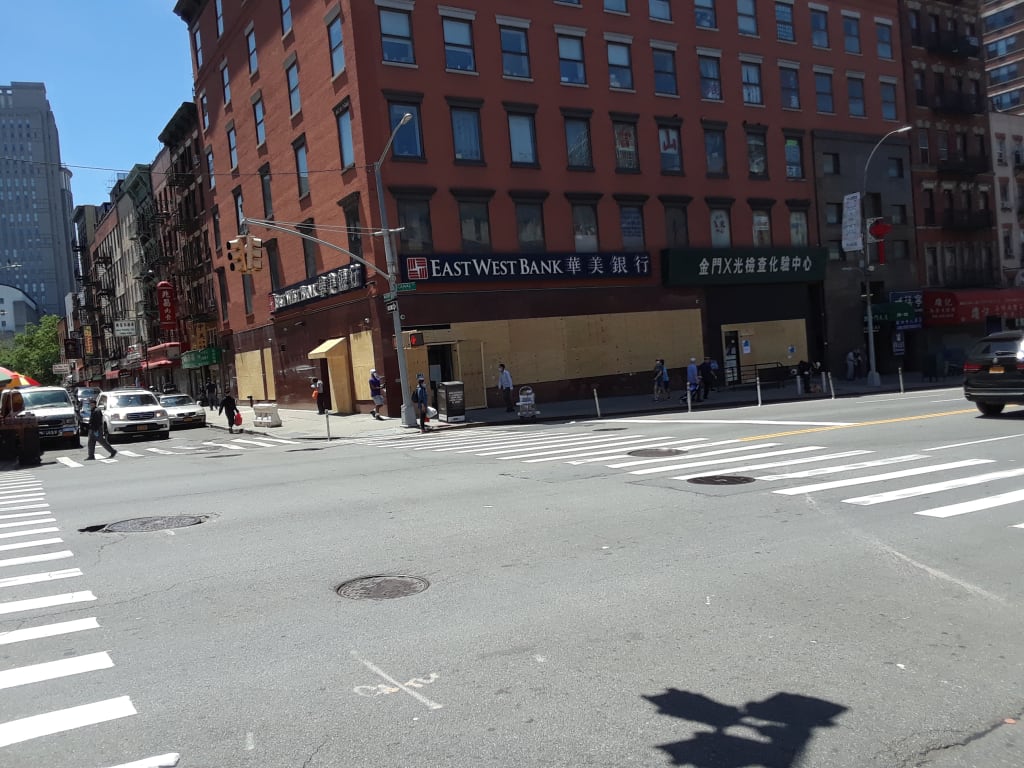
Our company managed two office buildings located directly across from each other on Broadway.
From the sidewalk they looked like two quiet sentries facing each other across the street.
Each building had one elevator. They were not identical—one was older and smaller, the other newer with a slightly larger load capacity—but both had served faithfully for years.
They were like two aging workers who never complained about their duties.
Because I didn’t have the technician’s phone number, I had no way of knowing exactly when he would arrive or which building he would inspect first.
But the distance between the two buildings was only about thirty meters. I could easily see both entrances from the sidewalk.
So I decided on a simple strategy.
I would wait outside one building and watch carefully.
If the technician appeared at the other building first, I could cross Broadway in less than a minute.
In those days, the usually busy avenue had become strangely quiet. There were fewer cars, fewer pedestrians, and an atmosphere that still carried the uneasiness of the pandemic.
Standing there alone on the sidewalk, I had plenty of time to think.
Part of me wondered whether these inspections were even necessary anymore. With so few people coming into the buildings, the elevators were barely being used.
But safety was never something to take lightly.
Just like medical testing during the pandemic—if testing was recommended, people did it, even when they felt fine. Early detection could prevent bigger disasters.
Elevator maintenance worked the same way.
Better to inspect early than regret later.
The Technician Arrives
Eventually I saw a man walking toward the building across the street—the one with the odd-numbered address.
He wore a work jacket and carried a toolbox.
That had to be him.
I quickly crossed Broadway and greeted him with enthusiasm.
“Good morning!” I said, perhaps a little too cheerfully.
Although I had never met this technician before, I treated him like an old acquaintance. During normal times, I often chatted with maintenance workers while they did their inspections. Those small conversations helped pass the time.
Now, after months of isolation, even a brief human interaction felt refreshing.
I opened the building door and led him to the elevator.
Together we rode up to the roof.
Once there, I unlocked the heavy safety door leading to the elevator machinery room. The technician nodded, stepped inside, and began his inspection.
My job was finished for the moment.
About thirty minutes later, he came down to our office.
“All good,” he said casually.
“Everything OK.”
I felt relieved.
Then I guided him across the street to the second building and repeated the same procedure: elevator to the roof, unlock the machinery room door, and leave him to work.
Altogether the task took less than twenty minutes of my time.
When he finished, he returned to the office smiling, said goodbye, and left through the emergency staircase.
I watched him disappear down the stairwell.
Mission accomplished.
Or so I thought.
A Silent Elevator
During the pandemic, many people tried to avoid elevators whenever possible.
Elevators were small enclosed spaces with poor ventilation—exactly the kind of place where viruses could spread easily.
For that reason, I often used the emergency stairs instead.
But later that day, after finishing several other tasks, I decided to take the elevator back up to our office on the fourth floor.
The hallway was empty.
I pressed the elevator button.
Nothing happened.
I pressed it again.
Still nothing.
The elevator remained silent, as if it had suddenly decided to ignore me.
A strange feeling crept into my chest.
“Wait,” I thought. “Didn’t the technician just inspect this elevator?”
I pressed the button repeatedly.
Click. Click. Click.
No response.
Now I was truly alarmed.
My mind began racing through possibilities.
Had the elevator been damaged during the inspection?
Had my habit of spraying alcohol disinfectant on the buttons somehow caused a short circuit?
Whatever the reason, the elevator was clearly not working.
And that was a serious problem.
During the pandemic, people wore masks everywhere—sometimes even two masks at once. Climbing multiple flights of stairs while wearing masks could leave people breathless.
If tenants complained that the elevator was broken, our boss would certainly not be happy.
And the technician was already gone.
Worse yet, I didn’t have his phone number.
Calling Ms. Lin
I immediately called Ms. Lin.
After a few rings she answered from home.
“Hello?”
“Ms. Lin,” I said urgently, “the elevator was working perfectly before the inspection. But now it won’t move at all!”
“What?” she replied in surprise. “Are you serious?”
“Of course I’m serious!” I said. “The technician has already left. What should we do now?”
“How long ago did he leave?” she asked.
“About half an hour.”
She paused for a moment.
“Alright,” she said firmly. “I’ll call the maintenance company and ask them to send him back.”
While waiting for her response, I taped a notice next to the elevator door:
Elevator temporarily out of service. Please use the stairs.
Ten minutes later my phone rang again.
“Kaide,” Ms. Lin said, sounding slightly embarrassed, “the technician says the elevator is broken… but he doesn’t repair elevators. He only performs inspections.”
“He says a repair specialist will come tomorrow.”
I was speechless.
For a moment I stared at the silent elevator doors, trying to process what I had just heard.
The man who inspected the elevator couldn’t fix it.
I couldn’t help thinking—perhaps unfairly—that the inspection had somehow created more work for the repair department.
A Memory from the Past
My suspicion wasn’t entirely without reason.
Two years earlier, one of our elevators had broken down.
After Ms. Lin called the maintenance company, a repair technician arrived within an hour.
I happened to be nearby when he opened the machinery room on the roof.
Curious, I stayed and watched.
The repair turned out to be surprisingly simple.
One burned-out fuse.
The technician replaced it in less than five minutes.
But the repair bill was nearly one thousand dollars.
Months later the same elevator stopped working again.
This time I had a suspicion.
Maybe it was the fuse again.
I opened the machinery room myself and removed the fuse carefully. Then I took it to a nearby hardware store.
The clerk tested it and confirmed my guess.
“Burned out,” he said.
A new fuse cost only a few dollars.
I bought one, installed it, and—just like that—the elevator worked again.
I felt extremely proud of myself.
A Lesson in Boundaries
However, during the next routine inspection, a technician noticed the replacement fuse.
“This isn’t the standard fuse our company uses,” he said.
Then he looked at me.
“Do you know who replaced it?”
“I did,” I answered proudly.
His expression immediately became serious.
“Who authorized you to replace it?”
Suddenly my pride vanished.
“I… just thought I could fix it.”
He shook his head.
“You’re not certified to repair elevators. Only licensed technicians can do that.”
I felt deeply embarrassed.
“I’m sorry,” I said quietly.
“Don’t do that again,” he warned.
I nodded like a child being scolded.
That moment stayed in my memory.
Sometimes doing more than your job requires can actually cause trouble.
Back to the Present
Lost in these thoughts, I almost forgot about the broken elevator.
Then my phone rang again.
It was Ms. Lin.
“The maintenance company just reopened after the pandemic shutdown,” she explained. “They’re extremely busy. The repair technician won’t be able to come until the day after tomorrow.”
She gave me instructions:
“To be safe, please turn off the elevator’s power and keep the emergency stairwell doors open so tenants can use the stairs.”
I sighed.
“Okay,” I replied.
I hung up the phone and looked once more at the silent elevator doors.
Sometimes, I thought, the best thing an employee can do is simply perform the tasks assigned to him—no more, no less.
In the workplace, stepping beyond your role can easily create unexpected problems.
That day, as I turned off the elevator power and opened the stairwell doors, I reminded myself of a simple lesson learned through experience:
Everyone has their own job to do.
And sometimes, the wisest thing is knowing exactly where your responsibility ends.
About the Creator
Peter
Hello, these collection of articles and passages are about weight loss and dieting tips. Hope you will enjoy these collections of dieting and weight loss articles and tips! Have fun reading!!! Thank you.
On The Way To Work
I sidestepped another man walking down the street. Again, taking no care in the world to watch his surroundings - if I was as distracted and nonchalant as he, I’d likely have already been hit by a car. He’s lucky people see him, notice his presence. I don’t get that. Most of us don’t.
By Maddy Haywood2 days ago in Fiction
You Should Stop Trying to Be a Better Person
A year ago, I spent two days in the Colombian mountains drinking ayahuasca as part of a spiritual ceremony. An experience that pulled apart every detail of my being and rearranged me in a new sequence. I wish that life became easier after the feat. It didn’t.
By Annaise Michelle8 days ago in Humans




Comments
There are no comments for this story
Be the first to respond and start the conversation.