
Why Star Color Indicates Temperature: The Science Behind Blue, White, Yellow, and Red Stars
Why does star color indicate temperature? Learn how star color reveals temperature, stellar classification, and the physics behind blue and red stars.

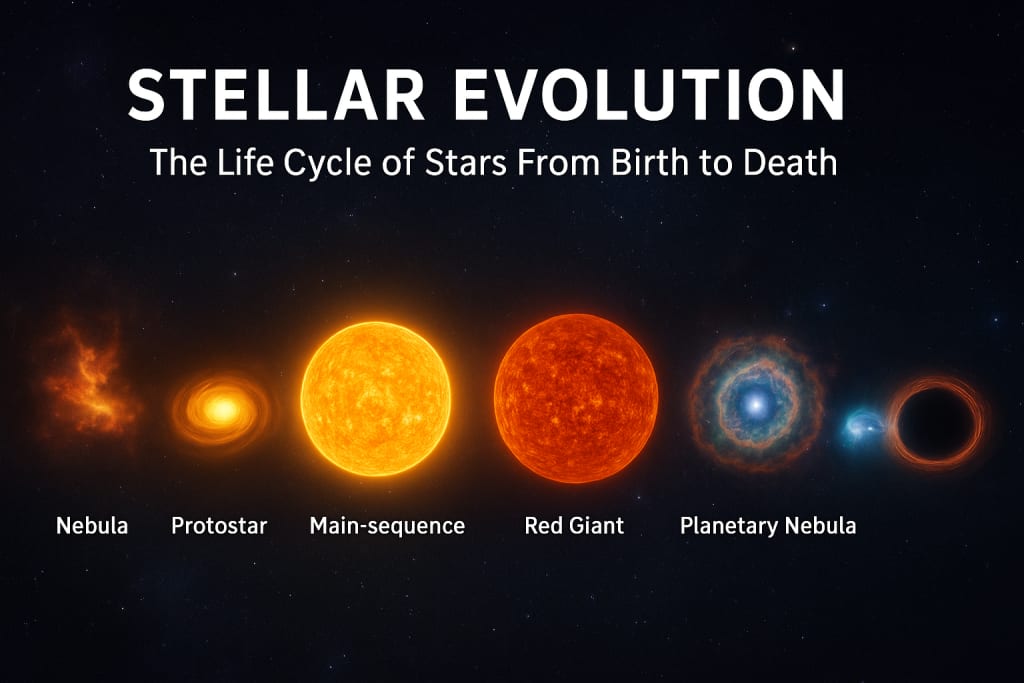
Why Star Color Indicates Temperature
The Night I Noticed a Red Star
One night, far from city lights, I looked up at the sky expecting to see the usual white stars scattered across the darkness. But something unusual caught my eye. One star looked slightly red, while another nearby star looked bluish-white. At first, it seemed like a trick of the eyes or maybe atmospheric distortion.
But it wasn’t.
Stars really do have different colors, and those colors reveal something incredibly important: their temperature.
Astronomers can estimate how hot a star is simply by observing its color. Without touching the star, without traveling to it, and without sending a probe, scientists can determine its temperature just by analyzing the light it emits.
This relationship between color and temperature is one of the most important concepts in astronomy and helps scientists classify stars, understand stellar evolution, and study galaxies across the universe.
________________________________________
Light, Heat, and Color Are Connected
To understand why star color indicates temperature, we need to understand how heat and light are connected.
Any object that is hot emits radiation. This radiation includes light. The hotter the object becomes, the more energetic the radiation it emits.
Scientists call this type of radiation thermal radiation or blackbody radiation.
Stars behave very similarly to blackbody radiators. They emit light across many wavelengths, but the peak wavelength depends on temperature.
In simple terms:
• Cooler objects emit more red light
• Medium-temperature objects emit yellow or white light
• Hot objects emit more blue light
This is why star color directly indicates temperature.
________________________________________
Everyday Example: Heating Metal
You don’t need a telescope to see this effect. You can observe it in everyday life.
If you heat a piece of metal, it begins to glow:
1. At lower temperatures → Red
2. Hotter → Orange
3. Even hotter → Yellow
4. Very hot → White
5. Extremely hot → Blue-white
Stars follow this exact same pattern.
The color of a star is essentially telling us how hot its surface is.
________________________________________
Star Color and Temperature Chart
Astronomers have measured the temperatures of many stars and matched them with colors.
Here is a simplified chart:
Star Color Surface Temperature
Red 2,500 – 3,500°C
Orange 3,500 – 5,000°C
Yellow ~5,500°C
Yellow-White 6,000 – 7,500°C
White 7,500 – 10,000°C
Blue-White 10,000 – 20,000°C
Blue 20,000 – 40,000°C
This means blue stars are the hottest stars, and red stars are the coolest.
This often surprises people because we usually associate red with heat, like fire or lava. But in physics, blue light carries more energy than red light, which means hotter objects glow blue.
________________________________________
Why Blue Stars Are Hotter Than Red Stars
The reason blue stars are hotter comes down to wavelength and energy.
Light comes in different wavelengths:
• Red light → long wavelength → lower energy
• Blue light → short wavelength → higher energy
Hotter objects emit more high-energy radiation, which shifts their color toward the blue end of the spectrum.
This relationship is described by Wien’s Law, which states that as temperature increases, the peak wavelength of radiation shifts toward shorter wavelengths (blue light).
So:
Hotter star → shorter wavelength → blue color
Cooler star → longer wavelength → red color
________________________________________
Stellar Classification and Star Colors
Astronomers classify stars based on temperature using the spectral classification system.
The classification sequence is:
O – B – A – F – G – K – M
This sequence goes from hottest stars to coolest stars.
Class Color Temperature
O Blue 30,000°C+
B Blue-white 10,000–30,000°C
A White 7,500–10,000°C
F Yellow-white 6,000–7,500°C
G Yellow ~5,500°C
K Orange ~4,500°C
M Red ~3,000°C
Our Sun is a G-type star, which is why it appears yellow.
This classification system helps astronomers organize billions of stars in the universe.
________________________________________
What Determines a Star’s Temperature?
The main factor that determines a star’s temperature is mass.
More massive stars have stronger gravity, which compresses their cores more. This increases pressure and temperature in the core, causing nuclear fusion to happen faster.
Faster fusion produces more energy, which increases the star’s surface temperature.
So the general rule is:
More mass → faster fusion → hotter star → bluer color
Smaller stars have slower fusion, lower temperatures, and appear red.
________________________________________
Nuclear Fusion and Star Temperature
All stars generate energy through nuclear fusion.
Inside a star’s core:
• Hydrogen atoms fuse into helium
• This releases enormous amounts of energy
• Energy moves outward and escapes as light and heat
The rate of fusion determines how hot the star becomes.
Massive stars fuse hydrogen rapidly, making them extremely hot and blue. Small stars fuse slowly, making them cooler and red.
________________________________________
Star Color Changes Over Time
Stars do not stay the same color forever.
As stars age, their temperature changes, which changes their color.
For example:
• Sun-like stars eventually become red giants
• Massive stars may become blue supergiants
• Some stars end as white dwarfs
So star color can also tell astronomers the stage of a star’s life.
This is why star color is extremely important in studying stellar evolution.
________________________________________
Why Star Color Is Important in Astronomy
Star color helps astronomers determine many important things:
By studying color, astronomers can estimate:
• Star temperature
• Star age
• Star mass
• Star composition
• Star life stage
• Distance of galaxies
• Structure of star clusters
Without star color measurements, modern astronomy would be much more difficult.
Large sky surveys classify millions of stars just by measuring their color and brightness.
________________________________________
The Night Sky Is Full of Different Stars
When you look at the sky, most stars appear white because our eyes are not sensitive enough to detect subtle color differences in dim light.
But through telescopes or long-exposure photography, star colors become clear:
• Red stars
• Orange stars
• Yellow stars
• White stars
• Blue stars
Each color represents a different temperature and a different type of star.
This means the night sky is not just a random collection of lights—it is a map of different types of stars at different temperatures and stages of life.
________________________________________
A Universe Written in Color
One of the most amazing things about astronomy is that we can learn about stars simply by studying their light.
We cannot touch stars.
We cannot travel to most of them.
But we can analyze their light.
And that light tells us:
• How hot they are
• What they are made of
• How old they are
• How big they are
• How they will die
All of this information begins with something simple: color.
________________________________________
Final Thoughts
Star color indicates temperature because stars emit thermal radiation, and the wavelength of that radiation depends on temperature. Cooler stars emit more red light, while hotter stars emit more blue light.
This relationship allows astronomers to estimate star temperatures, classify stars, and understand stellar evolution across the universe.
Blue stars are the hottest, white and yellow stars are medium temperature, and red stars are the coolest.
The next time you look up at the night sky, remember that those tiny points of light are not all the same. Some are cool red stars slowly burning for trillions of years, while others are massive blue stars burning incredibly hot and living fast, short lives.
The universe is full of stars of different colors, and each color tells a story about temperature, energy, and the life of a star.
About the Creator
Keep reading
More stories from shahkar jalal and writers in Education and other communities.
How Stellar Classification Works: The System Astronomers Use to Classify Stars
How Stellar Classification Works The Night Sky Is Not as Simple as It Looks On a clear night, when you look up at the sky, the stars appear almost identical. They shine as tiny points of light, forming constellations that humans have recognized for thousands of years. To ancient observers, stars were fixed, unchanging, and nearly identical objects scattered across the sky.
By shahkar jalal9 days ago in Education
Why Fresh Perspectives Are Essential for Business Growth
Organizations often depend heavily on internal knowledge, which can limit their ability to see beyond established routines. While internal expertise plays a crucial role, it can also create patterns that restrict innovation. An external perspective introduces new ways of thinking that challenge these patterns and open the door to improvement. This shift allows businesses to evaluate their strategies more effectively and adapt to changing conditions.
By Nicole Metzabout 10 hours ago in Education
Uncovering Pre-IPO Opportunities: How Investors Can Navigate the Private Market
Pre-IPO investing has gained significant attention as investors look for opportunities beyond traditional public markets. These investments allow individuals and institutions to participate in a company’s growth before it goes public. While the potential for strong returns is appealing, navigating the private market requires careful planning, informed decision-making, and a clear understanding of how this space operates. For investors, uncovering pre-IPO opportunities is not just about access. It is about strategy, discipline, and insight.
By Michael Christopher Venturino6 days ago in Education
The Devil's Lettuce
We're all sitting here in a world where you can buy cannabis infused seltzer at a boutique shop that looks like an Apple store... but for about 80 years, the government treated this plant like it was a literal demon from the seventh circle of Hell. Why? Was it because it was actually dangerous? Please. If being dangerous was the criteria, we would have also banned lawn darts and gender reveal parties decades ago.
By Sara Wilson5 days ago in Potent



Comments
There are no comments for this story
Be the first to respond and start the conversation.