
Why Some Stars Are Hotter Than the Sun: The Science Behind Stellar Temperature
Why are some stars hotter than the Sun? Learn how stellar mass, nuclear fusion, and star classification determine star temperature and why blue stars are the hottest.

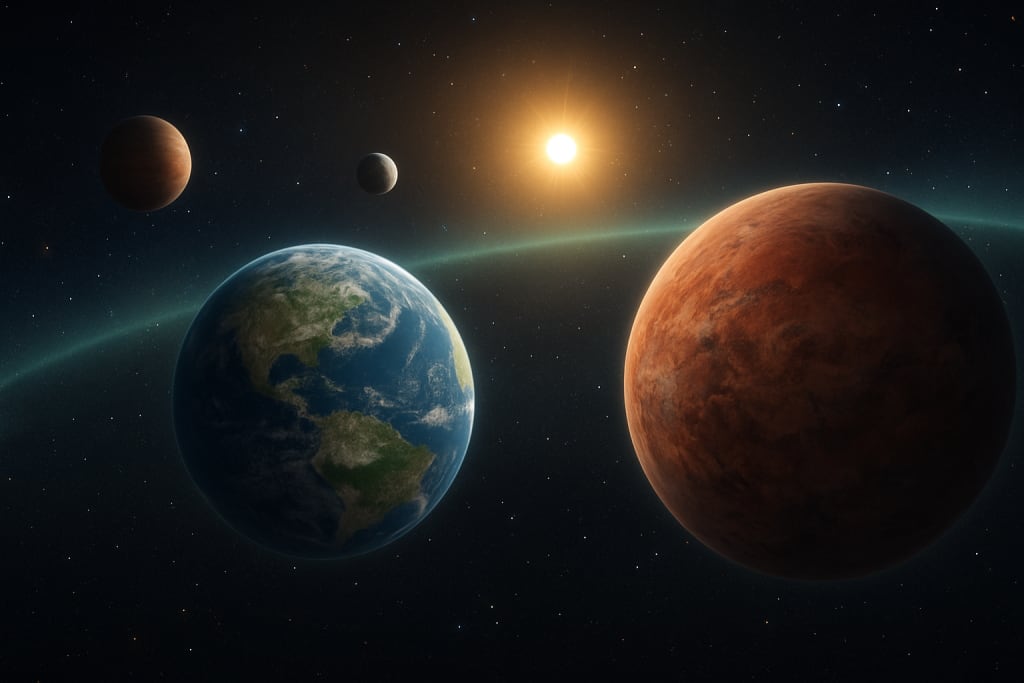
Why Some Stars Are Hotter Than the Sun
A Night Sky That Hides Powerful Secrets
On a clear night, far from city lights, the sky fills with thousands of stars. They look calm, distant, and almost identical—tiny white dots shining silently in the darkness. To the naked eye, it seems like every star is similar to our Sun, just much farther away.
But this is not true at all.
Some of those stars are far larger, brighter, and much hotter than the Sun. While the surface of the Sun is about 5,500°C, some stars reach 20,000°C, 30,000°C, or even more.
This raises an interesting question:
Why are some stars hotter than the Sun?
The answer lies in how stars form, how massive they are, and how nuclear fusion works inside their cores.
________________________________________
Understanding the Sun First
To understand hotter stars, we must first understand the Sun.
The Sun is a medium-sized star located in the Milky Way Galaxy. Astronomers classify it as a G-type main-sequence star, sometimes called a yellow dwarf.
Important facts about the Sun:
• Surface temperature: ~5,500°C
• Core temperature: ~15 million°C
• Age: ~4.6 billion years
• Expected lifespan: ~10 billion years
In astronomy, the Sun is actually considered an average star. It is not extremely large, extremely bright, or extremely hot compared to many other stars in the universe.
________________________________________
The Main Reason: Stellar Mass
The most important factor that determines how hot a star is mass.
Mass controls:
• Gravity inside the star
• Pressure in the core
• Speed of nuclear fusion
• Energy output
• Surface temperature
Massive stars have stronger gravity, which compresses their cores more intensely. This compression increases the temperature and pressure in the core, causing nuclear fusion to occur much faster.
Faster fusion releases more energy, making the star:
• Brighter
• Larger
• Hotter
So the basic rule is:
More mass → stronger gravity → faster fusion → hotter star
________________________________________
Nuclear Fusion: The Energy Source of Stars
All stars produce energy through nuclear fusion.
Inside a star’s core, hydrogen atoms fuse together to form helium. This process releases enormous amounts of energy in the form of heat and light.
In the Sun, fusion happens at a steady rate, which keeps the star stable for billions of years.
But in massive stars, fusion happens much faster.
Because fusion reactions occur more rapidly, these stars produce much more energy, which raises their surface temperature dramatically.
This is why massive stars can be many times hotter than the Sun.
________________________________________
Star Color Reveals Temperature
One of the easiest ways astronomers determine a star’s temperature is by its color.
Stars come in different colors:
• Red
• Orange
• Yellow
• White
• Blue
These colors correspond directly to temperature.
Star Color Surface Temperature
Red 2,500–3,500°C
Orange 3,500–5,000°C
Yellow ~5,500°C
White 7,500–10,000°C
Blue 20,000–40,000°C
This means blue stars are the hottest stars, while red stars are the coolest.
This may seem strange because we often associate red with heat, but in physics, blue light has higher energy than red light, which means hotter objects appear blue.
________________________________________
Stellar Classification System
Astronomers classify stars using a system based on temperature called spectral classification.
The sequence is:
O – B – A – F – G – K – M
This sequence goes from hottest to coolest stars.
Class Color Temperature
O Blue 30,000°C+
B Blue-white 10,000–30,000°C
A White 7,500–10,000°C
F Yellow-white 6,000–7,500°C
G Yellow ~5,500°C
K Orange ~4,500°C
M Red ~3,000°C
The Sun belongs to Class G, which means many stars are much hotter than the Sun, especially O and B type stars.
________________________________________
Blue Giant Stars: Much Hotter Than the Sun
Some of the hottest stars are blue giants and blue supergiants.
These stars are:
• Extremely massive
• Extremely bright
• Extremely hot
• Short-lived
An example of a very hot star is Zeta Puppis, a massive blue star with a surface temperature far higher than the Sun.
Massive stars like this burn their fuel very quickly and may only live a few million years, compared to the Sun’s 10 billion-year lifespan.
________________________________________
Why Hot Stars Live Shorter Lives
It might seem logical that bigger stars would live longer, but the opposite is true.
Massive stars burn their fuel much faster because nuclear fusion happens at a higher rate.
Think of it like this:
• The Sun is like a slow-burning candle
• Massive stars are like giant torches
They burn brighter, hotter, and faster, but they run out of fuel quickly.
Some massive stars live only 1–10 million years, which is very short in cosmic time.
________________________________________
The Role of Gravity in Stellar Temperature
Gravity plays a major role in determining star temperature.
Inside a star, two forces are constantly competing:
1. Gravity pulling inward
2. Energy from fusion pushing outward
In massive stars, gravity is much stronger, so the core must reach higher temperatures to produce enough energy to balance gravity.
This leads to higher core temperatures, faster fusion, and higher surface temperatures.
So again, mass and gravity are the main reasons some stars are hotter than the Sun.
________________________________________
Are There Stars Cooler Than the Sun?
Yes, many stars are actually cooler than the Sun.
In fact, the most common stars in the universe are red dwarfs, which are smaller and cooler than the Sun.
Red dwarfs:
• Are small
• Are dim
• Burn fuel slowly
• Can live trillions of years
So while some stars are hotter than the Sun, most stars are actually cooler.
________________________________________
The Balance That Makes Life Possible
Interestingly, the Sun’s temperature is almost perfect for life on Earth.
If the Sun were much hotter:
• Earth’s oceans might evaporate
• Radiation levels would be higher
• Life might not survive
If the Sun were much cooler:
• Earth could freeze
• Liquid water might not exist
So even though hotter stars exist, the Sun’s moderate temperature makes it ideal for supporting life.
________________________________________
The Universe Is Full of Different Stars
Astronomers estimate there are hundreds of billions of stars in our galaxy alone, and billions of galaxies in the universe.
These stars vary enormously in:
• Size
• Mass
• Temperature
• Brightness
• Lifespan
Some stars are tiny red dwarfs barely glowing in space.
Others are massive blue giants burning at incredible temperatures and lighting up entire regions of galaxies.
This diversity is one of the reasons astronomy is so fascinating.
________________________________________
Final Thoughts
Some stars are hotter than the Sun mainly because they are more massive. Greater mass leads to stronger gravity, higher core pressure, faster nuclear fusion, and much higher temperatures.
This is why blue stars are hotter than yellow stars like the Sun, and why red stars are cooler.
In simple terms:
Star temperature is controlled by mass and nuclear fusion.
The universe contains stars of many different sizes and temperatures, from cool red dwarfs to blazing blue giants. Our Sun sits somewhere in the middle—not the hottest, not the coolest, but perfectly balanced for life on Earth.
The next time you look up at the night sky, remember that those tiny points of light are not all the same. Some are cooler than the Sun, and some are incredibly hotter—burning with temperatures that are almost impossible to imagine.
About the Creator
Keep reading
More stories from shahkar jalal and writers in Education and other communities.
How the Sun Compares to Other Stars: Size, Brightness, Temperature, and Its Place in the Universe
Introduction: A Star That Feels Ordinary — But Isn’t Every morning, the Sun rises over the horizon and fills the sky with light. It warms the Earth, drives weather systems, powers photosynthesis, and makes life possible. Because it appears so familiar, it is easy to assume the Sun is just a typical star.
By shahkar jalal17 days ago in Education
Why Healthcare Innovation Needs Empathy
Healthcare has seen incredible advances in recent decades. From robotic surgeries to wearable health devices and AI-assisted diagnostics, technology is transforming the way patients receive care. Yet, despite these breakthroughs, there remains a crucial element often overlooked: empathy. Innovation alone cannot guarantee better outcomes if the human side of healthcare is neglected. Understanding the experiences, emotions, and needs of patients is essential to making healthcare both effective and meaningful.
By Mark Bouzyk4 days ago in Education
How to Migrate an Existing UIKit App to SwiftUI
In the modern mobile landscape, companies face growing pressure to deliver high-quality, maintainable apps. Many organizations initially launch many apps on iOS before Android, due to the platform’s uniform hardware ecosystem, strong monetization potential, and a relatively predictable user base. While UIKit has been the mainstay for iOS development for over a decade, Apple’s SwiftUI offers a modern, declarative alternative that promises easier maintenance, faster iteration, and a more reactive approach to UI development. Migrating an existing UIKit application to SwiftUI requires careful planning, a strong understanding of both frameworks, and a strategy that minimizes disruption to users.
By Damian Brown5 days ago in Education




Comments
There are no comments for this story
Be the first to respond and start the conversation.