
The idiom “crossing the Rubicon
Origin and History of the idiom “crossing the Rubicon

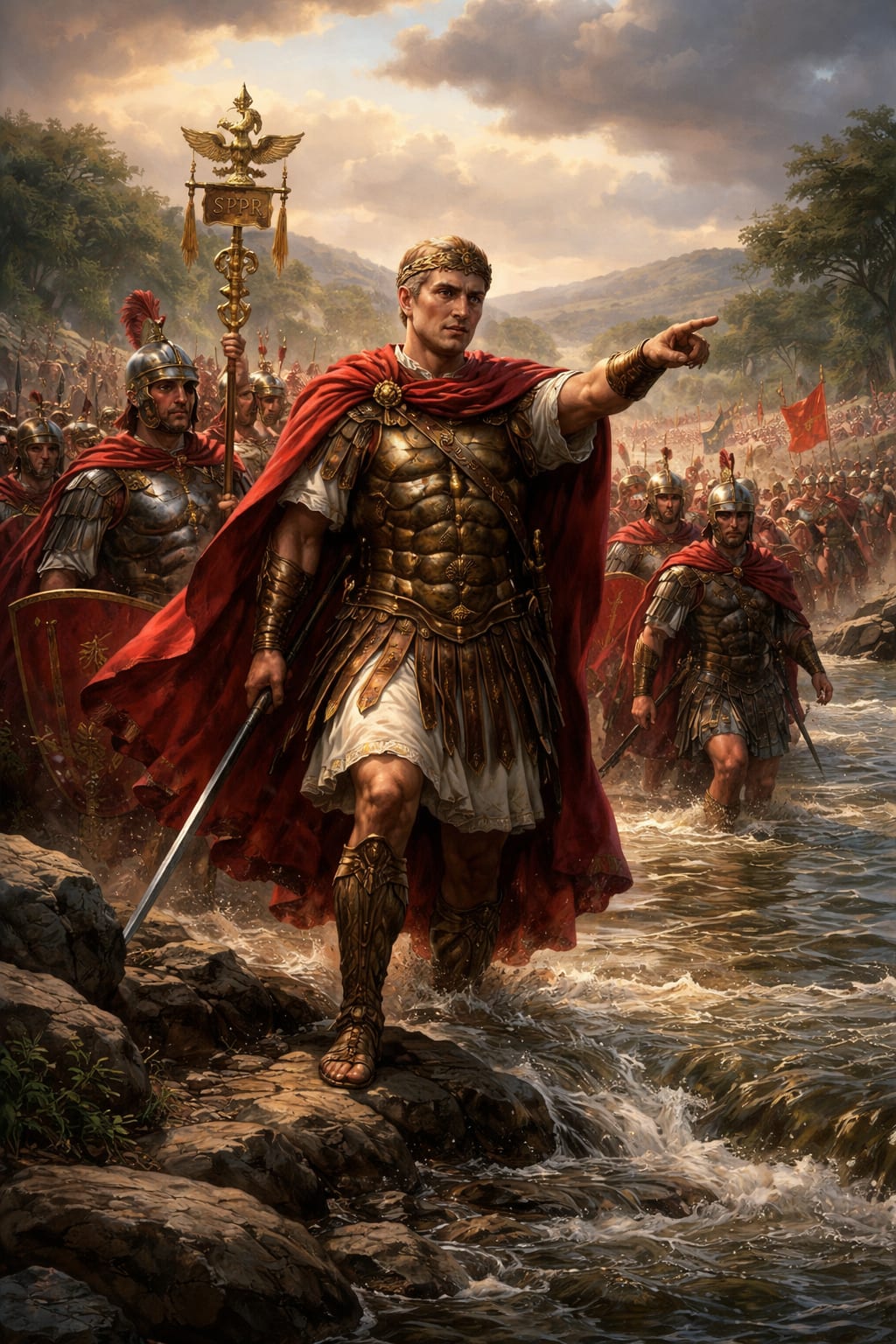
The idiom “crossing the Rubicon” is widely used today to describe a moment of irreversible decision—a point of no return after which consequences must be faced. But the story and history of this idiom is very historical and amazing.Its origin, however, is deeply rooted in interesting ancient Roman history, tied to a dramatic and pivotal event involving one of history’s most famous figures, Julius Caesar.
Historical Background
The phrase originates from the Rubicon River, a small but historically significant river in northern Italy. During the late days of the Roman Republic, the Rubicon served as a legal boundary. Roman law strictly forbade any general from bringing his army across this river into Italy proper. Doing so would be considered an act of treason and a declaration of war against the state.
In 49 BCE, Julius Caesar, a powerful general returning from his successful campaigns in Gaul (modern-day France), found himself at the center of a political crisis. The Roman Senate, fearing Caesar’s growing influence and power, ordered him to disband his army before returning to Rome. This demand placed Caesar in a difficult position: comply and risk losing his authority—or defy the Senate and risk civil war.
The Decisive Moment
Standing at the banks of the Rubicon River, Caesar made a decision that would change the course of history. Because he knows that if he went to roman as civil ,he will be either killed or exiled or put in prison for whole life. He took a bold decision and entered roman with his army and made a history.According to historical accounts, he uttered the famous phrase “alea iacta est”—Latin for “the die is cast”—before leading his troops across the river. By doing so, he knowingly violated Roman law and initiated a civil war against the Senate, led by his rival Pompey.
This act was more than just a military maneuver; it was a symbolic and irreversible step. Once Caesar crossed the Rubicon, there was no turning back. He had committed himself fully to a path that would either lead to his ultimate triumph or complete ruin.
Consequences and Legacy
Caesar’s decision ultimately led to victory. He defeated Pompey and his allies, consolidated power, and eventually became dictator of Rome. However, his rise also marked the beginning of the end for the Roman Republic and the transition toward the Roman Empire.
Because of the gravity of this moment, “crossing the Rubicon” became a powerful metaphor. It represents a situation where a person makes a bold, often risky decision that cannot be undone. The phrase captures both the courage and the danger associated with such actions.
Evolution of the Idiom
Over time, the idiom has moved far beyond its historical roots. Today, it is commonly used in everyday language, politics, business, and personal life. For example, someone might say a company has “crossed the Rubicon” when it invests all its resources into a risky venture, or an individual might use it to describe making a life-changing decision, such as moving to a new country or ending a long-term relationship.
What makes this idiom particularly enduring is its vivid imagery. The idea of physically crossing a boundary that cannot be re-crossed resonates universally. It reflects a fundamental human experience: the moment when hesitation ends and commitment begins.
Conclusion
The idiom “crossing the Rubicon” is a perfect example of how historical events shape language and culture. Rooted in a single, dramatic decision by Julius Caesar, it has evolved into a timeless expression used across the world. Its continued relevance lies in its powerful message: some decisions define our path so completely that once taken, there is no going back.
About the Creator
Ibrahim Shah
I am an Assistant Professor with a strong commitment to teaching,and academic service. My work focuses on fostering critical thinking, encouraging interdisciplinary learning, and supporting student development.
Keep reading
More stories from Ibrahim Shah and writers in Education and other communities.
IS Russia Winning Ukraine War?
For much of the conflict, Europe framed Ukraine’s struggle as a clear case of resistance against Russian aggression. The narrative was straightforward: Ukraine was defending sovereignty, and Europe stood firmly behind it. However, by 2026, the situation has evolved into something far more complex. The war is no longer just about Ukraine—it has become a broader strategic test for Europe itself. At the center of this test lies what analysts are calling the “Trump Conundrum.”
By Ibrahim Shah a day ago in The Swamp
Amelia Rowen: Professional Medical Writer Focused on Clear and Practical Health Advice
Not everyone who studies health decides to explain it to the public. Amelia Rowen did. She chose writing over clinical work. She chose clarity over complexity. Today, she works as a medical writer and wellness contributor, known for presenting health information in a way that feels direct and practical.
By Talha Zulfqarabout 16 hours ago in Education
The Solitude of The Chupacabra
Many say that the Chupacabra is a rather recent and modern tale, a mangy coyote or rabied dog. Some point out that it’s just twisted evolution. But very few know the true backstory of the shapeshifter that led to the bloodsucking legend. And perhaps once you will come to know and understand more, you might “forget” a few cattle out to wander.
By Oneg In The Arctic4 days ago in Fiction



Comments
There are no comments for this story
Be the first to respond and start the conversation.