
The Complete Study Framework Used by Top Performers in GAMSAT
Complete Study Framework

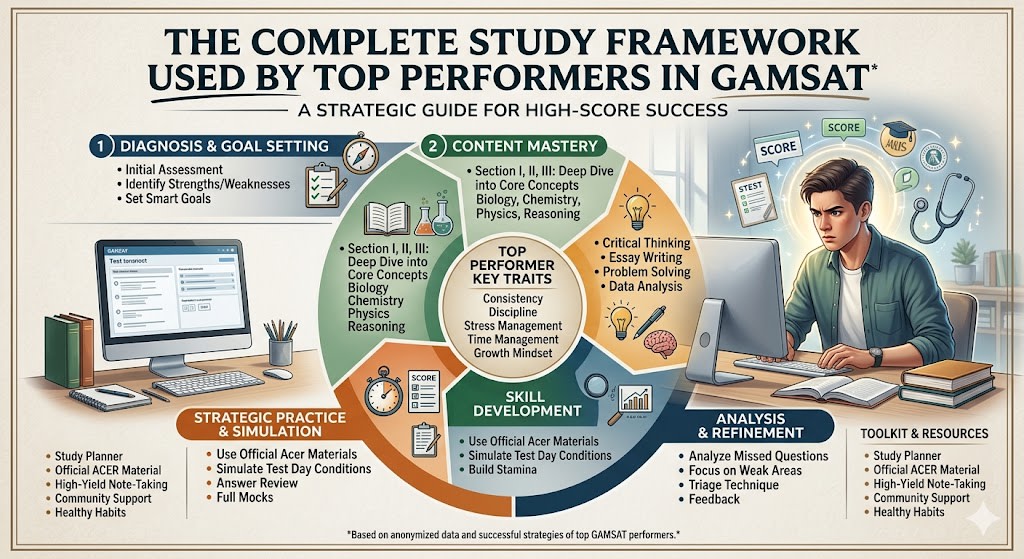
Most students preparing for GAMSAT are busy all the time. Notes, videos, and question banks are just some of the things that they use to prepare for the GAMSAT. Still, even after all that practice, the score stays the same. It makes them wonder what top performers do differently that they are missing.
The GAMSAT filters the performers on a whole other level. The exam doesn’t judge you only on how much knowledge you have, but also on how you process that information. This is why the exam is quite difficult to prepare for, and why some students even have to sign up for GAMSAT preparation courses in order to see any improvement in their scores.
Through this blog, you’ll get a complete study framework that top performers follow in their GAMSAT preparation.
Why Most Study Plans Fail for GAMSAT
The plan a lot of students make looks impressive on paper. Three hours of science, one hour of reading, one essay a day. It feels disciplined but also misses the point.
The exam does not care how many chapters you covered. It gives you material you have not seen before and watches what you do with it. That’s the reason most plans break. Because they train familiarity while the GAMSAT exam tests adaptability.
So you end up with students who “know” a lot, but hesitate the moment a question looks slightly different.
What the Exam Is Really Testing
There’s a pattern across all three sections, but it’s not obvious at first.
GAMSAT Section I looks like reading. Section II looks like writing. Section III looks like science. Underneath, all three are asking the same thing. Can you take messy, unfamiliar input and turn it into something clear?
That’s it. Once you see that, GAMSAT preparation becomes less scattered. You stop dividing your brain into subjects and start treating everything as reasoning practice.
Some people realise this early; most don’t. This gap shows up in scores.
How Top Performers Study Section I
They don’t chase speed first. It comes later.
In the beginning, they deliberately read slower than everyone else. They notice when the tone takes a turn, when a sentence contradicts the previous one, when a word feels slightly out of place. This sounds small, but Section I is built on those details.
Also, they don’t trust their first instinct too much. A lot of answer choices are written to match what you think you read, not what is actually there. So they check slowly, quietly, option by option. Not overthinking anything, just verifying each case.
Over time, this becomes automatic, and they gradually become capable of completing GAMSAT Section 1 questions faster. Many students use the question banks provided by GAMSAT preparation courses to practice and achieve this goal.
How They Handle Section II Without Templates
Templates are comforting. But they also flatten your thinking. You can usually tell when someone is writing from memory. The structure is clean, but the ideas feel recycled.
Top performers take a different route. They pause before writing, not for long, but enough to decide what they actually believe about the prompt.
Their GAMSAT essays don’t try to impress. You won’t find forced vocabulary or dramatic lines. Just clear movement from one idea to the next. You read it once and understand exactly what they’re saying. Clarity carries more weight than style.
GAMSAT preparation course providers are useful if you’re struggling with Section 2 of the GAMSAT, because they typically provide essay marking services to help you pinpoint how you can improve.
How They Approach Section III Without Memorising Everything
This is where people panic and start collecting material. Top performers trim this down early. They focus on a small set of core ideas and get comfortable applying them in different ways.
Then they practise with questions that don’t look familiar. A good GAMSAT preparation course can help, but only if it pushes you into uncomfortable territory. If everything starts feeling predictable, you’re probably not training the right skill.
Most Section III questions do not test recall. They’re testing whether you can read a graph properly, track relationships, and not get lost halfway through.
The Way They Review Mistakes
A lot of students check answers, read explanations, and move on. This is a shallow approach. Top performers slow this part down. If something went wrong, they want to know exactly where.
Did they misread the question? Assume something too early? Rush because of time?
They don’t just label it as a “mistake.” They trace it back.
After a while, patterns start appearing. Same type of error, different questions. Once you see that, fixing it becomes easier along the way.
How They Train for Speed and Mental Stamina
Everything feels manageable in short GAMSAT practice sessions. Then you sit for a full-length test, which is 5.25 hours over two sittings, and your focus drops halfway through.
Top performers prepare for that feeling. They don’t always do full mocks, but they spend enough time working in long stretches. Long enough to notice when their concentration dips and how their decisions change when they’re tired.
What They Focus on in the Final Weeks
At this stage, adding new material doesn’t do any good. Your focus shifts, which changes decisions, not knowledge.
Toppers work on:
- Staying steady when a question looks unfamiliar.
- Not second-guessing every answer.
- Keeping their approach consistent even when the paper feels difficult.
- They aren’t changing anything; they’re tightening what’s already there.
Conclusion
GAMSAT is not unpredictable. It just doesn’t reward the way most people prepare. Once you stop chasing coverage and start paying attention to how you think through problems, things begin to change. And that’s the difference.
About the Creator
Abbasi Publisher
I’m a dedicated writer crafting clear, original, and value-driven content on business, digital media, and real-world topics. I focus on research, authenticity, and impact through words
Keep reading
More stories from Abbasi Publisher and writers in Education and other communities.
How Storytelling Skills in High School Set Students Apart in Life and Admissions
High school is not just about the grades and extracurriculars, it is also where students learn and mold their narratives about what they value, who they are and what direction they are headed to. In this era full of digital content and highly competitive college admissions, storytelling skills become powerful differentiators. From making compelling essays to delivering presentations in your class that echo to many, storytelling transforms experiences into messages. Let’s explore how mastering storytelling elevates students both in school life and beyond.
By Abbasi Publisher7 months ago in Education
A Law Explains Patterns, Order, and Predictable Behavior
Laws play a central role in how humans understand the world around them. Whether in science, society, or philosophy, a law provides a structured explanation of how things behave under certain conditions. At its core, a law explains consistent patterns that can be observed, tested, and relied upon over time. It allows people to move beyond guesswork and toward knowledge that can guide decisions and actions with confidence.
By Juan Monteverde5 days ago in Education
Peter Ayolov's Publications
Peter Ayolov is a media theorist and lecturer at Sofia University ‘St. Kliment Ohridski’, Faculty of Journalism and Mass Communication. His research focuses on the political economy of communication, propaganda models, digital media, narrative structures, and the transformation of language in contemporary technological environments. His work examines how digital communication systems organise dissent, amplify outrage, and reshape the relationship between media, public opinion, and political power.
By Peter Ayolov4 days ago in Education
The Irony of Flying While We Bomb the "World's Greatest Terror Regime"
Ah, the irony of flying at this moment in time as the United States is simultaneously bombing Iran - the nation officials have insisted for decades is "The World's Greatest Terror Regime" - while the TSA is on a go-slow, courtesy of a funding squeeze that's left its officers unpaid, quitting in droves, and turning checkpoints into something like slow-moving bread lines.
By Scott Christenson🌴7 days ago in Humor




Comments
There are no comments for this story
Be the first to respond and start the conversation.