
How to Design a Wallet UX for DeFi: Managing Transactions, Approvals, and Risks
A Design Guide for Building User-Centric DeFi Wallet Experiences

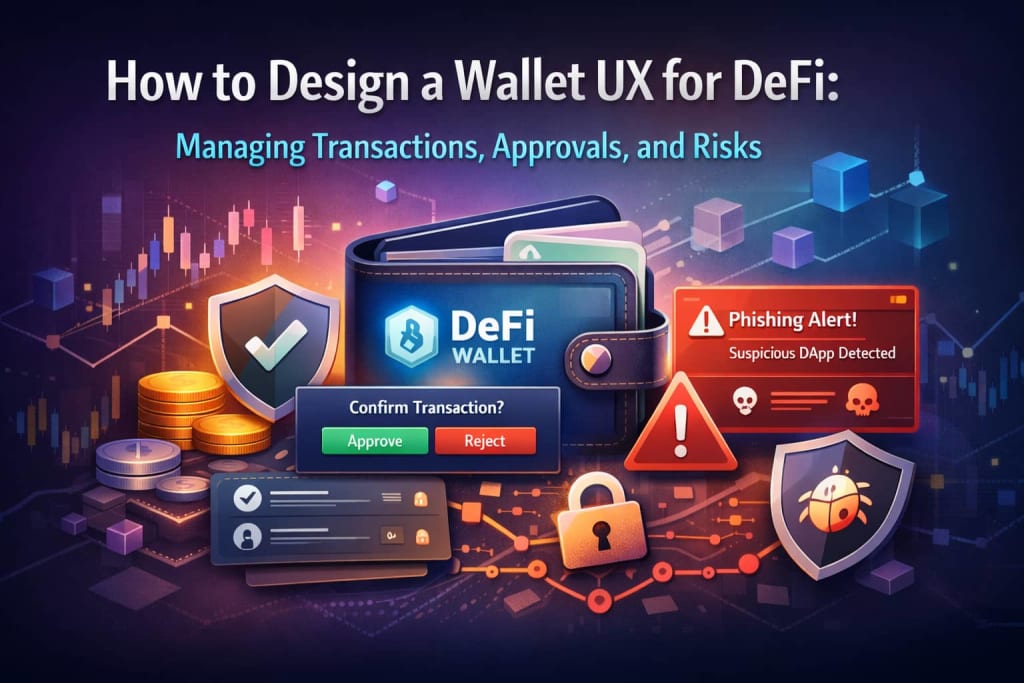
Designing a wallet for DeFi is not simply a matter of enabling transactions—it is about shaping how users understand, approve, and control interactions with decentralized systems. Unlike traditional applications, DeFi wallets operate in an environment where every action is irreversible, every approval carries risk, and every interaction may involve a smart contract beyond the user’s direct control.
A strong UX does more than make things look simple. It translates complexity into clarity, reduces user error, and builds trust in an environment where trust is minimal by design. The core challenge is to balance usability with security while preserving the principles of decentralization.
1. Understanding the Nature of DeFi Interactions
DeFi applications rely on smart contracts deployed on blockchains. These contracts govern:
- token swaps
- lending and borrowing
- staking and yield generation
- liquidity provision
Wallets serve as the interface between users and these contracts. Every interaction typically involves:
- signing a transaction
- paying a network fee (gas)
- authorizing contract behavior
Unlike traditional apps, there is no backend to reverse errors. UX must compensate for this by preventing mistakes before they happen.
2. Designing Clear Transaction Flows
A well-designed transaction flow is the foundation of a good DeFi wallet UX.
Key principles:
- Transparency: Show exactly what will happen before the user confirms
- Clarity: Avoid technical jargon where possible
- Predictability: Users should understand outcomes before acting
Each transaction should clearly display:
- assets being sent and received
- estimated gas fees
- destination contract or address
- expected execution outcome
Where possible, simulate the transaction and show potential results before confirmation. This reduces uncertainty and helps users make informed decisions.
3. Designing Token Approval UX
Token approvals are one of the most misunderstood—and dangerous—parts of DeFi UX.
When users interact with protocols, they often grant permissions to smart contracts to spend tokens on their behalf. Poorly designed UX can lead to users unknowingly granting excessive permissions.
Best practices:
Explain approvals in plain language
Avoid raw technical explanations. Instead, describe approvals as: “Allow this app to use your tokens”
Show the scope of permissions
- Clearly indicate:
- which tokens are affected
- how much access is granted (exact amount vs unlimited)
Warn about unlimited approvals
Highlight when a user is granting unrestricted access to funds.
Provide approval management tools .
Allow users to:
- view active approvals
- revoke permissions
- monitor contract access
4. Managing Risk in Wallet UX
Risk management should be embedded directly into the user interface—not left to the user to figure out independently.
Key UX strategies:
1. Risk labeling
Tag transactions or contracts with risk indicators:
- low
- medium
- high
2. Contract awareness
Display clear information about:
- the smart contract the user is interacting with
- whether it is verified or widely used
3. Transaction warnings
Warn users about:
- interacting with unknown contracts
- high-value transactions
- unusual behavior
4. Simulation and previews
Before confirmation, show:
- expected token changes
- potential slippage
- outcomes of the transaction
This transforms the wallet from a passive tool into an active risk assistant.
5. Designing for Gas Fees and Network Complexity
DeFi operates across multiple networks, each with its own fee structure and performance characteristics.
UX considerations:
Display gas fees clearly before confirmation . Allow users to adjust:
- speed (slow, standard, fast)
- priority fees
Provide estimates in fiat terms for clarity
Handle failed transactions gracefully with explanations Advanced wallets may also:
- suggest optimal times for lower fees
- switch networks dynamically
- batch transactions where possible
6. Building Trust Through Feedback and State Visibility
Users need to understand what is happening at every stage of a transaction.
Key UX elements:
- Pending states: clearly indicate when a transaction is awaiting confirmation
- Success states: confirm successful execution with clear outcomes
- Failure states: explain why a transaction failed and what to do next
Visibility reduces anxiety and builds confidence, especially for new users.
7. Designing Secure Interactions with Smart Contracts
Smart contracts are the backbone of DeFi systems, but they introduce complexity and risk.
A wallet must:
- verify contract addresses
- display contract metadata where possible
- highlight verified vs unverified contracts
- prevent blind signing where feasible
Users should never feel like they are signing “black box” transactions. The UX must make contract interactions understandable and auditable.
8. Integrating DeFi Solutions into Wallet UX
A critical aspect of wallet design is how DeFi features are integrated into the user experience.
Modern wallets are no longer just storage tools—they act as gateways to decentralized finance ecosystems.
A well-designed wallet should support:
- token swaps via decentralized exchanges (DEXs)
- staking and yield opportunities
- lending and borrowing protocols
- liquidity provision
To integrate these features effectively:
- Present DeFi actions as native wallet capabilities, not external steps
- Maintain consistent UX across all interactions
- Simplify complex workflows into guided steps
- Provide contextual information about each action
For example, when a user interacts with a DeFi protocol, the wallet should:
- guide them through each step of the process
- explain risks associated with the action
- show how the smart contract will behave
- clearly display approval and transaction requirements
By embedding DeFi functionality directly into the wallet, you reduce friction and help users interact with protocols more confidently. At the same time, the wallet must maintain strict boundaries around security, ensuring that every interaction is intentional and transparent.
9. Handling Errors and Edge Cases
DeFi environments are unpredictable. A good wallet UX anticipates failure.
Common edge cases:
- failed transactions due to insufficient gas
- network congestion
- slippage errors
- rejected approvals
UX responses:
- provide clear error explanations
- suggest actionable solutions
- avoid technical error dumps
For example, instead of “Transaction reverted,” say: “The transaction failed because gas was too low. Try increasing the gas fee.”
10. Supporting Advanced Users Without Overwhelming Beginners
A strong wallet UX must serve both novice and advanced users.
Strategies:
- Progressive disclosure: show basic options first, advanced options on demand
- Advanced settings: allow expert users to control gas, slippage, and parameters
- Defaults: provide safe, optimized defaults for beginners
This ensures accessibility without limiting power users.
Conclusion
Designing a DeFi wallet UX is about more than usability—it is about safety, clarity, and trust in a trustless system.
A successful wallet:
- simplifies complex interactions
- makes risks visible and understandable
- guides users through transactions and approvals
- integrates DeFi functionality seamlessly
- provides transparency at every step
Ultimately, the goal is to bridge the gap between human intuition and decentralized systems.
Because in DeFi, the wallet is not just a tool—it is the user’s primary interface with financial sovereignty.
About the Creator
Damian Brown
IT consultant with 7+ years’ experience helping organizations optimize technology, implement scalable solutions, and drive digital transformation for measurable business results.
Keep reading
More stories from Damian Brown and writers in Education and other communities.
How to Choose Between Blockchain Solution Types (Public Chains, Private Chains, or Consortium)
Choosing a blockchain solution is not about picking the most advanced technology—it is about aligning your system with the right trust model. The three primary categories—public, private, and consortium blockchains—represent fundamentally different approaches to governance, access, and control.
By Damian Brown3 days ago in Education
When a Child Is in Crisis: Valley Children’s Healthcare Is Answering the Call with Mental Health Care Services
For families in California’s Central Valley whose children are struggling with anxiety, depression or thoughts of self-harm, real help hasn’t always been within reach. For years, parents have driven three and four hours just to access inpatient psychiatric care for a child in crisis.
By Todd Suntrapak3 days ago in Education
Top 7 ERPNext Implementation Companies for Scalable Business Growth
In today’s fast-paced business world, growing your company means having the right tools. ERPNext is powerful software that helps manage almost every part of your business, including sales, inventory, accounting, and human resources. However, installing and setting up ERPNext properly can be tricky. That’s where expert implementation companies come in.
By Jamika Wilkerson5 days ago in Education



Comments
There are no comments for this story
Be the first to respond and start the conversation.