
Education Adds Months to Your Life, Smoking Shaves Off Years: What Recent Research Reveals
New studies show that more schooling is linked to longer life, while cigarette smoking significantly shortens lifespan — highlighting education and lifestyle as key determinants of longevity.

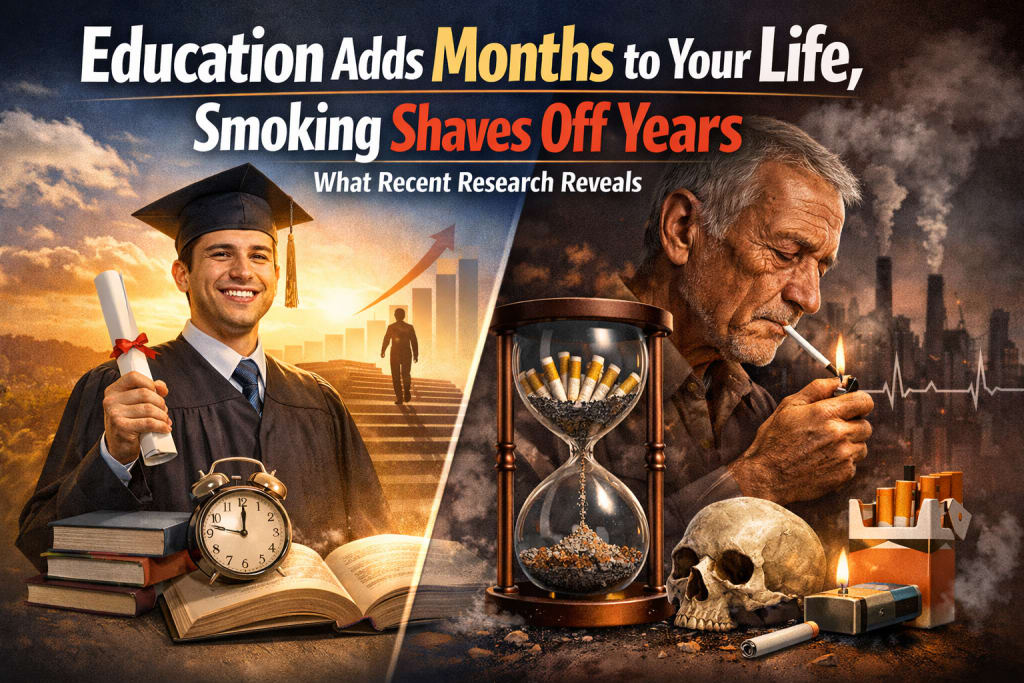
In health research, scientists increasingly recognize that factors outside of biology — like education and lifestyle choices — have profound effects on how long we live. Two trends emerging from recent studies paint a striking picture: every extra year of education can add measurable months to a person’s life expectancy, while tobacco smoking can cut years off it. These findings offer powerful public‑health lessons about how social conditions and personal behaviors shape longevity.
The Protective Power of Education
A major global analysis published in The Lancet Public Health found that each additional year of formal education reduces the risk of death by about 2% across diverse populations.  What this means in real terms is that individuals who spend more time in school tend to live longer than those who do not. The protective effect of schooling appears roughly equivalent to some healthy habits, such as eating a nutritious diet or engaging in regular physical activity.
Researchers examined data spanning 59 countries and hundreds of studies, covering populations from high‑income nations like the United States and UK to developing countries such as China and Brazil. They found that completing primary school is associated with a significant reduction in mortality risk, and continuing through secondary and tertiary education compounds that benefit. People with higher levels of education have lower death rates from a broad range of causes, including cardiovascular diseases and cancers.
Experts suggest several reasons education matters for longevity:
• Better health knowledge and behavior: People with more schooling are more likely to adopt preventive health habits, get regular check‑ups, and follow medical advice.
• Increased socioeconomic advantages: More education often leads to higher income, better jobs, and access to healthcare — all factors linked to longer life.
• Lower risk of harmful behaviors: Educated individuals tend to smoke less, drink less excessively, and make more informed lifestyle choices.
Taken together, these mechanisms help explain why the accumulated years of schooling — even if modest — can translate into months or even years of additional life.
Tobacco’s Toll on Lifespan
In stark contrast to the life‑enhancing effects of education, smoking remains one of the single largest preventable causes of premature death worldwide. Scientific estimates suggest that cigarette smoking shortens average life expectancy by 7–10 years when compared with non‑smokers.  According to research reported by the World Health Organization, smokers lose roughly a decade of life on average due to increased risk of heart disease, cancer, stroke, and respiratory illnesses.
To help make this impact easier to grasp, older studies attempted to break it down per unit of smoking. One such analysis estimated that each cigarette smoked reduces life expectancy by about 11 minutes, based on lifetime consumption and mortality differences between smokers and non‑smokers.  Although more recent work suggests this figure could be even higher (around 20 minutes per cigarette), the core message remains stark: tobacco use accelerates death and disease.
The harmful effects extend beyond just years of life lost — smoking also dramatically increases the likelihood of long periods of illness and disability. Many smokers develop chronic conditions years before death, meaning that not only do they die sooner, but they also spend more of their later years in poor health.
Comparing the Effects: A Public‑Health Perspective
When considering the relative impacts, the benefits of education and the harms of smoking highlight two ends of a spectrum of life determinants. On one side, education represents a structural and socioeconomic investment that builds long‑term resilience and health equity. On the other, smoking reflects cumulative personal risk that significantly shortens life and health span.
While individual choices matter, experts emphasize that not everyone has equal access to the determinants of a long life. For example, barriers to schooling — whether economic, social, or regional — can limit opportunities for health benefits associated with education. Similarly, tobacco marketing and addiction disproportionately affect lower socioeconomic groups, exacerbating health inequalities.
Recognizing these patterns, public‑health initiatives around the world increasingly focus on expanding educational opportunities and strengthening tobacco control measures. Policies such as raising the legal smoking age, increasing taxes on tobacco products, and investing in adult education programs seek to shift population health in positive directions.
Concluding Thoughts
The evidence is clear: education isn’t just a pathway to knowledge and economic opportunity — it’s also a significant contributor to longevity. At the same time, smoking remains one of the most potent preventable threats to life expectancy, shaving years off lives and burdening health systems. Investing in schooling and promoting smoke‑free lifestyles are powerful strategies for healthier, longer lives — both for individuals and societies.
About the Creator
Irshad Abbasi
Ali ibn Abi Talib (RA) said 📚
“Knowledge is better than wealth, because knowledge protects you, while you have to protect wealth.
Keep reading
More stories from Irshad Abbasi and writers in Education and other communities.
Where Is Education the Most Expensive in the World?
Education is often described as an investment in the future, but in many parts of the world, that investment comes with an extremely high price tag. While access to education has expanded globally, the cost of obtaining quality schooling—especially higher education—varies significantly from country to country. Some nations stand out for having the most expensive education systems, where tuition fees, living expenses, and associated costs can place a heavy financial burden on students and their families.
By Irshad Abbasi about 6 hours ago in Education
10 Unusual Quiz Round Ideas That Will Make Your Next Game Night Unforgettable
Most pub quizzes follow the same pattern. You get a geography round, a history round, maybe a music round, and then everyone argues about whether the answer to question seven was technically correct. It works - but it rarely surprises anyone.
By Faabul Quizzes7 days ago in Education
Compact Home Gym Essentials for Athletes Training in Small Spaces
Many sports enthusiasts want the convenience of a home gym but worry that limited space makes it impossible to achieve. Apartments, shared rooms, or small houses often leave little room for large workout machines. Fortunately, athletes do not need a huge area to build an effective training environment. With the right equipment choices, even a small corner of a room can become a powerful workout space.
By Joel Barjenbruch6 days ago in Education


Comments
There are no comments for this story
Be the first to respond and start the conversation.