
The Seedy History of Alcyone
The Architecture of the Scythe Lore

Investigative Memorandum of Arthur Penhaligon
Part I: The Catalyst
The St. Jude Tenement Fire (August 12, 1926)
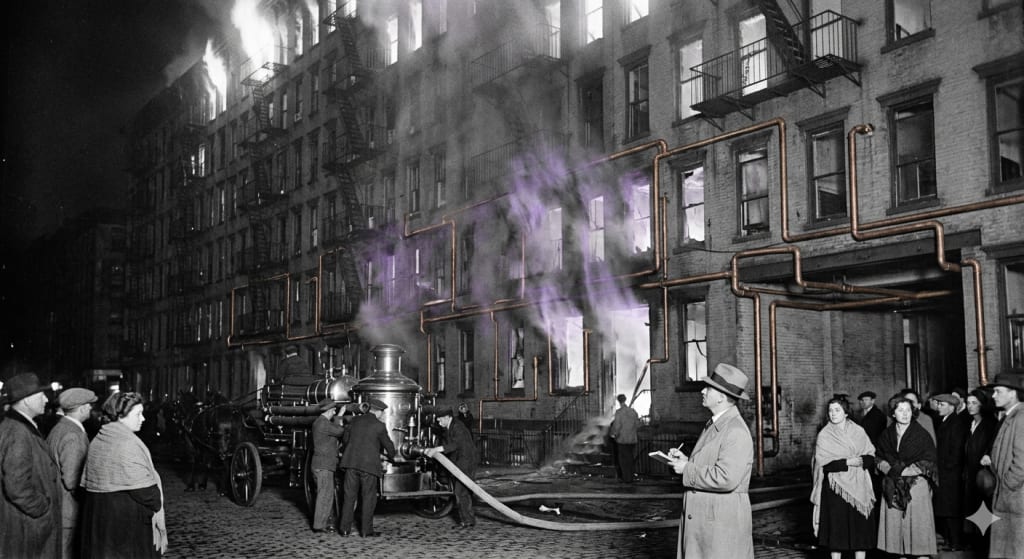
The summer of 1926 in Alcyone was defined by a heatwave that turned the city’s brick-and-mortar canyons into a kiln. In the District of Rust—then known as the "Iron Ward"—the St. Jude Tenement stood as a testament to the era’s unchecked density. It was a sprawling, twelve-story hive of soot-stained limestone and timber, housing three thousand souls within a footprint designed for half that number.
To the public, St. Jude was a slum. To the Fellowship of the Zodiac, it was an inconvenience.
The Tuning of the Hive
For months leading up to the disaster, the Fellowship had been "retrofitting" the building under the guise of municipal plumbing upgrades. They installed a web of lead-lined copper piping that followed no logical hydraulic path. Instead, the pipes traced the "Celestial Transit," a crude, astrological geometry designed to channel the collective anxiety of the overcrowded tenants into a singular basement focal point.
The Fellowship’s Goal: A Harvest of sorts. They sought to prove that human suffering, when compressed by specific architectural angles, could be distilled into a resonant frequency—a power source they called "The Hum."
The Night of the Ignition
At 2:14 AM on August 12, the "capacitor" overloaded. It began not with a spark, but with a sound—a low, discordant vibration that made the tenants' teeth ache and the glass in the windows vibrate until it shattered inward.
The fire did not behave like a natural element. Eyewitnesses from neighboring blocks described flames that moved with a terrifying, predatory intelligence. The fire didn't rise; it drifted horizontally, hugging the 90-degree intersections of the hallways as if following an invisible rail.
A sort of "Static" was born that night. Survivors spoke of a violet-hued shimmer in the smoke and a sensation of "weight" so heavy it crushed the lungs before the smoke could reach them. The Fellowship had succeeded in generating a harvest, but they lacked the structural containment to hold it. The building didn't just burn; it suffered a collapse.
The Morning of Slag and Shadows
When the sun rose, the St. Jude Tenement was a blackened ribcage of iron and ash. But the ruins presented a problem that the City’s Fire Marshal could not explain away:
Impossible Geometry: The structural steel had not merely melted; it had fused into perfect, repetitive fractals. In some sections, the slag had cooled into sharp, crystalline needles that hummed when touched.
Shadow-Stains: On the surviving North wall, the silhouettes of the victims were burned into the brick with such precision they looked like lithographs. These "Shadow-Stains" resisted all attempts at scrubbing or painting; they seemed to be etched into the molecular structure of the masonry.
The Basement Vault: At the center of the ruins, investigators found a lead-lined chamber that remained completely untouched by the heat. Inside were the Fellowship’s brass "Zodiac Wheels" and journals detailing the "Applied Suffering" of the residents.
The Fallout
The sheer scale of the horror—412 dead and a city block reduced to a haunted graveyard—stripped the Fellowship of their anonymity. The public outcry was a polyphonic roar of grief and rage. Within forty-eight hours, the City of Alcyone, pressured by a frantic Governor and a terrified populace, filed the initial brief for Case No. 1926-Z: The City of Alcyone v. The Fellowship of the Zodiac.
The city sought more than just damages; they sought the total condemnation and dissolution of the Fellowship. They wanted to erase the Zodiac from the map. They didn't realize that by dragging the Fellowship into the light of a courtroom, they were providing the very catalyst the cult needed to evolve into something far more dangerous.
The "Gospel of the Grid" was about to be written in the language of the law.
Part II: The Inciting Action
Case No. 1926-Z: The City of Alcyone v. The Fellowship of The Zodiac
If the St. Jude fire was the spark, the legal filing was the containment vessel. Within weeks of the tragedy, the City of Alcyone did something unprecedented: they didn't just sue for damages; they filed for Corporate Dissolution. The city sought to treat the Fellowship not as a religious or fraternal order, but as a "malignant entity"—a legal parasite that had violated the very "Social Contract."
1. The Opening Salvo: The "Negligence" Mask
The initial brief filed by the District Attorney was built on the foundation of Structural Negligence. The city’s argument was deceptively simple:
The Charge: The Fellowship had willfully ignored municipal fire codes to install "non-functional aesthetic conduits" (the lead pipes) which accelerated the disaster.
The Goal: Immediate seizure of all Fellowship assets—including thirty-four prime city blocks—under the doctrine of Eminent Occult Domain (a term the D.A.’s office coined to bypass standard property rights).
2. The Courtroom as a Ritual Circle
The trial took place in the Alcyone High Court, a building ironically designed by a founding member of the Fellowship. The air in the courtroom was said to be perpetually ten degrees colder than the hallway.
The Fellowship’s defense was led by Julian Vane’s grandfather, Alistair Vane, a man who treated the law as a form of "Linguistic Geometry." He didn't argue that the Fellowship was innocent of the rituals; he argued that the rituals were a Civic Necessity.
The Vane Defense: Alistair argued that the "Celestial Transit" piping was actually an experimental "vibration dampener" meant to protect the city from the very seismic instability that eventually caused the fire. He framed the Fellowship as a group of misunderstood scientists rather than mystics.
3. The Discovery of the "Shadow Ledgers"
The turning point—and the true inciting action of the twenty-year war—occurred during the "Discovery Phase." A junior clerk in the DA’s office found a hidden cache of blueprints in the ruins of the Fellowship's Grand Lodge.
These weren't blueprints of buildings; they were Blueprints of Behavior. They showed that the Fellowship had been tracking the emotional output of the city’s residents for decades. They had mapped every suicide, every riot, and every wedding in Alcyone against a grid of "Resonant Occult Nodes."
This revelation shifted the trial from a negligence case into a Cultural Exorcism. The public, previously merely grieving, became hysterical. They demanded not just the dissolution of the Fellowship, but the total erasure of their influence from the city's skyline.
4. The Trap is Set: The Request for "Neutral Oversight"
As the trial entered its second year, Alistair Vane made a tactical "concession" that would change history. He suggested that because the Fellowship’s holdings were so vast and their "experimental technology" so complex, the City of Alcyone was ill-equipped to manage the condemned properties.
Vane proposed a Public-Private Partnership: A "temporary" third-party foundation to hold the properties in trust until the trial reached a final verdict.
5. The Birth of the Vane Foundation (December 1928)
Under the pressure of a collapsing municipal budget and the need to "sanitize" the St. Jude site, the court approved the creation of The Vane Foundation.
The "Inciting Action" was complete. By suing the Fellowship, the City had inadvertently forced the cult to evolve. The Fellowship spent the first two years of the trial "dying" so that the Vane Foundation could be born—a legal shell that was clean, philanthropic, and, most importantly, invisible to the very laws that were trying to destroy it.
The Question of Consumption: Did the city get consumed by the Fellowship? No. The City of Alcyone became the substrate. The Fellowship (now transforming into an as yet, unknown by my office, Secret Order) realized they no longer needed to be a "secret society" hiding in basements. By embedding themselves into the Vane Foundation, they became the city’s landlord, its benefactor, and its lead architect.
The "Sprawling Court Case" was the anesthesia; while the city was focused on the legal drama, the Order was performing surgery on the city's soul.
Part III: The Twenty-Year War of Attrition (1926–1946)
The case of City of Alcyone v. The Fellowship of the Zodiac did not merely last two decades; it became the atmospheric pressure of the city. A generation of lawyers was born, practiced, and retired within the gravitational pull of Case No. 1926-Z. By the mid-1930s, the "St. Jude Fire" had moved from a tragedy to a myth, and finally to a legal abstraction.
Phase 1: The Paper Wall (1926–1933)
The first seven years were a masterclass in "Structural Obstruction." Alistair Vane and his legal team buried the District Attorney’s office under a mountain of specialized filings. They challenged every building inspector’s credentials and filed injunctions against the seizure of the Fellowship’s "Sanctified Blueprints."
The goal was simple: Exhaustion. The Fellowship knew that public outrage is a volatile fuel that burns out quickly. By 1930, the headlines about the fire had been moved to the back pages, replaced by the economic grind of the era. The "Static" in the city was low, a dull hum of bureaucratic boredom that allowed the Fellowship to begin quietly dismantling their old astrological altars and replacing them with something more "industrial."
Phase 2: The "Gospel of the Grid" Exposed (1934–1941)
The trial entered its most "radioactive" phase when a whistleblower—a disgraced Fellowship "Auspice" named Templeton Stone leaked the Codex of the Iron Ward.
This document was the first time the public heard the term "Applied Suffering." It revealed that the Fellowship hadn't been worshipping stars; they were worshipping the geometry of the stars as applied to human density.
The Revelation: The leaked documents proved that the Fellowship had calculated the "Melancholy Threshold" of every street corner in the District of Rust. They knew exactly how many 90-degree intersections were required to induce a state of permanent low-level anxiety in a population.
The Public Exorcism: For the first time, the "deplorable rituals" were detailed in open court. Witnesses described "Harmonic Seances" where the Fellowship used massive pipe organs to vibrate the foundations of tenement buildings, "tuning" the residents like strings on a cello.
The city erupted in a second wave of fury, but this time it was different. It wasn't just about the dead; it was about the survivors realizing their entire lives had been "architected" for a harvest.
Phase 3: The Internal Coup & The Generational Shift (1942–1945)
As the 1940s began, the "Zodiac" model was failing. The old guard of the Fellowship, led by men who still wore robes and consulted star charts, was being systematically purged from within.
A younger faction, spearheaded by a rising Alistair Vane, realized that "Magic" was a dirty word that invited prosecution. "Engineering," however, invited investment.
The Silent Sabotage: Alistair began secretly feeding the Prosecution evidence against his own elders. He allowed the "archaic" members of the Fellowship to be painted as monsters in the press.
The Strategic Pivot: While the DA was busy preparing nooses for the "Zodiac Cultists," Alistair was drafting the bylaws for a new, "scientifically-minded" philanthropic organization. He was moving the Fellowship’s assets out of "Temples" and into "Holding Companies."
The 1946 Settlement: The Death of the Zodiac
On the twentieth anniversary of the fire, the court issued its final decree. The Fellowship of the Zodiac was declared a "Criminal Architectural Conspiracy" and ordered to be dissolved immediately. Its leadership was decimated, its name stricken from the municipal registry.
The public celebrated. They thought they had won. They saw the "Zodiac Wheels" being melted down for scrap metal. What they didn't see was the possible birth of a new Order—a group that had traded the clumsy robes of the mystic for the sharp, tailored suits of the urban developer, a group likely peopled by and funded by a “Kanois Aristoi”, a sort of Classic Greek term for new aristrocracy.
The twenty-year war had served as a "Refinement Process." It burned away the superstition and left behind the pure, cold math of control. The city thought it had condemned the Fellowship’s property; in reality, the city had just provided the legal framework for the Vane Foundation to begin its "Restoration"—a project that would eventually culminate in the construction of the Vane Tower and the total "Grid-Locking" of Alcyone’s soul.
Part IV: The Verdict and the Sleight of Hand (1946–1947)
The conclusion of City of Alcyone v. The Fellowship of the Zodiac was not a bang, but a coordinated silence. By 1946, the city was exhausted. The Great Depression and the subsequent industrial mobilization had turned the "occult scandals" of the 1920s into distant, embarrassing memories. Alcyone wanted to move forward; the Kanois Aristoi was ready to lead the way.
1. The Verdict: The Public Exorcism
In October 1946, Judge Horatio Halloway delivered a 400-page ruling that was broadcast over the city’s radio stations. The Fellowship was found guilty on all counts of "Structural Malfeasance" and "Predatory Civic Engineering."
The Sentence: Total dissolution. Every lodge was shuttered, every "Zodiac Wheel" was seized, and the senior "Astronomers" of the cult were sentenced to life in the Alcyone State Penitentiary.
The Public Reaction: There were bonfires in the District of Rust. The citizens burned effigies of the Zodiac, believing they had finally purged the "Shadow-Stains" from their walls. They mistook the pruning of the branches for the death of the root.
2. The Sleight of Hand: The Asset Transfer
While the public focused on the arrests, the real work happened in the Judge's chambers during the "Disposition of Assets."
The "Neutral" Successor: Because the city lacked the funds to manage thirty-four blocks of condemned, "harmonically unstable" property, the court permanently vested all Fellowship holdings into The Vane Foundation.
The Legal Fiction: The Foundation was presented as a "Sanitizing Entity." Its charter, written by Alistair Vane, claimed its sole purpose was to "deconstruct the occult geometry of the past and replace it with the rational architecture of the future."
The Trap: In reality, the "Rational Architecture" was simply a more efficient version of the old rituals. The Vane Foundation didn't destroy the lead pipes of St. Jude; they integrated them into the city’s new electrical and subway grids.
3. The Birth of the Kanois Aristoi
The transition from the "Fellowship" to the "Order" represented a fundamental shift in the philosophy of power.
From Stars to Steel: The old Fellowship believed they had to align the city with the stars to gain power. The new Order, led by the Vane lineage, believed that with enough steel, glass, and "Applied Suffering," they could become the stars.
The Kanois Ideal: They abandoned the dusty, astrological mysticism of their fathers. They embraced the "Dionysian" concept of controlled chaos—using the city’s inherent entropy (the crime, the poverty, the noise) as a churning engine of energy.
The Boardroom Temple: The Order stopped meeting in basements with candles. They met in the top-floor offices of Sky Scrapers overlooking the city they now legally owned. Their "prayers" were drafted as municipal bonds; their "sacrifices" were disguised as urban renewal projects.
4. The Result: The Grid-Lock
By 1947, the "Sleight of Hand" was complete. The city had "consumed" the Fellowship, but in doing so, it had swallowed a parasite that now controlled its nervous system.
The Vane Foundation became the largest employer and landlord in Alcyone.
The Kanois Aristoi became the invisible hand that guided every major architectural decision for the next eighty years.
This legal victory was the "Big Bang" of modern Alcyone. It ensured that when a man like Silas Thorne eventually arrived to build his "Gospel of the Grid," he wasn't just building on soil—he was building on a twenty-year-old foundation of legal lies, buried rituals, and a harvested grief that had never truly been laid to rest.
The Cycle was Locked. The city wasn't just a place where people lived anymore; it was a finished circuit, waiting for a master architect to flip the switch.
Part V: The Reconstruction & The New Normal (1948–1985)
If the 1946 verdict was the "Death of the Old World," the following two decades were the "Birth of the Glass Age." This era, known in Alcyone’s historical records as the Great Restoration, was the period when the Vane Foundation physically transformed the city from a sprawling, chaotic limestone labyrinth into the clinical, vertical grid that Silas Thorne would eventually inherit.
1. The "Glass Curtain" Strategy
The Vane Foundation’s first major project was the demolition of the "Harmonically Unstable" districts—specifically the Iron Ward. Under the leadership of a young, charismatic Board of Directors, the Foundation argued that the "Shadow-Stains" and "The Static" were products of archaic materials: brick, timber, and soot.
The Solution: They introduced the Glass Curtain Wall. They argued that glass was "honest"—it let in the sun and left no room for the dark rituals of the Fellowship.
The Reality: The glass used in the new Vane-funded high-rises was specifically tempered to reflect internal frequencies back into the rooms. It didn't "let the light in"; it acted as a mirror for the human psyche, trapping the emotional output of the workers and residents within the structural envelope.
2. Subterranean Integration: The Transit Circuit
While the skyline was being "sanitized," the Order was busy below ground. The city’s aging subway system was bankrupt following the twenty-year trial. The Vane Foundation offered to modernize it for "one dollar and a ninety-nine-year lease on the air rights."
The Upgrade: They replaced the old iron tracks with a proprietary "High-Resonant Alloy."
The Circuitry: Every subway station was surreptitiously designed. As a million of citizens moved through the tunnels in a state of rush-hour stress, their collective anxiety was channeled through the tracks and fed directly into the foundations of the Vane Tower. The subway wasn't just moving people; it was the city's power cord.
3. The Apotheosis of the Architect
During this era, the social hierarchy of Alcyone shifted. The Order realized that to maintain control, they needed "High Priests" who didn't look like priests. They turned the Architect into a cultural celebrity.
The Propaganda: The Vane Foundation funded architectural schools that taught a very specific, rigid philosophy: The Gospel of the Grid. * The Doctrine: Students were taught that 90-degree angles represented "Civic Virtue" and that "Chaos" (natural curves, irregular streets) was a sign of moral and mental decay. This created a generation of designers—Silas Thorne’s predecessors—who believed they were "curing" the city, never realizing they were actually refining a cage.
4. The Dionysian "Bacchanals" of High Society
While the working class was being "tuned" by the Grid, the elite—the descendants of the Fellowship—evolved into a new kind of aristocracy. They moved from the shadows of the Grand Lodge to the penthouses of the new spires.
The New Rituals: The "deplorable rituals" of the 1930s became the "exclusive galas" of the 1950s. The Order used these high-society gatherings to harvest "High-Yield Entropy"—the refined, sharp emotions of the powerful—which was far more potent than the "Low-Yield" grief of the slums.
5. The Legacy of the "Silent Era"
By 1985, the City of Alcyone v. The Fellowship of the Zodiac was a footnote in history books. The "Shadow-Stains" had been covered by sleek aluminum panels, and the "humming teeth" of the survivors were dismissed as "urban tinnitus."
The Vane Foundation had achieved the impossible: they had built a machine so perfect that the people living inside it fought to defend its walls. The city was no longer a victim of a cult; it was a self-sustaining occult engine, humming with a violet light that only those with a "rewired" mind—like an Architect born of lightning—would ever be able to see.
About the Creator
Nathan McAllister
I create content in the written form and musically as well. I like topics ranging from philosophy, music, cooking and travel. I hope to incorporate some of my music compositions into my writing compositions in this venue.
Cheers,
Nathan
Keep reading
More stories from Nathan McAllister and writers in Criminal and other communities.
The Zealous DA
The Obsidian Room did not merely overlook Alcyone; it judged it. Situated at the apex of the Vane Tower, the lounge was a masterclass in Silas Thorne’s "Gospel of the Grid." Every surface was a study in polished basalt and tempered glass, lit by recessed LEDs that cast a sterile, lunar glow over the occupants. Outside the floor-to-ceiling windows, the city was a sprawling circuit board of amber streetlights and neon pulses.
By Nathan McAllister4 days ago in Criminal
Badass Heather: Escort Kills Serial Killer Who Responded to Backpage Ad
Heather Saul had no idea who she was dealing with. Not that it mattered. It could have been anyone. She wanted to live and fought for that right. As it turns out, Neal Falls was likely a serial killer responsible for the deaths of nine escorts. She shot him dead during a fight for her life.
By Criminal Matters4 days ago in Criminal
The Irony of Flying While We Bomb the "World's Greatest Terror Regime"
Ah, the irony of flying at this moment in time as the United States is simultaneously bombing Iran - the nation officials have insisted for decades is "The World's Greatest Terror Regime" - while the TSA is on a go-slow, courtesy of a funding squeeze that's left its officers unpaid, quitting in droves, and turning checkpoints into something like slow-moving bread lines.
By Scott Christenson🌴7 days ago in Humor


Comments
There are no comments for this story
Be the first to respond and start the conversation.