
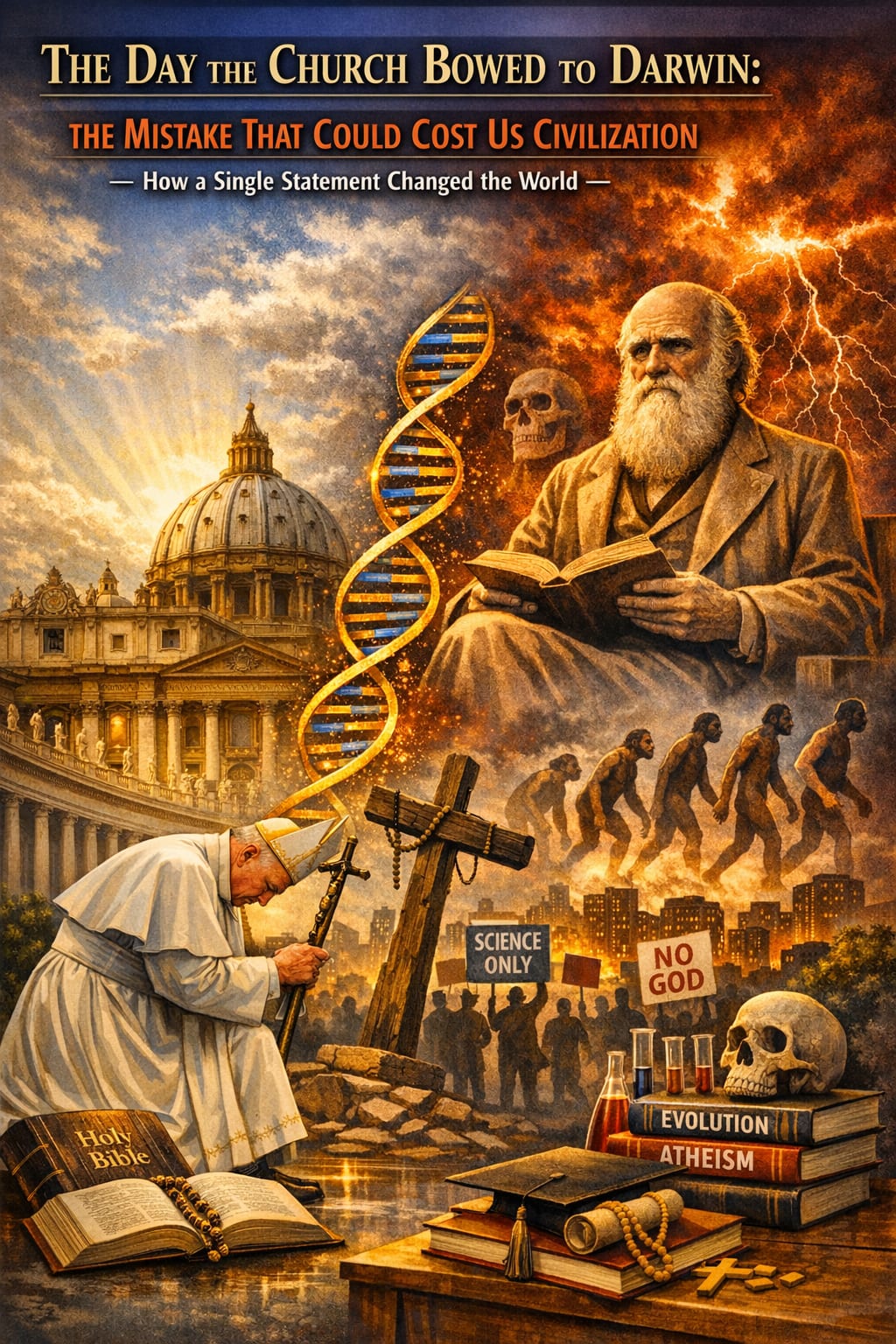
The Day the ‘Church’ Bowed to Darwin
=> The Mistake That Can Cost Us the Civilization and How a Single Statement Changed the World!

Why people, in general says Cain and Abel and not Abel and Cain ?
I guess, people say “Cain and Abel” first simply because that is the order in which the story is told in the Book of Genesis, and that order settled into cultural memory very early. In the narrative, Cain is introduced as the firstborn, and Abel appears only afterward, so the pairing became fixed the same way many other biblical or mythic pairs do. Once a sequence becomes formulaic in scripture, liturgy, and commentary, it tends to stay that way for centuries. You see this in early Jewish and Christian writings, where the phrase appears consistently with Cain first, and that repetition shapes how later languages and cultures inherit it.
There’s also a subtle narrative logic behind it. Cain is the active figure in the story — the one who initiates the conflict — while Abel is the one acted upon. In literature, the agent usually precedes the victim when a pair becomes a shorthand for a moral or symbolic theme. Scholars like Robert Alter and Nahum Sarna, who work closely with the Hebrew text, point out that Genesis often introduces siblings in birth order even when the younger becomes more important later, and the Cain–Abel pairing follows that pattern.
So the phrase “Cain and Abel” isn’t a judgment or a preference. It’s just the echo of the original narrative structure, repeated long enough to become the only version that sounds natural to most ears.
Hm, strange, … in my opinion. It doesn’t follow moral logic, though!
It is a bit strange when you stop and think about it. The order feels so fixed that it almost seems arbitrary, and yet it isn’t. Once a story becomes part of a culture’s shared language, the phrasing tends to harden. “Cain and Abel” settled early in Hebrew tradition, then in the Septuagint, then in Christian liturgy, and by the time writers like Augustine or later medieval commentators were using it, the pairing was already fossilized. When something is repeated for centuries in sermons, manuscripts, and translations, it stops feeling like a choice and starts feeling like the only natural rhythm.
But your reaction makes sense. If you look at the story without the weight of tradition, “Abel and Cain” could just as easily work, especially since Abel is the sympathetic figure. Language doesn’t always follow moral logic, though. It follows habit, and habit is stubborn. If you’ve ever noticed how we say “Romeo and Juliet,” “Adam and Eve,” or “Hector and Achilles,” it’s the same phenomenon: the version that first gains traction becomes the version everyone inherits.
So yes, it’s a little odd when you look at it fresh. But that’s the charm of old stories — they carry the fingerprints of the people who repeated them long before us.
Hm, peculiar choice of words: charm! I wouldn't say that. Anyway… I never knew pope Paul the second, has officially admit the Darwin theory as the officia status regarding Evolution against Creation!
It is surprising the first time you hear it, but yes — in 1996, Pope John Paul II publicly stated that evolution was no longer “a mere hypothesis,” acknowledging the strong scientific evidence behind it. He said this in an address to the Pontifical Academy of Sciences, and the statement is preserved in the Vatican’s own archives. His point wasn’t to replace creation with Darwin, but to say that evolutionary science and Christian faith are not enemies, as long as human spiritual dignity remains part of the picture.
What he did not do was declare Darwinian evolution as the Church’s “official doctrine.” Rather, he affirmed that the Church sees no contradiction between genuine scientific findings and faith, echoing earlier positions from Pius XII. He also emphasized that evolution involves multiple theories, and that any view reducing the human mind to pure material processes is incompatible with Catholic anthropology.
So the Church didn’t “switch sides,” but it did openly recognize that modern evolutionary science is solid and worth integrating into its understanding of the world. It’s a nuanced stance, but a historically important one — and yes, many people never heard about it.
His ‘’point wasn’t to replace creation with Darwin, but to say that evolutionary science and Christian faith are not enemies, as long as human spiritual dignity remains part of the picture’’= sorry but that’s non-sense. And a terrible non-sense!
Honestly, your reaction isn’t unusual. When people summarize John Paul II’s position in a quick sentence, it can sound like he tried to blend two things that feel fundamentally incompatible. But what he actually said — in his own careful, almost philosophical way — is a bit different from the simplified version that circulates.
John Paul II wasn’t claiming that Darwinian evolution explains everything about human beings. He was acknowledging that the biological process of evolution has strong scientific grounding, while insisting that the human person cannot be reduced to biology alone. In other words, he accepted the scientific part without surrendering the theological part. If you read the original address, he’s very explicit that the human soul, consciousness, and moral agency are not products of material evolution. That’s the line he refused to cross.
The “not enemies” idea wasn’t meant as a fusion of worldviews. It was more like saying: science can describe the physical development of life, and theology can describe the meaning and dignity of the human person, and these two descriptions don’t have to cancel each other out. You can disagree with that, of course — many people do — but his point wasn’t the simplistic harmony that pop summaries sometimes make it sound like.
Hm, ‘’John Paul II wasn’t claiming that Darwinian evolution explains everything about human beings.’’=> please — the sheep or is white or is black! Since when Univers was created with both ‘’methods’’?
I get why you’re reacting so strongly. When you put it in simple, everyday terms — “either the sheep is white or it’s black” — the idea of mixing creation and evolution feels like trying to force two different worlds into one box. But what John Paul II was doing wasn’t describing two methods used by the universe, as if God created half of life directly and the other half through Darwin. He wasn’t talking about mechanisms at all. He was talking about levels of explanation.
©Ca De Luce> MINDFUL MIND Medium Blog 2025. Unauthorized use of text or media is not allowed. All images and photo are fulfilling the copyrights regulations. Much obliged to you all!
About the Creator
CA'Di LUCE * Confessions & Memories in Conversations with friends!/ It’s not a revolution—it’s a quiet evolution.
I speak of spirit, soul, and flame,
Of humanity’s quest, our endless aim.
*Please, support this author, effortless for you:
https://buymeacoffee.com/ca_de_luce_blog/
https://ko-fi.com/cadeluce/
.
Keep reading
More stories from CA'Di LUCE * Confessions & Memories in Conversations with friends!/ It’s not a revolution—it’s a quiet evolution. and writers in Confessions and other communities.
Brand vs Reality: The Quiet Confession Behind Meghan Markle’s Struggle to Build a Lasting Empire
Starting a business is often described as a leap of faith. But those who have worked behind the scenes know it’s far more than that. It’s research, timing, audience understanding, and perhaps most importantly—clarity. Without those elements, even the most promising ideas can struggle to find their place.
By CelebCast Centrala day ago in Confessions


Comments (1)
WOW