
The Culture of Tardiness
Exploring Countries Where Arriving Early Is Socially Unacceptable

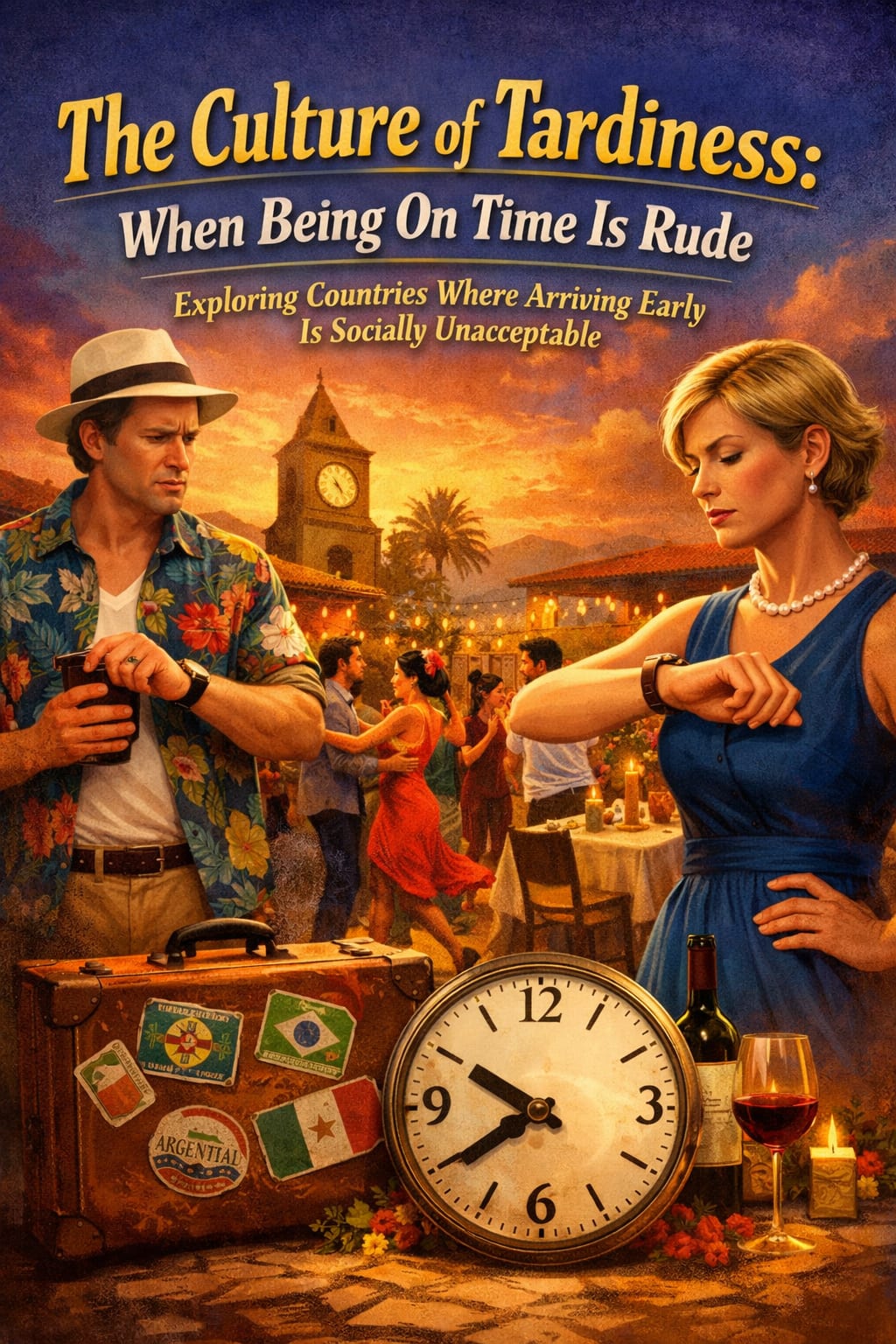
Time is often considered a universal constant, yet the way societies perceive it can differ dramatically. While punctuality is celebrated in some cultures as a sign of respect and professionalism, in others, arriving too early can be seen as intrusive, presumptuous, or even rude. This cultural paradox highlights that time is not just a mechanical measurement but a social construct, intertwined with etiquette, expectations, and values.
One of the most prominent examples of such a society is Brazil. In Brazilian culture, particularly in social settings like dinners, parties, or casual meetings, arriving exactly on time—or worse, early—is considered socially awkward. Invitations are often seen as a flexible timeframe rather than a strict schedule. If a host extends an invitation for 8:00 PM, guests might commonly arrive at 8:30 PM or even later, and this is socially acceptable. Early arrival can put pressure on the host, who may still be preparing, and may inadvertently convey impatience or disrespect for the informal flow of social life.
This relaxed approach to time is not limited to Brazil. Several other Latin American countries, such as Argentina, Colombia, and Mexico, share similar norms. In these cultures, social interactions are fluid and prioritize human connection over clock-bound schedules. Punctuality is reserved primarily for formal or professional engagements, while casual social events operate on what anthropologists sometimes call “elastic time.” This flexibility allows people to focus on relationships and shared experiences rather than rigid adherence to a schedule.
The roots of this cultural attitude are multifaceted. Historical, social, and climatic factors all play a role. In countries with hot climates, social interactions often adapt to the rhythm of the day, with afternoons or evenings reserved for leisure and socializing when temperatures are more tolerable. Moreover, many Latin American societies place a strong emphasis on hospitality and spontaneity. Arriving exactly on time might disrupt the natural flow of conversation or preparation, making early guests unintentionally imposing.
For someone from a culture that values strict punctuality, such as Germany, Switzerland, or Japan, the Brazilian approach to time can be baffling. A German guest arriving 15 minutes early for a dinner party may be seen as eager and polite at home, but in Brazil, they could unintentionally create discomfort. Understanding these nuances requires not only knowledge of local customs but also an openness to reinterpret one’s own assumptions about time, respect, and social interaction.
The phenomenon also extends beyond Latin America. In countries like Italy and Spain, especially in southern regions, social events frequently operate on a relaxed schedule. Dinner invitations, family gatherings, or casual meetups may have an expected start time that serves more as a guideline than a rule. In these contexts, arriving early can signal impatience, disrespect, or a lack of social intuition. The emphasis is on enjoying the experience, not on checking the clock.
For travelers or expatriates, adapting to such time norms can be challenging yet rewarding. It requires patience, flexibility, and a willingness to let go of the rigid schedules ingrained by one’s upbringing. It also offers a valuable lesson: cultural respect is not merely about language, gestures, or dress—it extends to how we understand and interact with time itself. Embracing the local rhythm can lead to more meaningful social connections and a deeper appreciation for the culture.
Interestingly, the concept of “lateness” can also reveal underlying social hierarchies. In some contexts, the host may deliberately delay an event to signal status, control pacing, or demonstrate leisure and control over time. Guests learn to read these cues and respond appropriately, understanding that punctuality is not always equivalent to politeness. In essence, time becomes a language of social navigation rather than a strict metric.
In conclusion, while many societies equate punctuality with respect, there are cultures where arriving exactly on time—or early—is socially inappropriate. Countries like Brazil, along with parts of Latin America and southern Europe, illustrate the elasticity of social time and the importance of cultural context. Recognizing these differences is crucial for anyone wishing to navigate social interactions smoothly. After all, being “on time” may not always mean being respectful; in some cultures, patience, flexibility, and harmony with the group’s rhythm are the true markers of etiquette.
About the Creator
Irshad Abbasi
Ali ibn Abi Talib (RA) said 📚
“Knowledge is better than wealth, because knowledge protects you, while you have to protect wealth.
Keep reading
More stories from Irshad Abbasi and writers in Chapters and other communities.
The American Village Where Christmas Never Ends
In a remote corner of the United States, far from the bustling cities and crowded highways, lies a small town that seems to exist in a permanent state of holiday cheer. The town is called North Pole, located in Alaska, and unlike the icy, uninhabited Arctic region its name suggests, this North Pole is very much alive—with colorful lights, candy cane decorations, and a year-round celebration of Christmas.
By Irshad Abbasi 10 days ago in Chapters
Life will find a way
One cocoon twitches; my screaming must have disturbed it. It’s followed by a sound like the shaking of a cobra’s tail. A dry rattle sends a shiver down my spine. The rest of the cocoons respond the same way, as if communicating with one another; the cave fills with rattling. The glow becomes stronger as they vibrate and bathes the cave floor in an eerie blue light.
By N J Delmas12 days ago in Chapters
You Knew Full Well I was a Snake, Chapter Three
Back at the café, Flashsatsumas had piled up his empty plates so was only too aware how the situation stood. Waiting for Miss Ugly to return with Mini-Flash Juniper safe and sound was proving to be more than he could take, and every interminable minute that passed seemed to increase the likelihood of something having gone wrong. Flashsatsumas didn’t need to look at Pat and Maureen to know they felt the same, so instead he was concentrating on what toys remained and the discarded packages strewn across the table. These Flashsatsumas turned endlessly over in his hands one by one, at his wits’ end for some opportunity he may have missed. His card, Juniper’s card, Maureen’s cats, Pat’s box…
By Doc Sherwood7 days ago in Chapters
Rousseau's Last Tour
This was a strange comfort to me these last few weeks. Actually, more than a few weeks. I began this book at the beginning of the year, and put it aside as I realized that I was reading not a fictional account of a life, but the very true thoughts of a writer who has put his fingerprints over much of what I know of French thought in that era.
By Kendall Defoe 8 days ago in BookClub



Comments
There are no comments for this story
Be the first to respond and start the conversation.