
NEGENTROPIC CULTURE, THE MISCOMMUNICATION TRILOGY, “The Entropy of Communication, Vol. II”. Part 2
Book Review

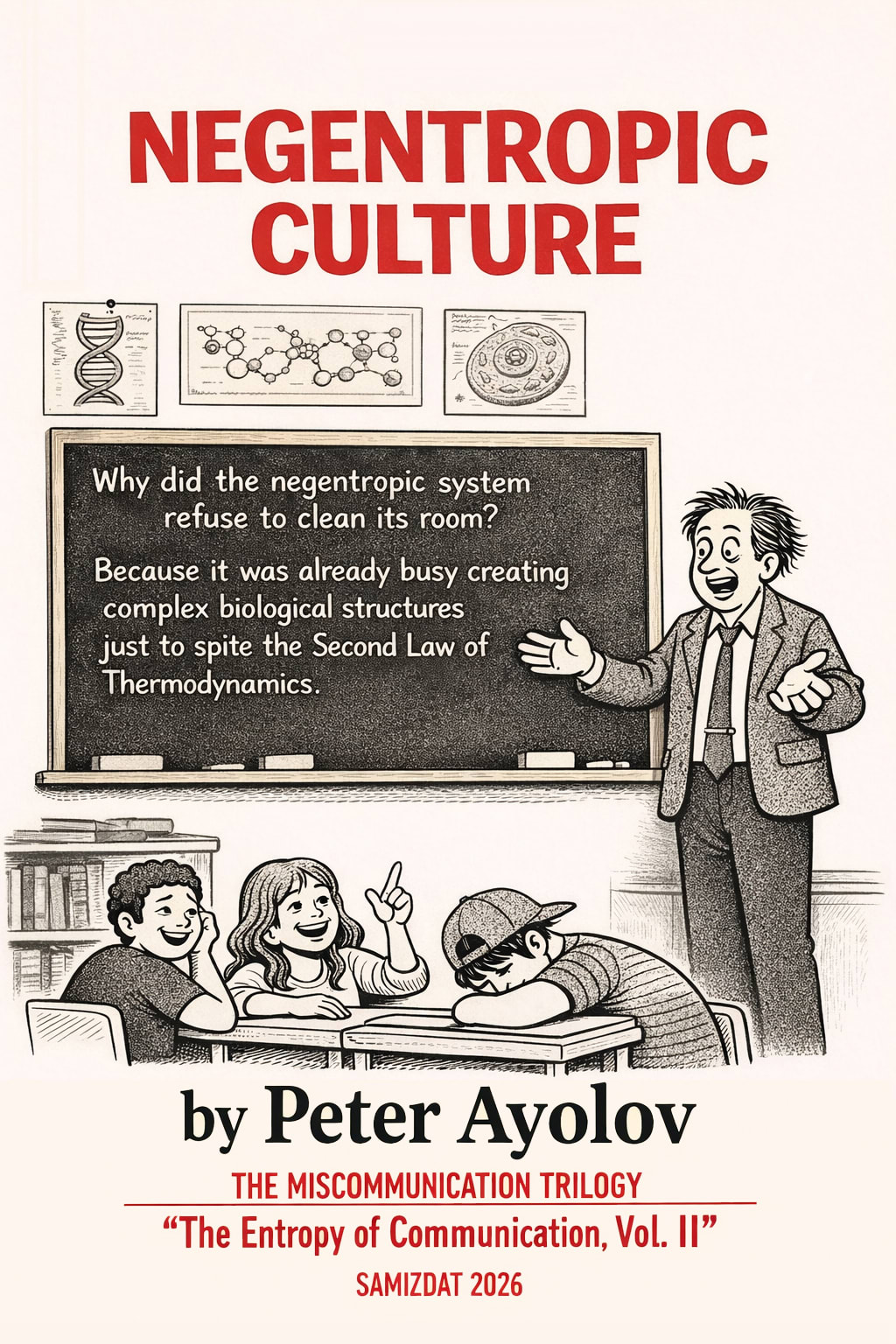
Review-Negentropic Culture: The Entropy of Words
‘Language expands toward infinity,
but understanding survives only
where speech remembers its limits.
Every civilisation drowns in its own words
before it learns again how to speak.
When words multiply faster than meaning,
silence becomes the last refuge of truth.’
-Peter Ayolov
The second part of The Entropy of Communication, Vol. II, titled Negentropic Culture, presents a sustained and ambitious exploration of one of the central paradoxes of contemporary communication: humanity has never produced more language, yet the stability of meaning appears increasingly fragile. Situated within The Miscommunication Trilogy, the work continues a broader intellectual project devoted to examining the historical, philosophical, and technological conditions under which language gradually loses its capacity to sustain shared understanding. Negentropic Culture focuses particularly on the tension between linguistic entropy—the tendency of communicative systems to drift toward disorder—and the cultural mechanisms that attempt to resist that drift.
The book begins from a provocative premise: modern societies may be experiencing what can be described as the planned obsolescence of language. The concept borrows from industrial economics, where products are often designed to become outdated in order to sustain cycles of production and consumption. Applied to communication, the idea suggests that contemporary discourse increasingly produces linguistic expressions that are not meant to endure. Political slogans, ideological catchphrases, media narratives, and digital phrases appear suddenly, dominate public conversation briefly, and then disappear almost as quickly as they emerged. Words become disposable instruments of mobilisation rather than durable tools of thought. Meaning circulates rapidly but rarely stabilises. This argument is situated within a long intellectual tradition of language criticism and linguistic pessimism. The book places itself in conversation with thinkers such as Gorgias, Ferdinand de Saussure, Fritz Mauthner, Karl Kraus, and Ludwig Wittgenstein—figures who each, in their own way, challenged the reliability of language as a medium of truth. The sophist Gorgias famously questioned whether being could be known or communicated at all. Saussure demonstrated that linguistic meaning arises not from direct reference to the world but from differences within a system of signs. Mauthner developed a radical critique of language as an inherited structure full of historical metaphors and conceptual confusions. Kraus examined the corruption of public discourse in journalism and politics. Wittgenstein explored the limits of language and the way meaning emerges from practices embedded in forms of life. Negentropic Culture continues this tradition by asking how these earlier insights might illuminate the communicative environment of the twenty-first century.
One of the book’s central contributions lies in its adoption of metaphors from thermodynamics and information theory. Communication is analysed not merely as the exchange of messages but as a dynamic system in which signals, interpretations, and misunderstandings accumulate over time. The concept of entropy—borrowed from physics—serves as a metaphor for the gradual dispersion of meaning within such systems. In thermodynamics, entropy describes the tendency of closed systems to move toward states of disorder or equilibrium. When applied to language, the concept suggests that as communication expands across populations and technological networks, interpretative noise inevitably increases. Every message introduces the possibility of multiple readings, reinterpretations, and distortions. As the volume of discourse grows, maintaining a shared interpretative framework becomes increasingly difficult. The book unfolds through four main conceptual sections: Apparatus, Second Evolution, Entropology, and Negentropy. Each stage examines a different dimension of the relationship between language, culture, and disorder.
The opening section, Apparatus, establishes the theoretical framework necessary to analyse language as a complex communicative system. Drawing on social physics and computational models of discourse, the author explores how political communication in particular exhibits patterns similar to thermodynamic systems. In highly polarised environments, speech within ideological groups becomes predictable and repetitive, often compressed into simplified slogans or symbolic expressions. At first glance such uniformity appears to represent clarity or consensus. Yet the book argues that this local reduction of entropy within groups produces increased disorder at the level of the broader communicative system. Different communities develop incompatible linguistic frameworks, and the same words acquire radically different meanings depending on the group using them. From this perspective, the deterioration of public discourse is not merely a moral or political failure but a structural outcome of linguistic systems operating under conditions of informational expansion. The more messages circulate, the more interpretative possibilities emerge. Communication becomes saturated with signals that compete for attention but rarely converge upon shared meaning.
The second section, Second Evolution, shifts the analysis toward the cognitive and evolutionary foundations of language. Drawing on research in cognitive science, anthropology, and neuroscience, the book examines how human communication emerged through a gradual evolutionary process involving tool use, social cooperation, and recursive thought. Recursion—the ability to embed thoughts within thoughts and structures within structures—plays a central role in this account. It allows humans to construct narratives, imagine future events, and organise knowledge across generations. Yet recursion also introduces interpretative instability. Each additional layer of reflection multiplies possible meanings. Language becomes capable of generating infinite expressions, but the stability of interpretation cannot keep pace with this expansion. The evolutionary perspective also reveals the deep connection between language and embodied action. Studies of tool use demonstrate that the neural systems responsible for manipulating tools often overlap with those used for processing grammatical structures. The brain appears to employ similar computational mechanisms to organise physical sequences of actions and linguistic sequences of words. This insight suggests that language did not arise as a purely abstract faculty but evolved from cognitive capacities originally developed for interacting with the material world. The syntax of speech echoes the structured coordination of the hand.
In the third section, Entropology, the book develops its most original analytical concept: the systematic study of linguistic entropy within modern communication. The author argues that contemporary discourse increasingly exhibits characteristics of entropic systems. Political vocabulary compresses into slogans, narratives fragment into competing chronologies, and interpretative frameworks diverge between communities. Communication begins to pass through three stages: communication, miscommunication, and discommunication. In the first stage language functions as a bridge between perspectives. In the second stage words continue to circulate but their meanings diverge. In the third stage speech remains active but no longer aims at shared understanding. Dialogue persists as a performance of identity rather than as a search for truth. Digital media intensify this process by accelerating the recursive nature of language. Every statement generates commentary, which generates further commentary, producing layers of meta-discourse that refer increasingly to other words rather than to shared experience. Conversations become conversations about conversations. Language turns inward upon itself.
The final section, Negentropy, explores the counterforces that resist this drift toward linguistic disorder. Cultural systems continually generate structures that attempt to reorganise meaning. Philosophy clarifies conceptual frameworks. Literature and art experiment with new narrative forms. Scientific discourse constructs specialised vocabularies capable of stabilising complex ideas. Educational institutions transmit linguistic traditions across generations. These activities function as negentropic processes within communication. They do not eliminate entropy, but they temporarily slow its expansion. The concept of negentropic culture therefore represents the human effort to preserve meaning within an environment saturated with words. It emphasises that language does not simply deteriorate; it also renews itself through cultural practices that reorganise discourse. Every era generates new symbolic frameworks capable of restoring coherence to communication, even if only temporarily.
One of the strengths of Negentropic Culture lies in its interdisciplinary scope. The book moves fluidly between philosophy, linguistics, neuroscience, anthropology, and media theory. This breadth allows the author to situate contemporary communication within a long historical and intellectual context. The argument is not confined to digital media or political discourse alone but addresses the deeper cognitive and cultural mechanisms that shape language itself.
At the same time, the work raises important questions about the limits of linguistic pessimism. If language is inherently prone to entropy, can communication ever achieve stable meaning? The book suggests that complete stability is impossible. Miscommunication is not an accidental disturbance but a structural feature of symbolic systems. Yet the author also emphasises that cultural practices can mitigate these tendencies. Negentropic structures emerge whenever societies invest effort in preserving clarity, precision, and shared interpretative frameworks. The final impression left by the book is therefore not one of despair but of cautious realism. Language will always drift toward instability because its recursive architecture multiplies interpretations beyond the intentions of speakers. However, human cultures possess the capacity to reflect upon language and reorganise its structures. The history of writing, printing, scientific discourse, and literary traditions demonstrates that new forms of communication continually arise in response to expanding cognitive and social demands.
Negentropic Culture thus offers both a critique and a diagnosis of contemporary discourse. It identifies the structural forces driving the fragmentation of meaning while also recognising the cultural resources capable of resisting that fragmentation. In doing so, the book contributes to a broader conversation about the future of language in an era defined by unprecedented communicative abundance. Ultimately the work invites readers to reconsider the role of language within civilisation itself. Words are not merely tools of communication but the symbolic architecture through which societies interpret reality. When language becomes unstable, the structures of meaning that sustain collective life become fragile. The defence of language therefore becomes inseparable from the defence of shared understanding. In this sense Negentropic Culture stands as both an intellectual investigation and a cultural warning: the health of civilisation may depend on the ability to preserve islands of meaning within an ever-expanding ocean of words.
About the Creator
Peter Ayolov
Peter Ayolov’s key contribution to media theory is the development of the "Propaganda 2.0" or the "manufacture of dissent" model, which he details in his 2024 book, The Economic Policy of Online Media: Manufacture of Dissent.
Keep reading
More stories from Peter Ayolov and writers in BookClub and other communities.
THE ENTROPIC CIVILISATION, THE MISCOMMUNICATION TRILOGY, “The Entropy of Communication, Vol. II”, part 1
Review- Entropic Civilisation: At the Edge of Linguistic Collapse Few ideas are as deceptively simple and yet as intellectually provocative as the claim that civilisation is built not on armies, machines, or markets, but on language. Entropic Civilisation develops precisely such a thesis and expands it into a wide-ranging diagnosis of contemporary society. The book proposes that language is the fundamental technology through which human societies organise themselves, yet it is also the fragile mechanism that eventually contributes to their decline. What begins as a tool of order gradually becomes a generator of disorder. Civilisations rise through language, but they may also fall through it. The central argument rests on the concept of communication entropy. Borrowed from thermodynamics and information theory, entropy refers to the tendency of systems to move from order toward disorder. Applied to language and communication, the concept describes a process in which communication expands in quantity while declining in clarity. Societies produce ever more messages, narratives, and symbols, yet genuine understanding becomes increasingly difficult. The paradox of modern civilisation is therefore not the disappearance of language but its excess. People speak more, write more, publish more, and transmit more information than ever before, yet meaning appears increasingly unstable. The book situates this problem within a broad historical framework. Civilisations have always relied on official languages to establish social order and political legitimacy. Latin served as the administrative and legal foundation of the Roman Empire. Classical Chinese supported the bureaucratic continuity of imperial China for centuries. Arabic became the intellectual and religious medium of Islamic civilisation. In each case language functioned as the operating system of society, allowing large populations to coordinate their actions and imagine themselves as part of a shared cultural universe. However, these linguistic systems were never permanent. Words acquire authority only as long as people continue to believe in their meanings. Over time, political slogans, ideological narratives, and institutional vocabularies lose their persuasive force. Concepts that once inspired loyalty become empty formulas repeated without conviction. At this stage language continues to circulate but its meaning weakens. The result is a peculiar condition in which the structures of civilisation remain intact while the language that sustains them begins to hollow out.
By Peter Ayolova day ago in BookClub
Orlam
Introduction This year for my birthday Fiona bought me the new PJ Harvey album "I Inside The Old Year Dying" and then found that there was a linked book "Orlam" so I got that as well. I love everything that Polly Jean does, even though I don't have everything she has done.
By Mike Singleton 💜 Mikeydred 5 days ago in BookClub



Comments
There are no comments for this story
Be the first to respond and start the conversation.