
The Architects of Atmosphere: How Three Women are Redefining the Sonic Cinema of R&B
3 architects under Review
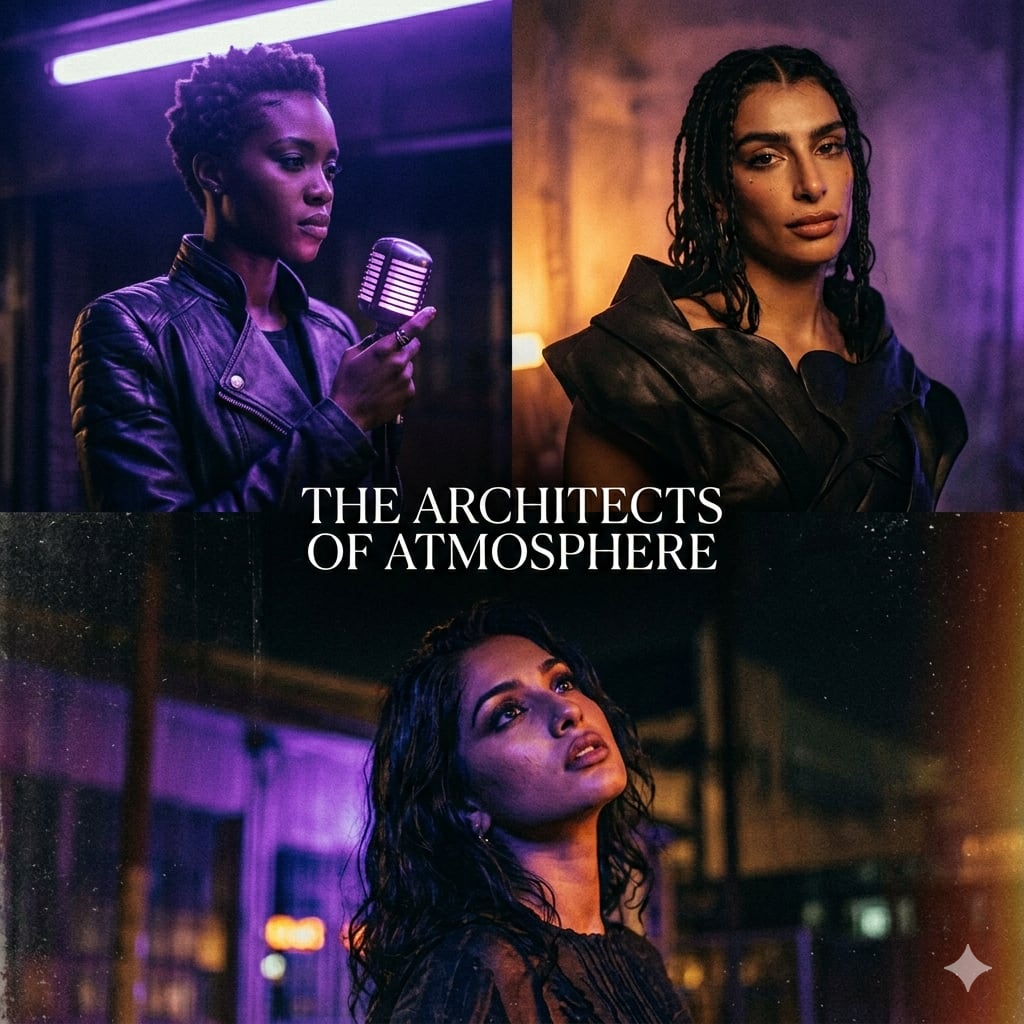
In an age of hyper-fast consumption and 15-second viral loops, a new vanguard of female artists is staging a quiet, atmospheric revolution. They are moving away from the "hit factory" and towards the "score"—creating R&B that doesn't just play in the background but demands to be witnessed as a full-scale cinematic experience.
The term "Cinematic R&B" has often been used loosely to describe anything with a heavy reverb or a slow tempo. But true sonic cinema is much more than an effect; it is a philosophy. It is the art of world-building through sound. Today, we look at three pioneers—070 Shake, Sevdaliza, and RAYE—who have mastered the intersection of visual grandeur and emotional depth, setting a new standard for the industry.
1. 070 Shake: The Queen of Dystopian Noir
When 070 Shake (Danielle Balbuena) first broke into the mainstream consciousness, she didn’t do it with a radio-friendly pop hook. She did it with a raw, haunting vulnerability that felt like a transmission from a lonely satellite. Her work, specifically on the seminal album You Can’t Kill Me, represents the pinnacle of "Noir-Futurism."
070 Shake understands the power of space. Her production often feels vast, like a drive through a neon-lit desert at 3 AM. By utilizing distorted synthesizers, heavy analog textures, and vocal layers that bleed into the instrumentation, she creates a sense of "landscape." To listen to her music is to see a movie in your mind—usually one shot on 35mm film with deep shadows and amber lighting. She has reclaimed the "album" as an art form, insisting that her audience follow her through a curated emotional journey rather than a collection of singles.
2. Sevdaliza: The Architect of High-Concept Avant-Garde
If 070 Shake is the feeling of the film, Sevdaliza is its high-end CGI and technical precision. The Iranian-Dutch artist has spent the last decade blurring the lines between human emotion and machine-like perfection. Her approach to R&B is architectural; she builds songs from the ground up using trip-hop foundations, orchestral arrangements, and experimental electronic elements.
Sevdaliza’s visual identity is inseparable from her sound. She is one of the few artists today who effectively uses AI, robotics, and complex visual metaphors to expand her sonic universe. For Sevdaliza, a song is not finished until its visual counterpart exists. Whether she is exploring themes of femininity, identity, or transhumanism, she does so with a visual gravity that rivals Hollywood’s most ambitious directors. She doesn't just release music; she releases "installations." Her influence is seen in the increasing "high-fashion" aesthetic that is currently taking over the underground R&B scene.
3. RAYE: The Storyteller of Independent Grandeur
While 070 Shake and Sevdaliza operate in the darker, more experimental fringes, RAYE has brought the "Big Score" back to the center of the industry. Her journey as an independent artist has allowed her to embrace a level of theatricality that major labels often fear.
With tracks like Genesis, RAYE isn't just delivering a vocal performance; she is delivering a three-act play. The use of live brass sections, dramatic tempo changes, and a "Bond-theme" level of sophistication has reintroduced the concept of "Grandeur" to modern soul. She proves that cinematic music can be both deeply personal and commercially explosive. Her success is a signal to the industry that audiences are hungry for substance over simplicity. They want the drama. They want the strings. They want the feeling that they are part of something epic.
The Shift: Why Atmosphere is the New Currency
Why does this matter in 2026? Because we are reaching a saturation point with "content." In a sea of endless, disposable audio, the only thing that sticks is Atmosphere.
These three architects are proving that the future of R&B lies in the "Cinematic Experience." For a new generation of artists, the goal is no longer just to be heard—it is to be felt. The production needs to breathe. The visuals need to bleed into the sound. The artist must become the director of their own legacy.
As we look toward the horizon, we see a new wave of underground talent following in these footsteps. They are leaning into film-grain textures, anamorphic storytelling, and minimalist pressure. They know that in a world of 4K screens, your sound needs to be just as sharp, just as deep, and just as immersive.
The era of the "Sonic Cinema" is here. And these three women are the ones who drew the blueprints.
About the Creator
Melodic Major and Melodic Minor
The world of music theory often feels like a map of well-trodden paths—the bright meadows of the Major scale and the somber forests of the Natural Minor. But for the seeker of true atmosphere, there are two hidden trails that twist through the shadows and the light: the Melodic Minor and its ghostly, underrated sibling, the Melodic Major.
By Nathan McAllister4 days ago in Beat
A Visitor's Guide To Victorian England
A Book Review Being interested in all things Victorian, I am constantly looking for books on the Victorian Era. In fact, I should admit that I am obsessed about ‘all things Victorian’. From the clothes worn by men and women, rich or poor, to how they lived, where they lived, what they ate and would (or would not ) drink, what kind of transport there was, who worked where, who went to school (and who didn’t), the list really is endless.
By Ruth Elizabeth Stiff6 days ago in BookClub




Comments
There are no comments for this story
Be the first to respond and start the conversation.