
Rock Outgrew Gene Simmons
The bassist from KISS complains about rap and reveals how deeply hip-hop has shaped modern rock music.

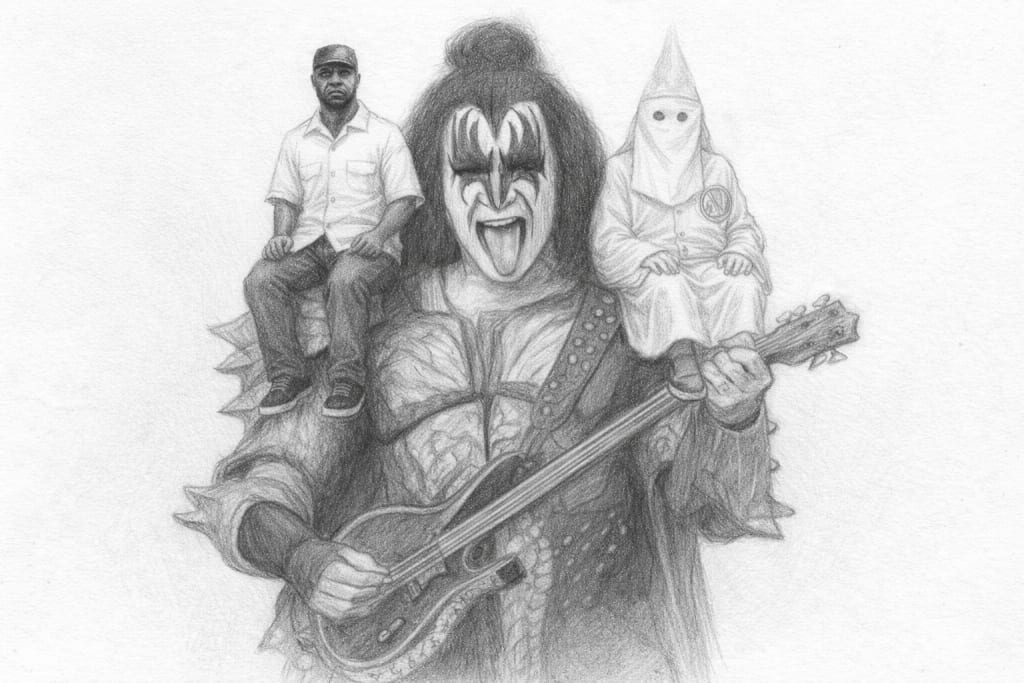
“And they claim that it's music."
— Sampled in Public Enemy’s “Contract on the World Love Jam”
Gene Simmons cannot seem to hold his tongue. Just weeks after being named a recipient of the Kennedy Center Honors, an award he did not deserve, the bassist from KISS made headlines again, showing how rock stars sometimes age into caricatures. Ironically, the aging rock legend was complaining about rap artists being inducted into the Rock and Roll Hall of Fame.
Before describing a conversation he had about the subject with Ice Cube, Simmons dug out the age-old trope of pointing out that Ice Cube is "a bright guy," as if complimenting one Black man grants him diplomatic immunity from accusations of racism. I’m only surprised he didn’t go for the full cliché and insist he can’t be racist because he has a “Black friend.”
After securing his rhetorical force field against accusations of racism, KISS’s demon got to the crux of his argument. In Simmons’s worldview, his personal taste is the center of the musical universe — and the only valid metric for what the Hall should honor. And with that, he laid out his disqualifying criteria for rap:
"It's not my music. I don’t come from the ghetto. It doesn’t speak my language."
These statements reveal just how far Simmons is from modern popular culture. The music he plays may have been birthed in rebellion, but the founding member of KISS long ago traded that spirit for a $300 million brand. Otherwise, he might have noticed that while hip-hop emerged from the neighborhoods he dismisses as “ghetto,” its audience crossed racial, geographic, and economic lines decades ago.
“The problem isn't the lyrics on the records.
It's the fear of the white kids liking a black artist."
— Body Count, “The Real Problem”
Simmons’s comments aren’t new; they’re part of a long lineage of white discomfort with Black musical influence. Ice‑T found this out after he released the song “Cop Killer.”
In a foreshadowing of the Streisand Effect, sudden attention fell on the rap artist’s metal track, and he found himself embroiled in a controversy wildly outsized for a song that was never destined for commercial radio. When a reporter asked why there was such intense interest now, given that he had spent his entire career exploring police brutality, he answered by pointing to a photo of white kids enjoying his band Body Count during his set at Lollapalooza. His point was simple: once white audiences started listening to him, the message suddenly became dangerous.
“Elvis was a hero to most, but that's beside the point
A black man taught him how to sing
— Living Colour, “Elvis Is Dead”
A few years later, Eminem — a white man — broke the color barrier wide open when he became the biggest-selling artist in the genre. And he didn't achieve this success using the Pat Boone/Elvis model of sanitizing Black music to make it palatable for white audiences; his raps were as raw as anything else in the genre. More importantly, he worked with Black artists, often elevating their careers in the process. His success made one thing undeniable: rap didn’t need to be whitened to be embraced by white audiences; it already was.
But Simmons wasn’t done digging. When confronted with criticism over his comments, he tried to take the racial aspect out of his remarks by pointing out that the word "ghetto" originated as a description of Jewish communities. Even this explanation falls flat when one considers the successful careers of the Beastie Boys. Comprised of three artists, who, like Simmons, were New Yorkers with a Jewish heritage, their songs were among the first to combine rap and metal, planting the seeds even deeper with white audiences.
“They say rap and metal can never mix
Well, all of them can suck our...
(Sexual organ in the lower abdominal area!)"
— Anthrax, “I’m the Man”
Anthrax’s “I’m the Man,” released in 1987, showed how rap was already influencing one of thrash metal’s Big Four. A few years later, the band took it even further by collaborating with Public Enemy on a reworking of “Bring the Noise.” Their joint tour blended the audiences of both genres even more. It would be interesting to hear the opinion of Scott Ian — the band’s rhythm guitarist who rapped on both tracks — on Simmons’s comments, especially since he has repeatedly stressed the impact KISS had on his musical development.
As the ’90s progressed, the influence of rap on metal became even more evident as nu‑metal rose to prominence. Bands like Korn, Limp Bizkit, and Linkin Park all incorporated vocal stylings descended from rap. The latter two, along with Slipknot, even included DJs among their members, using turntables as instruments — something first popularized in rap.
By the end of the decade, rap wasn’t just influencing metal — it was embedded in its DNA, whether Simmons wants to acknowledge it or not. Even if one refuses to recognize rap as a genre within rock, it clearly meets the criteria as an influence.
A stated mission of the Rock and Roll Hall of Fame is to recognize music that has influenced the development of the genre, and Simmons’s suggested ban would violate that spirit. Traditionally, this has been reflected in the induction of blues and country artists. Under this criterion, there should also be room for rap artists.
Gene Simmons has transformed from the rock star who achieved fame riding a wave of rebellion into a retiree shouting at kids to get off his lawn. Having stepped offstage, he might consider putting the microphone down. Because with every one of these slips of the tongue, he risks permanently damaging the KISS brand he spent decades building.
Rock may have outgrown him, but the Hall of Fame shouldn’t shrink to fit his limitations.
About the Creator
Carl J. Petersen
Carl Petersen is a former Green Party candidate for the LAUSD School Board and a longtime advocate for public education and special needs families. Now based in Washington State, he writes about politics, culture, and their intersections.
Keep reading
More stories from Carl J. Petersen and writers in Beat and other communities.
The Rivers of Babylon
The iconic disco group Boney M from the 1970s left an indelible mark on the music world with their infectious beats and unforgettable melodies. Formed in West Germany, the group's vibrant sound, blending Caribbean rhythms with European pop sensibilities, quickly catapulted them to international stardom.
By Rasma Raisters5 days ago in Beat


Comments
There are no comments for this story
Be the first to respond and start the conversation.