
Profile Pictures as a New Form of Digital Art
From simple photos to AI-generated portraits, profile images are becoming a modern visual art form.

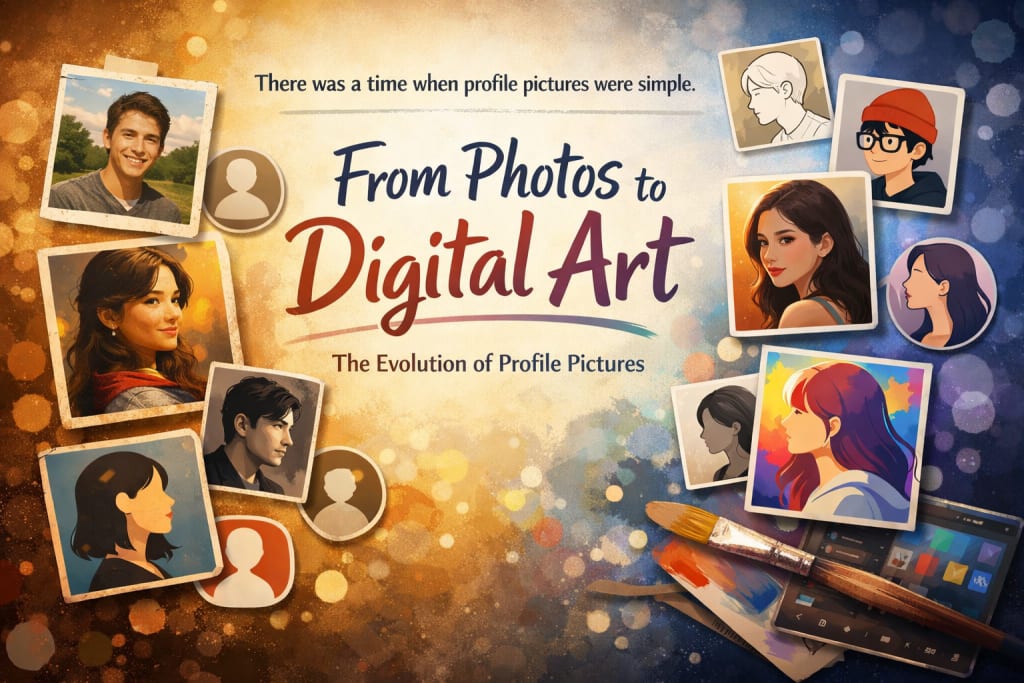
I didn’t think much about profile pictures for a long time.
They were just… there. Something you uploaded once and forgot about. Maybe a decent photo, maybe not. As long as it wasn’t embarrassing, it worked.
But recently I started noticing something different.
Scrolling through social platforms, comment sections, even random communities — fewer and fewer people are using plain photos. Instead, I kept seeing soft illustrations, simplified portraits, stylized versions of faces that looked almost like drawings.
At first I thought it was just a trend.
But the more I paid attention, the more it felt like something else was happening.
There’s a strange shift in how people choose to represent themselves online.
It’s no longer just about recognition. It’s not even really about accuracy anymore.
It’s about feeling.
A slightly blurred portrait feels calmer. A high-contrast image feels sharper, more intentional. A simplified illustration feels softer, more approachable. Even a rough sketch can feel more expressive than a perfectly clear photograph.
And none of these choices are random.
What’s interesting is that many of these images are actually less detailed than traditional photos.
Cleaner lines. Flatter colors. Fewer textures.
At first glance, that might seem like a downgrade — like something is being lost.
But it doesn’t feel that way when you look at them.
If anything, they feel more focused.
Less about capturing everything, more about capturing just enough.
I started wondering why that is.
Why does a simplified version of a face sometimes feel more “real” than the original?
Maybe it has something to do with how we process images online.
We don’t look at profile pictures for long. Most of the time, they appear as small circles or tiny thumbnails next to text. There’s no space for subtle detail. Everything has to communicate quickly.
In that context, clarity matters more than complexity.
A clean shape, a recognizable silhouette, a distinct tone — those things stand out more than fine detail ever could.
At some point, I even tried turning one of my own photos into a more stylized version, just out of curiosity.
It’s surprisingly easy now — even a simple AI photo enhancer
can shift the lighting and tone of an image enough to make it feel less like a raw photo and more like something designed.
Not necessarily better, just… different.
And that difference is interesting in itself.
There’s also something else going on.
A photograph is tied to a specific moment. A specific version of you.
But a stylized image feels more flexible.
It’s still “you,” but not locked to a single expression, a single lighting condition, or a single point in time. It feels slightly removed from reality, and because of that, a little more adaptable.
Maybe that’s part of the appeal.
I’ve also noticed how consistent some people are with their profile images.
Same style across platforms. Same tone, same visual language.
It almost feels like a personal design system.
And over time, that image becomes recognizable — not because it’s realistic, but because it’s consistent.
That’s something photography alone doesn’t always achieve.
There’s a quiet kind of creativity in all of this.
Not the kind you usually associate with art galleries or exhibitions, but something more everyday. More casual.
People adjusting how they appear. Choosing what to emphasize, what to soften, what to simplify.
Even if they don’t think of it as “making art,” there’s still intention behind it.
And maybe that’s the part I find most interesting.
These images aren’t created to be framed or displayed in a traditional sense. They’re small, functional, often overlooked.
But they travel everywhere.
They show up next to comments, messages, usernames. They repeat over and over again, becoming a kind of visual shorthand for a person.
In a way, they act like tiny, portable artworks.
It’s not a dramatic change. There wasn’t a clear moment when profile pictures suddenly became more expressive.
It happened slowly.
One person switching to a stylized portrait. Another trying a simplified illustration. Then another.
And eventually, it started to feel normal.
Now, when I see a plain, unedited photo as a profile picture, it almost stands out — not because it’s unusual, but because it feels like something from an earlier version of the internet.
A time when images were just representations.
Before they became interpretations.
I don’t think most people are consciously thinking about all of this when they choose a profile picture.
But the choices are still there.
What to show.
What to soften.
What to leave out.
And maybe that’s enough.
Because even in something as small as a profile picture, there’s still a trace of how someone wants to be seen.
About the Creator
Violet
Exploring how AI reshapes memory and creativity.
Watching The End Of The World From The Diner
Introduction I am not sure how to approach this. Guy Peellaert was an amazing artist who created iconic fantasy images of famous people, usually musicians or politicians, as well as creating commissioned album covers such as "It's Only Rock'n'Roll" by The Rolling Stones and David Bowie's "Diamond Dogs" which you can read more about below.
By Mike Singleton 💜 Mikeydred 4 days ago in Art




Comments
There are no comments for this story
Be the first to respond and start the conversation.