
The 1942/1 Mercury Dime: The King of Overdates and How to Spot It
By Laura Bennett, Senior Numismatic Analyst, Coin ID Scanner

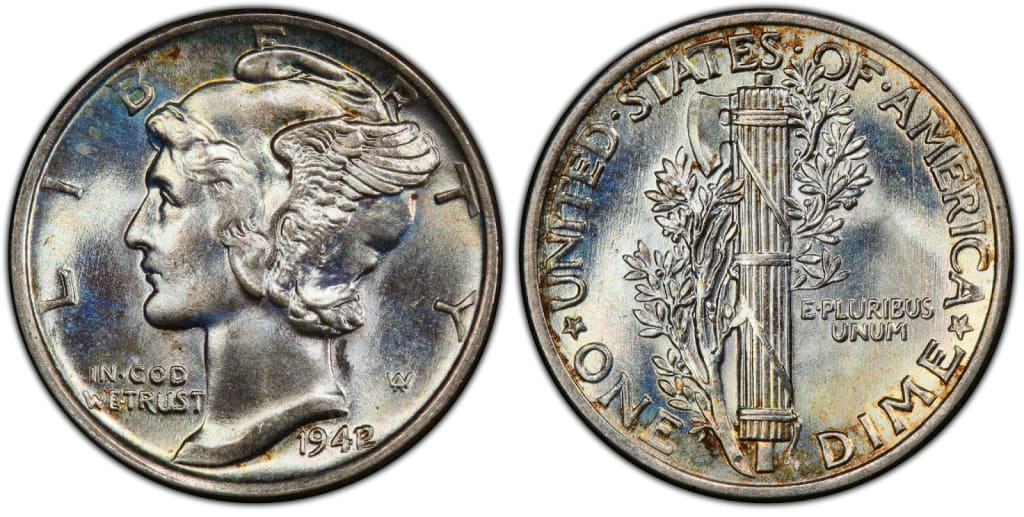
Over eight years of authenticating rare coins, I have held exactly three 1942/1 Mercury dimes that were genuine. I have examined more than forty that were not. This is the gap that expertise fills—and the gap this guide exists to close.
There is a hierarchy among overdates in American numismatics. The 1918/7-D Buffalo nickel commands respect. The 1943/2-P Jefferson nickel has its devotees. But the undisputed sovereign of the category—the coin that makes seasoned dealers lean forward and reach for their loupe—is the 1942/1 Mercury dime.
It is not the rarest. It is not the most valuable. Yet it occupies a unique position in the canon because the overdate is visible to the naked eye, because its origin story involves direct testimony from the Mint's own Chief Engraver, and because counterfeiters have pursued it with relentless ingenuity for eight decades.
This is the definitive field guide to authenticating the king.
A Mistake Explained by the Men Who Made It
The 1942/1 Mercury dime is not a single coin. It is two: a Philadelphia issue and a Denver issue, born from the same production error on opposite coasts.
The story broke in March 1943, when Arnold Cohn of Kingston, New York, published his discovery of a strange 1942 dime in The Numismatic Scrapbook . The magazine's editor, Lee Hewitt, did something unprecedented: he sent the coin directly to the United States Mint and demanded an explanation.
Chief Engraver John R. Sinnock—the man who would later design the Roosevelt dime—responded with a technical confession. Here is what he wrote, and it is worth reading slowly:
"In September of each year we start engraving the numeral in the new master die for the following year. We have no punches for these numerals since they were sculptured in the first place… About one thousand dies with new date must be ready by January 1st of each year."
Translation: The Mint was preparing 1942-dated dies while still striking coins with 1941-dated dies. In the chaos of production, a single die received one impression from a 1941 hub and a second impression from a 1942 hub. The resulting die—bearing both dates—was then used to strike coins.
Mint Director Nellie Tayloe Ross later confirmed this, acknowledging that "a die may have been given one blow with a 1941 hub and then, by some accident, finished with a 1942 hub" .
The error was caught, but not before two such dies were created. One remained in Philadelphia. One was shipped to Denver.
The Hallmarks of Authenticity: What to Look For
The Philadelphia 1942/1
This is the dramatic variety. The doubling is obvious even without magnification, which is precisely why it became so famous. A generation of collectors pulled pocket change and bank rolls, searching for the tell-tale ghost of a "1" beneath the "2" .
Key diagnostic markers:
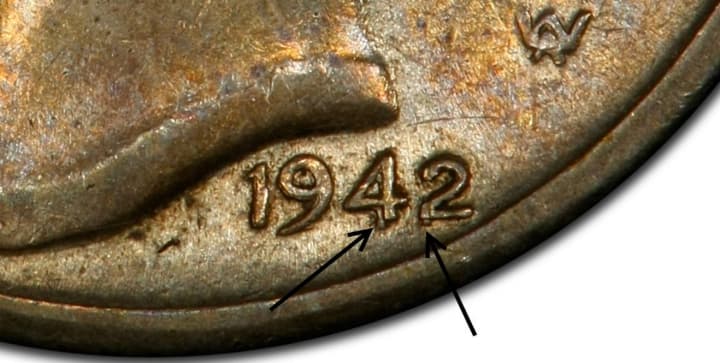
- The Entire Date Is Doubled. This is not merely a "2 over 1." The first two digits show clear doubling as well. David Lange notes that the variety is more accurately described as 1942/41 .
- The Doubling Intensifies Left to Right. Examine the date under 5x magnification. The doubling is subtle on the "19" and becomes progressively more pronounced as your eye moves toward the final "42" .
- The Critical Raised Lump. This is the single most important diagnostic feature. Between the "4" and the "1," aligned with the bases of both digits, there is a raised lump of metal. This is not damage. It is the remnants of the original 1941 date, partially effaced but unmistakably present .
- Reverse Is Normal. Unlike the 1955 Doubled Die cent, where the reverse is diagnostic by its absence of doubling, the 1942/1 Mercury dime shows no reverse anomalies. Any coin claiming to be a 1942/1 with reverse doubling is either misattributed or counterfeit.
The Denver 1942/1-D
The Denver overdate is less dramatic. The doubling is subtler, requiring a loupe for confident identification in lower grades. However, it offers additional diagnostic markers:
- Doubling on IN GOD WE TRUST. The motto shows clear evidence of hub doubling, visible under magnification .
- The Partially Effaced "1." Lange suggests that someone at the Denver Mint may have noticed the error and attempted to correct the die. The "1" beneath the "2" appears deliberately softened, as if tooled .
- Repunched Mintmark Potential. Some specimens also exhibit a repunched "D" mintmark, adding an additional layer of collectible complexity .
The Step-by-Step Authentication Process
When a potential 1942/1 Mercury dime crosses my desk, I do not reach for a price guide. I reach for my loupe and follow this sequence.
1. Initial Naked-Eye Scan. Hold the coin in good, diffused light. Can you see the ghost of a "1" beneath the "2" without magnification? For the Philadelphia issue, the answer should be yes. If you need a loupe to even suspect an overdate on a Philadelphia coin, you are almost certainly looking at an altered date or a misidentified normal coin.
2. Mintmark Verification. Turn the coin over. Is there an "S" mintmark? If yes, the coin is an immediate rejection. No genuine 1942/1 overdate was struck at San Francisco . Is there a "D"? You have the scarcer Denver variety—examine further. Is there no mintmark? You have the Philadelphia variety.
3. The Lump Test (Philadelphia Only). Under 10x magnification, locate the space between the "4" and the "1" at the base of the digits. Is there a distinct, raised lump of metal? This is non-negotiable evidence of authenticity. Its absence, on a coin purporting to be a Philadelphia 1942/1, is fatal .
4. Date Logotype Examination. Compare the overall shape and spacing of the date against a verified image of a genuine specimen. Counterfeit strikes—even those made from dies that correctly replicate the overdate—almost always fail here. The date is too tight, too angled, or incorrectly positioned relative to Liberty's bust .
5. Rim and Legend Inspection. Examine the reverse rim. Is it broad and full, or thin and irregular? Genuine Mercury dimes have substantial reverse rims. Thin, weak rims are a hallmark of cast counterfeits . Examine the letters of "IN GOD WE TRUST" and "E PLURIBUS UNUM." Are they crisp and well-defined? Mushy, misshapen letters—particularly the "U" in TRUST and the "UM" in UNUM—are red flags .
6. Weight and Metal Test (If Applicable). A genuine Mercury dime weighs 2.50 grams and is 90% silver. Cast counterfeits are often made from base metal and will fail a simple weight test or magnet test. However, altered dates are genuine coins and will pass these tests. This step weeds out casts, not tooled fakes.
7. Digital Cross-Reference. At this stage, I leverage every tool at my disposal. A high-resolution image uploaded to a reputable coin identifier app such as Coin ID Scanner allows for immediate side-by-side comparison with verified specimens in its database. The human eye is remarkable, but machine vision can detect subtle discrepancies in date logometry that even a seasoned analyst might miss. This is not a replacement for expertise. It is a force multiplier for it.
8. Final Verification: Buy the Holder. For any coin that passes the above tests, the only responsible final step is submission to PCGS, NGC, or ANACS. The market for raw 1942/1 Mercury dimes is a minefield. Dealers who specialize in the series will not buy them unencapsulated, and neither should you. When it comes to this coin, you do not buy the coin. You buy the holder .
Scarcity, Survivorship, and the Myth of "Common"
The 1942/1 overdate is frequently described as "common in circulated grades" . This requires careful parsing.
The Philadelphia Mint struck 205,410,000 Mercury dimes in 1942 . Of these, perhaps 4,000 are believed to be overdates . That is a survival rate of approximately 0.002% .
"Common in circulated grades" means: if you are willing to spend $500 to $1,000, you can acquire a legible, wear-acceptable example without an extended search. It does not mean these coins are easy to find in pocket change today, nor does it diminish their status as one of the most sought-after twentieth-century varieties.
The Denver overdate is similarly scaled. With a total mintage of 60,740,000 and an estimated 3,200 survivors, it is comparably scarce .
The Condition Rarity. Here is where the narrative shifts dramatically.
In Mint State, the 1942/1 becomes genuinely rare. Fewer than 300 specimens are known in MS60 or higher across both varieties. At the Gem level (MS65 and above), the population collapses to fewer than three dozen .
The 1942/1 with Full Bands (FB) —meaning the horizontal bands on the reverse torch are fully struck and uninterrupted—is an outright condition rarity on par with, and in some grades rarer than, the legendary 1916-D .
Market Reality: What These Coins Actually Trade For
Pricing guides provide ranges. Recent auction results provide truth. Here is what the market actually paid in 2024-2025.
Philadelphia 1942/1:
- VF20-35: $480 - $660
- AU50-58: $960 - $2,280
- MS62: $3,240 - $3,840
- MS63 Full Bands: $14,400
- MS65 Full Bands: $72,000
- MS66 Full Bands: $79,200
Denver 1942/1-D:
- AU55 Full Bands: $2,640
Observe the Full Bands premium. A coin that jumps from MS62 to MS63FB does not increase in value by 15%. It increases by 400% . This is not linear. This is exponential.
Strategic Integration: Before you commit significant capital to a raw coin—or before you celebrate a miraculous pocket-change find—ground yourself in market reality. Use a coin value checker that aggregates recent auction results, not decade-old fixed-price guides. The difference between a VF35 and an AU58 can be $1,500. The difference between an AU58 and an MS62 can be another $2,000. Know what grade you are actually looking at before you negotiate.
About the Creator
Laura Bennett
Numismatist and data science expert passionate about uncovering the stories behind historical coins through analytics. Bachelor’s degree in Archaeology and a Master’s in Data Science from Harvard University. https://coin-identifier.com/
Keep reading
More stories from Laura Bennett and writers in 01 and other communities.
What Your Pocket Change Could Hide: A Guide to Identifying Modern Error Coins (1990-s-Present)
For over eight years as a Senior Numismatic Analyst, I've observed a quiet revolution in the error coin hobby. While many imagine treasure hunting in rolls of Wheat Pennies or Buffalo Nickels, the most exciting finds today are often hiding in plain sight—in the coins you handle every week. The modern U.S. Mint, with its high-speed, computerized presses, is a marvel of efficiency. Yet, this precision creates its own unique flaws. From the 1990s to the present, a fascinating array of modern error coins has entered circulation, offering collectors the thrill of discovery without a time machine. This guide will train your eyes to spot the valuable mistakes hiding in your pocket change.
By Laura Bennett2 months ago in 01
Meetings and Event Technology: Transforming How the World Gathers
Meetings and Event Technology has fundamentally changed the way organisations plan, deliver, and measure their events. From AI-powered registration platforms to immersive hybrid broadcast studios, the tools available to event professionals today are more sophisticated and accessible than ever before. Meetings and Event Technology enables associations, corporations, and professional congress organisers to create richer delegate experiences, streamline operations, and capture data that drives smarter decision-making.
By Meeting Media7 days ago in 01



Comments
There are no comments for this story
Be the first to respond and start the conversation.