
How AI Chatbots for E-commerce Help Increase Sales and Conversions in 2026
Convert More Visitors with Real-Time, AI-Driven Customer Interactions

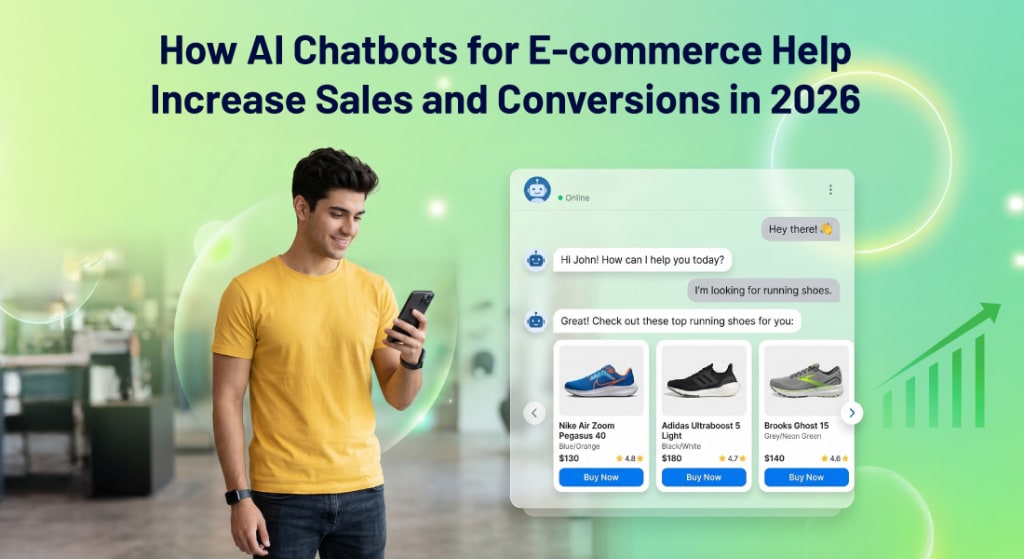
TL;DR: In 2026, AI chatbots are not just a conversational tool for e-commerce platforms. They offer personalized product recommendations, faster checkout, guide buyers, reduce cart abandonment, and automate repetitive tasks. When integrated with CRMs, inventory, payment gateways, and analytics, AI chatbots can boost sales and provide a 10–20% sales ROI uplift.
Companies worldwide, from small and medium to large enterprises, are developing AI chatbots for their e-commerce platforms. In 2026, tools like e-commerce AI chatbots act as a 24/7 support for existing and potential buyers. They offer personalized product recommendations and make the checkout process much simpler. This improves user experience and reduces the chance of cart abandonment.
Not just that, e-commerce brands can use AI chatbots to manage product stock, identify the most popular products, and optimize the inventory to ensure the right products are available at the right time. According to a McKinsey report, companies investing in AI are seeing 3–15% revenue uplift and 10–20% sales ROI uplift.
This article explores how AI chatbots work in the e-commerce sector and how brands can increase their sales:
Understanding e-commerce AI Chatbots
AI chatbots are computer programs that simulate human conversation. They are useful for e-commerce platforms to interact with audiences 24/7. These specialized software technologies primarily use:
- Machine Learning (ML),
- Data Analytics,
- Natural Language Processing (NLP), and
- Automation Technologies.
How Do AI Chatbots Create Measurable Value in 2026?
When interacting with a customer, predefined scripts used by rule-based chatbots may not meet the customer demands. That is why AI chatbots are so popular in 2026. They can understand queries and respond to them accordingly.
Let’s take an example to elaborate on how it works.
Example:
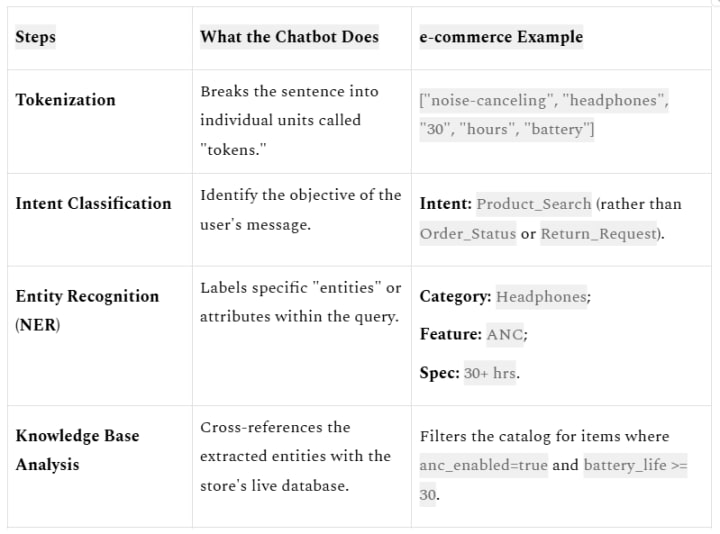
A potential buyer has asked for “noise-cancelling headphones with 30 hours of battery life.”
Tokenization
AI chatbots break queries into smaller phrases or words for easier processing, such as:
- Noise-cancelling
- Headphone
- 30 hours
- Battery life
Intent Classification
AI bots can understand customer intent and help with product recommendations, order tracking, returns, or general support.
Entity Recognition
Once the bot understands the intent, it narrows down the search to what the customer is looking for. In this case:
- Product: Headphone
- Feature: Noise cancellation
- Product Specification: 30 hours of battery life.
Knowledge Base Analysis & Response Generation
The bots then search the product catalogue and related data to match customer queries. It also looks into:
- Stock availability,
- Pricing,
- Product descriptions,
- FAQs,
- Shipping, or
- Warranty details.
And shares the most suitable options in a conversational way.
What’s most admirable about these bots is that they improve future responses based on user interactions. And it only takes a fraction of a second to a few seconds for them to show the results. Doing the same task manually, on the other hand, could have taken the users a few minutes or more.
How Do AI Chatbots Increase Sales and Conversions for e-commerce Brands
Capgemini’s 2026 consumer trends report indicates that AI is moving beyond experimentation and into measurable business impact. For e-commerce brands, this makes AI chatbots more than a customer support add-on. They are becoming a practical way to improve shopper interactions, streamline buying journeys, and create measurable business impact.
1. Meeting the Changing Customer Expectations
The days when online shoppers had to wait for a single product page to load are long gone. Buyers now prefer a faster and smoother experience. They do not want to
- Browse multiple pages,
- Wait for support replies, or
- Search manually for basic information.
Therefore, AI chatbots are becoming central to e-commerce. They can share information fast, exactly what buyers are looking for.
2. Delivering 24/7 Support
Online stores are not limited by 9-6 boundaries. Potential buyers come and go anytime they want to. They also expect the e-commerce platform to be prompt with their queries, even late at night or across time zones, for instance:
- Delivery,
- Returns,
- product features, or
- Stock availability.
AI chatbots are perfect for that. They offer human-like responses with a natural flow to keep buying intent alive when human teams are offline.
3. Offering Faster Product Discovery
Product catalogs are fine as long as they are 3-4 pages. But some e-commerce platforms have 100+ product pages. This makes it a real “pain-in-the-neck” for customers to find what they are looking for.
They check a few pages, get tired when they can’t find what they are looking for, and leave. AI chatbots can shorten this journey. They can understand natural-language queries and narrow options quickly. Hence, buyers find products faster than manual browsing.
4. Personalizing Shopping Experiences
For any e-commerce brand, understanding your buyers’ emotions is critical to grow sales and build long-term relationships. And which buyer won’t love to have a personal assistant helping them with
- Relevant product suggestions,
- Exclusive deals and offers,
- Meaningful conversations.
Utilizing AI in e-commerce can perform predictive analysis based on intent, preferences, and behaviour, and offer hyper-personalized recommendations.
5. Reducing Cart Abandonment
Cart abandonment still remains a major challenge in the e-commerce sector. In several cases, shoppers leave without completing a purchase because of unanswered queries or last-minute hesitation.
AI-powered assistance can be very useful here. They share insights on:
- Product clarifications,
- Shipping answers,
- Alternative options,
- Reminders, and
- Relevant offers.
This makes chatbots useful not just for support, but also for protecting revenue that might otherwise be lost.
6. Being a Step Ahead of Competitors
Your potential buyers have more choices than ever. They can compare products, prices, and brands in seconds, which leaves very little room for friction in the shopping journey.
That is why brands investing in e-commerce development services need to deliver faster support and a smoother shopping journey. Even a small inconvenience can push a buyer toward a competitor. AI chatbots help brands stay a step ahead by making the shopping experience more responsive, helpful, and convenient.
7. Support Teams Need Help Handling Repetitive Queries
Like any other sector, several e-commerce queries are repetitive. For instance:
- Order tracking,
- Return policies,
- Sizing,
- Shipping timelines,
- Warranty details,
- Stock checks, etc.
These tasks don’t need human intervention. In fact, letting your team handle these tasks wears them out and increases the chance of errors. AI chatbots can take care of these routine interactions instantly. Hence, your human agents focus on more complex or higher-value conversations.
8. Creating Better Conversion Opportunities
Many brands use AI chatbots for e-commerce conversions, not just to answer queries. The McKinsey study we discussed above also suggests that companies investing in AI are seeing measurable revenue uplift and higher sales ROI. They guide hesitant shoppers and support checkout-related decisions in real time. That makes them useful across multiple stages of the buying journey.
9. Providing Smarter Data and Insights
With traditional analytics, brands have access to visitor demographics, traffic, and best-selling products. However, brands still need to interpret this data themselves to understand customer needs and decide how to adjust marketing or promotions.
E-commerce automation with AI helps marketers to analyze interactions and identify what customers actually want. Hence, your marketing team can create more targeted ads, promotions, and product strategies based on real customer intent rather than just raw data.
Technology Stack Behind AI Chatbots for E-commerce
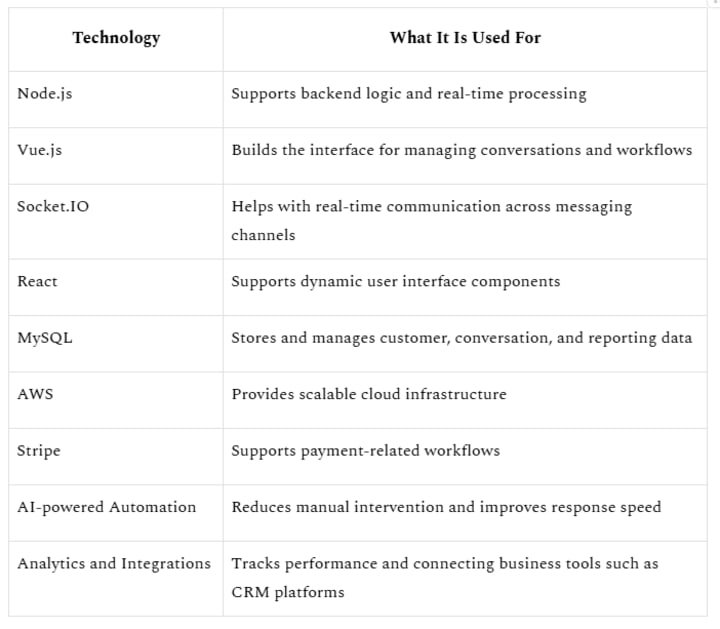
While your customer usually sees an AI chatbot, it is actually built using multiple technologies working together. Developers use different tools and systems so the chatbot can understand customer queries, access product and customer data, automate routine tasks, and deliver faster, more relevant responses.
Modern AI chatbots are often built using technologies like Node.js, React, Vue.js, and cloud infrastructure such as Amazon Web Services.
What to Consider Before Implementing an AI Chatbot for Your e-commerce Platform
Implementing an AI chatbot for your online store has multiple advantages. However, brands still need to:
1. Set a Clear Business Goal
You shouldn’t integrate a chatbot just because AI is trending. Your objective clarity is essential. Consider your long-term and short-term goals, such as:
- Product discovery,
- Support response time,
- Cart recovery,
- Lead capture, or
- Average order value.
Depending on your requirements, the development team can help you choose the right stack.
2. Make Sure Product and Customer Data are Clean
AI-powered chatbots can only answer your queries when they have access to vast amounts of existing text data. Otherwise, the chatbot will "hallucinate" or may share information that may not be accurate. This can become a major drawback and you may end up losing your customer trust.
To prevent this, e-commerce brands must train and support the AI chatbot with clean, structured, and regularly updated data on:
- Product details,
- Prices,
- Stock levels,
- FAQs, and
- Customer context.
3. Plan the Right Integrations
There is a difference between a chatbot that just ‘talks’ and one that ‘works’.
With proper integration, AI chatbots can assist with:
- Answer product-related questions.
- Track a package.
- Personalize recommendations.
- Modify an order.
- Resolve technical issues.
Ensure you are also planning the right integrations, to transform chatbots from simple conversational tools into powerful digital assistants that improve customer experience and reduce the workload on human support teams.
Conclusion
Rule-based chatbots have been used in e-commerce for decades. But there is a niche difference between the traditional one and the AI chatbots used for e-commerce conversions. In 2026, the shift is toward Agentic AI. Chatbots now don’t just share information but also execute tasks. e-commerce brands that have understood the nuance are now experiencing better revenue through higher sales and conversion.
About the Creator
Nicholas Winston
Working as an IT Manager in a reputed Digital Transformation and Software Solution Company in India. Being a technical writing enthusiast, I have served in the Information technology, Services, and Product industry.
Keep reading
More stories from Nicholas Winston and writers in 01 and other communities.
13 Crucial IT Solutions that can Revolutionize Your Business
The relationship between businesses and digital solutions has evolved drastically. According to Gartner, in 2023, the total IT spending worldwide is estimated at around $4.7 trillion, an increase of 4.3% from 2022. That indicates the high demand for digital solutions. Furthermore, IDC states that 90% of global businesses will focus on digital business tools or Business IT Solutions for physical space and asset enhancement with digital experiences by 2023. With the high demand for these solutions and their impact, let us look deeper at these tools.
By Nicholas Winston2 years ago in 01
Top Dog Training Essentials: Extra Large Dog Bowl, Leather Lead & Dog Treat Pouch
Training a dog is one of the most rewarding responsibilities a pet owner can undertake. Whether you have a playful puppy or an energetic adult dog, the right tools can make the training process smoother, more effective, and enjoyable for both you and your canine companion. While techniques and consistency are essential, having the proper equipment can significantly improve communication, control, and motivation during training sessions.
By Von Ultimate Dog Shop5 days ago in 01
I Switched to a Foldable Phone for 6 Months...
I stood in the Verizon store holding the Samsung Galaxy Z Fold 5 for the first time in March 2024, mesmerized by the engineering marvel of a device that transformed from a normal-sized smartphone into a mini tablet with a single motion, and the sales representative was showing me how the apps automatically adjusted to the larger screen and how I could run three applications simultaneously side-by-side, and I was thinking about all the productivity gains and the reduced need to carry both a phone and a tablet, and within twenty minutes I had traded in my iPhone 14 Pro and walked out with this $1,799 piece of folding technology that I was convinced would revolutionize how I worked and consumed media. Six months later, as I sit writing this on my laptop while my Z Fold 5 sits closed on the desk beside me, I have thoughts about foldable phones that are significantly more nuanced than my initial enthusiasm, and while I do not regret the purchase, the experience has taught me lessons about the gap between impressive technology and practical daily usefulness that anyone considering a foldable phone needs to understand before spending nearly two thousand dollars on a device that in many ways is still a first-generation product category despite being Samsung's fifth iteration.
By The Curious Writera day ago in 01


Comments
There are no comments for this story
Be the first to respond and start the conversation.